





HEADER

REGIONAL

Vision pushes for "Complete Streets;" "Smart Growth Public Infrastructure" bills in Albany

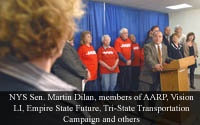
On Monday, May 10th, Vision Long Island joined with NYS Assemblyman Sam Hoyt, Senator Suzi Oppenheimer, Senator Martin Dilan, AARP, Empire State Future, Tri-State Transportation Campaign, American Cancer Society and others to announce Complete Streets and Smart Growth public infrastructure agendas for New York State. NYS Sen. Brian Foley has sponsored both bills.

Complete Streets

press conference

The Complete Streets Bill, S5711A, amends the state highway law, enabling safe access to public roads for all users by utilizing Complete Streets design principles. Complete Streets is a policy that ensures all users of the transportation system, including pedestrians, bicyclists, transit users, motorists, children, seniors and individuals with disabilities are able to travel safely and conveniently on and across all roads. The legislation recognizes that bicycle and pedestrian travel are integral to New York’s transportation system, and requires that they are included in the planning and development of state, county and local transportation facilities, plans and programs. These accommodations would include, but not be limited to bicycle lanes, lane striping and paved shoulders suitable for use by bicyclists, shared road signage, crosswalks, pedestrian control signals, curb cuts and ramps. This bill would bring positive change to make our planners, both at the state and local level, consider all non-auto forms of travel as a routine part of project development as well as the planning for automobiles. It will bring more of a balance to our roads and make them safer and healthier for all users.

Smart Growth Public Infrastructure Policy Act

press conference 2

The State Smart Growth Public Infrastructure Policy Act, S5560/A8011, will sharply curtail the use of new public funds for projects that support or induce sprawl by redirecting some of that funding to efforts that lead to the economic revitalization of our communities. Sprawl exists in New York State in part because of public funding that prioritizes that type of development. However, there are 95 Smart Growth projects and 45 master plans, hamlet studies and vision plans of various size and scale currently underway throughout Long Island that reject sprawl and seek a more livable and sustainable system. Smart Growth has taken hold for Long Island’s local governments, businesses, advocacy groups and residents.

This bill clearly instructs state agencies and corporations to align their infrastructure planning and spending with Smart Growth criteria. The agencies would prioritize funding to the infrastructure and development plans of local governments, as well as create advisory committees that include community and environmental interests to review any proposed projects. The Smart Growth Public Infrastructure Policy Act conserves public expenditures for both services and infrastructure, promotes economic development throughout the State where it is most needed, protects open space vital to New York’s economy and helps New York State achieve its energy and climate change goals by reducing auto use.

The two bills, marketed together as a legislative package, have the backing of an unprecedented group of organizations including health care advocates, senior and consumer organizations, disability advocacy groups, transportation advocates, environmentalists, businesses and bike enthusiasts. The Times Union covered the press conference,  emphasizing that "legislators say they are closer than they have ever been to having both bills pass."

Assemblyman Sam Hoyt sponsored this bill and Long Island Assemblymembers Michelle Schimel, Steve Englebright and Ginny Fields are co-sponsors.

The event was also covered in Streetsblog, quoting Vision's director: 

Eric Alexander, the executive director of Vision Long Island, thinks the combination could be transformative across his region. If both were passed, he said, it would "unleash a series of municipal initiatives for traffic calming or even opening up street grids." The efficacy of local street redesigns, though, can't be realized until the state stops subsidizing sprawl so much, he said. "Our first message was 'Stop hurting us,'" said Alexander. "Don't continue to widen roads." Alexander highlighted road and sewer construction as especially sprawl-inducing, but was also intrigued by the possibility of shifting economic development dollars to downtowns. "Even the market forces are saying let's not sprawl out," said Alexander, "so for the government to subsidize it is idiocy."

The following are some additional remarks:

“Creating and investing in sustainable communities with infrastructure that takes into account the accessibility and mobility needs of the aging population is essential to New Yorkers who want to age in their communities,” stated Lois Aronstein, AARP New York State Director.

"New Yorkers have reconsidered the way in which they move about. They have opted for cleaner, more fuel-efficient vehicles. Instead of driving, they now walk and ride when they can. It is time for the state to accommodate their choice. It’s time we plan, design and build for a multi-modal state and future,” said Senator Martin Malavé Dilan, Chair of the Senate Transportation Committee.

“Planning for infrastructure improvements in a way that protects our natural resources makes sense economically, as well as environmentally, stated New York State Senator Susan Oppenheimer, Chair of the Senate Education Committee. That’s why I’m pleased to work with my colleagues Assemblyman Hoyt and Senator Montgomery on legislation that will incorporate smart growth principles in the evaluation of public infrastructure projects.”

"My goal with this legislation is to restore once vibrant urban neighborhoods and revitalize our historic main streets by ensuring the state's project criteria is consistent with smart growth principles,” said Assemblymember Sam Hoyt. “As a state we have foolishly squandered resources by inducing sprawl. The enactment of policy-level strictures which tie agency public infrastructure expenditures to Smart Growth principles would help to minimize, and in some cases eliminate, waste caused by poor management and a clear lack of centralized goals."

“The 39 member organizations of the Empire State Future Coalition are pleased to join our partners from AARP, the Tristate Transportation Campaign, the New York State League of Conservation Voters and the Public Health community to call for a 2010 Livable Communities agenda for New York State,” stated Peter Fleischer of Empire State Future. “This agenda has many aspects but today we note two important legislative priorities. The Public Infrastructure Policy Act is a much-needed means to turn the State’s limited infrastructure dollars into investments that create future growth, stronger communities while protecting our natural resources. The Complete Streets Bill is a good example of the kind of investment we can and must make for the public’s safety, the public health and for revitalized and more commercially successful downtowns and main streets in rural, suburban and urban places throughout New York State.”

"Complete Streets are an economic driver that can help draw residents, tourists, and businesses back to our hamlets so that Main Street can thrive again,” stated Nadine Lemmon, Legislative Advocate for Tri-State Transportation Campaign.

"Exercise is key to preventing cancer," said Sherry Tomasky, Regional Advocacy Director for the American Cancer Society. "Increasing physical activity doesn't have to mean joining a gym or participating in a structured program, a walk around the block a few times is a great start. But we need to have the infrastructure in place so people can walk and bike safely, without the fear that a simple stroll could turn into a visit to the emergency room."

“Long Island has some of the most dangerous roadways in New York State along with a lack of critical infrastructure funds to grow our downtown centers,” stated Eric Alexander, Executive Director, Vision Long Island, a nonprofit smart growth planning organization. “These proposed bills are also a part of the legislative agenda for the Long Island Lobby Day Coalition consisting of 15 regional and 30 local organizations. Vision Long Island is proud to partner with Empire State Future and AARP to advance this important legislation.”

Contact your local New York State Senator or Assemblymember to urge passage of these bills. Read the Complete Streets bill here and the Infrastructure bill here.

Senator Schumer pushes to revitalize Long Island downtowns; calls for EPA-DOT-HUD "Sustainability Partnership"

Vision Long Island and others to assist in local initiative

schumer

Last year, the Environmental Protection Agency (EPA), Department of Transportation (DOT) and Department of Housing and Urban Development (HUD) joined together to form the "Partnership for Sustainable Communities" to coordinate local investments in the environment, transportation, and housing. This week, US Senator Charles E. Schumer announced that he wants this partnership to meet with local leaders to map out strategies for improving Long Island's Main Streets and encouraging sustainable development across Long Island. Senator Schumer said that the Partnership needs to hear firsthand the setbacks, red-tape and stumbling blocks experienced by local communities as they seek to redevelop their "at-risk" downtown cores. In addition, Schumer also wants the Partnership to map out areas of coordinated affordable housing, environmental and transportation planning to promote sustainable development methods to revitalize local economies in the area.

Senator Schumer has joined with local sustainability advocates on Long Island, including Vision Long Island, Sustainable Long Island and the Hofstra Center for Suburban Studies in an effort to promote downtown revitalization and sustainable development throughout the area. Schumer and local partners are asking for members of the Sustainable Partnership to hold a public meeting and work session with local government officials and planning advocates. Schumer is calling on Partnership to plan a visit to Long Island to learn about some of the initiatives in both Nassau and Suffolk counties that embrace ideals like transit-oriented development that will help revitalize and rebuild downtowns and walkable communities.

“Long Island is the oldest suburb in the nation and we need to revitalize our downtown areas so that they thrive with new economic development, create jobs and provide better transit options for commuters,” Schumer said. “Unfortunately, far too often red tape gets in the way of progress. That is why I am urging the EPA, DOT, and HUD to hold a public meeting with residents of Long Island to work through these problems and begin developing a plan to help local communities work through these obstacles to promote economic development and a rebirth of downtown economies that were the heart of commerce just several decades ago.”

The recently announced Clean Water State Revolving Fund PILOT identified New York as one of three states selected to receive assistance to ensure that water infrastructure investments are coordinated with transportation projects, so that roads don't need to be torn up twice. It is an important opportunity for Long Island, which needs sewers to revitalize downtowns in Suffolk County, including many near commuter stations.

While hardly a cure-all for suburban ailments, the Partnership for Sustainable Communities has the potential to increase resources and support to Long Island's most distressed communities by making the process for redevelopment easier for local stakeholders. The local meeting will help better inform agency directors about the challenges to rebuilding Long Island, including multiple layers of government, inadequate affordable housing and high numbers of brownfields.

The latest Census notes that more than 50% of the US population now lives in the suburbs. As the oldest suburb, Long Island is a laboratory for what does and does not work for these communities. In anticipation of a public meeting, Schumer will solicit the participation of local elected officials, planners and community advocates regarding sustainability projects that have interest or business before the 3 federal agencies.

NATIONAL

Brooking Institute finds reverse white flight

suburbia

An analysis of 2000-2008 Census data by the Brookings Institution finds a reverse trend in the United States: the suburbs are more likely to be composed of minorities, poor people and seniors, while young, educated white people move to cities for jobs and shorter commutes. The report, titled "The State of Metropolitan America," urges policymakers to shift its conceptions of America's urban and suburban landscape, and to work quickly to address these dramatic population changes. The report suggests: affordable housing and social services for older people in the suburbs; better transit systems to link cities and suburbs; and a new federal Office of New Americans to serve the education and citizenship needs of the rapidly growing immigrant community.

According to the Huffington Post, "The findings could offer an important road map as political parties, including the tea party movement, seek to win support in suburban battlegrounds in the fall elections and beyond. In 2008, Barack Obama carried a substantial share of the suburbs, partly with the help of minorities and immigrants."

The article also quotes William H. Frey, one of the report's writers: "A new image of urban America is in the making. What used to be white flight to the suburbs is turning into 'bright flight' to cities that have become magnets for aspiring young adults who see access to knowledge-based jobs, public transportation and a new city ambiance as an attraction."

Read the report here.

SMART GROWTH NEWS

Newsletter Editor: Michelle Dutchen, Director of Communications
Contributors: Eric Alexander, Executive Director; Tara Klein, Planning Coordinator;
Tawaun Weber, Assistant Director; Elissa Ward, Director of Sustainability; Juliana Roberts Dubovsky, Planning Consultant; Chris Kyle, Program Coordinator

We strive to provide continued quality publications such as this each week. If you have any news or events that you would like to add to our newsletter, submit them to info@visionlongisland.org for consideration.

If you are interested in becoming a newsletter or news blast sponsor, please call the office at 631-261-0242 for rates and opportunities.

Contact Us

For more information about Vision Long Island, visit visionlongisland.org or contact us at:
24 Woodbine Ave. Suite One Northport, NY 11768.
Phone: (631) 261-0242. Fax: (631) 754-4452.
Email: info@visionlongisland.org

Home | Contact Us | Resources | Newsletter Archive | Donate | About Us
