
The 13th Annual Smart Growth Summit Recap
More than 1,100 Long Islanders join together to address
downtown revitalization and infrastructure!
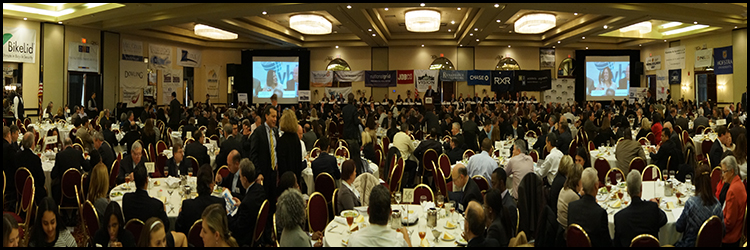
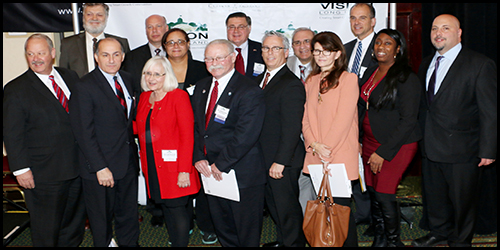
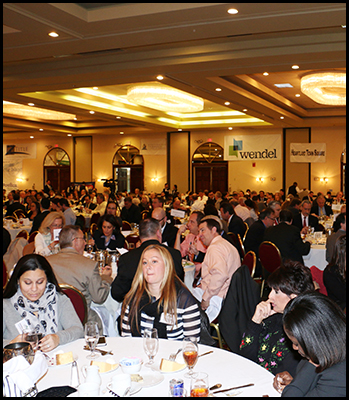
Vision Long Island was very happy to see the outpouring of positive support for the 2014 Smart Growth Summit. More than 1,100 attendees participated at the Melville Marriott, with over 500 for breakfast and 850 for lunch. The energy in the rooms was palpable and a truly optimistic vision emerged.
Highlights from the event included an excellent and thorough speech from Senator Chuck Schumer on federal infrastructure investments at breakfast, an upbeat luncheon keynote from Congresswoman-elect Kathleen Rice, and economic updates from Suffolk County Executive Steve Bellone, Suffolk Presiding Officer DuWayne Gregory and Nassau Presiding Officer Norma Gonsalves.
Nassau County Comptroller George Maragos released a report on the demographic challenges and investment solutions. National Grid's Ken Daly announced a $700 million upgrade to the Natural Gas system.
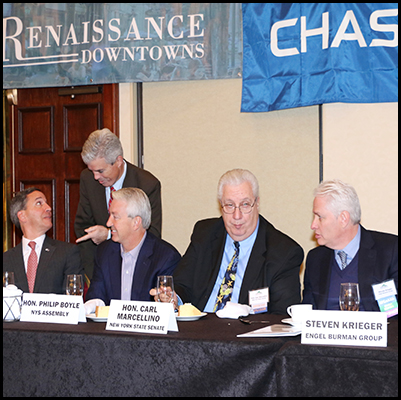
NYS Senators Jack Martins, Phil Boyle and Carl Marcellino committed to bringing infrastructure dollars and jobs for Long Island and passing the small business savings accounts legislation.
Supervisors Judi Bosworth from North Hempstead, Brookhaven's Ed Romaine, Southampton's Anna Throne Holst and Huntington's Frank Petrone, along with Councilmen Steve Flotteron from Islip and Ed Ambrosino from Hempstead outlined redevelopment efforts in Port Washington, Ronkonkoma, North Bellport, Southampton and Huntington Station respectively. Mayors and Trustees from the Villages of Westbury, Great Neck Plaza, Mineola, Freeport, Babylon, Patchogue and Mastic Beach updated folks with their projects.
Other Villages present included Great Neck, Manorhaven, Farmingdale, Valley Stream and Brightwaters.
Project and development updates were outlined from Don Monti's Renaissance Downtowns approval in Hempstead, David Wolkoff's Heartland Square project in Brentwood, RXR's approval at Garvies Point in Glen Cove and Tritec's Ronkonkoma HUB. Off Long Island Forest City Ratner presented for a project on Roosevelt Island; Mill Creek presented in redevelopments in Jersey City. Steven Krieger from Engel Burman covered the economic impact of redevelopment on school districts. Around the region developer/invester George Tsunis spoke on the economic importance of infrastructure investment.
Civic, chamber of commerce and neighborhood revitalization groups were present and active throughout the day. A report on Fair Housing was previewed at the Summit as well from the LI Housing Services. Office of Storm Recovery's Jon Kaiman led a post Sandy recovery panel with other NYS officials and Sandy rebuilding groups.
Workshops were held on topics ranging from energy, water, downtown redevelopment, public safety, arts, tourism, parking, jobs, new town centers, fair housing, transit, traffic calming, healthy communities and others - 24 workshops in all with over 160 speakers.
Finally, the 40-table trade show was great and the well-attended Youth Summit at Dowling College with participation from Dowling, St. Joseph's College, Stony Brook University, Hofstra, and Deer Park and Syosset High Schools continued to engage young folks in the future of Long Island.
Vision co-Chair Trudy Fitzimmons reiterated the organization's support for locally-based planning efforts to meet our regional needs.
Special thanks to Vision's Board, staff and of course all of the Summit sponsors: JP Morgan Chase, Jobco, Renaissance Downtowns, National Grid, Southwest Airlines, RXR, Engel Burman, H2M, GPI, South Asian Times, VHB and 50 other sponsors.

Opening Remarks
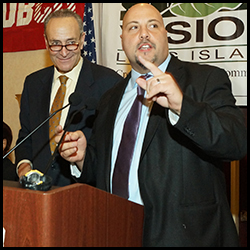
 Senator Charles Schumer addressed the breakfast crowd about promoting infrastructure growth, bringing more jobs and creating sustainable community in Long Island in a post-industrial era.
Investing in infrastructure, Schumer said, is a fundamental function of government. Recognizing the need to repair as well as revitalize Long Island infrastructure following Superstorm Sandy, Schumer presented a bill to fund resiliency in infrastructure. About a third of the money, billions, was for resiliency improvements on Long Island to do new things and to upgrade. The Bay Park Nassau County sewage plant, which processes sewage for half million people, received an $810 billion FEMA grant to build a more modern, cleaner plant. In Suffolk, where only 30 percent of the county is sewered, flooding is more likely. In low-lying communities within Shirley, North Babylon, Oakdale, $315 million was allocated for new sewer systems.
Schumer also stressed the importance of revitalization projects to bring back downtowns. He used Wyandanch as an example, saying he was able to obtain funds for sewers and the train station. In Nassau, he used Glen Cove as an example, where the community is moving closer to creating a waterfront community and on what was once a Brownfield site. Money has also gone toward making dangerous roads safer, slowing traffic and improving walkability.
Schumer said the transportation bill is a big thing coming up. He wants to replenish the Highway Trust Fund with this bill and make sure Long Island gets it's fair share. He also wants to obtain TIGER transportation grants to help with the revitalization of the island's downtowns.
"Long Island is a great place to live, but if we don't revitalize our infrastructure it won't be such a great place for the next generation," Schumer said. "We have to build the downtowns, rebuild and revitalize, and get the best transportation possible. I'm going to do everything I can to deliver smart, future-looking transportation and infrastructure dollars to Long Island as long as I'm senator for the United States."
Current State of the Towns and Villages
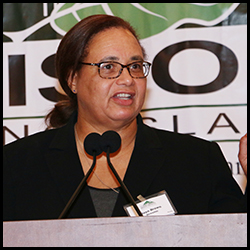 Traditionally, we welcome a panel of town supervisors and village mayors who are supportive of downtown redevelopment and infrastructure investments in their communities.
The breakfast panel, State of the Towns & Villages, was led by Joye Brownfrom Newsday. The panel featured Judi Bosworth, Town of North Hempstead supervisor; Frank Petrone, Town of Huntington supervisor; Ed Romaine, Town of Hempstead supervisor; Anna Throne-Holst, Town of Southampton supervisor; Ed Ambrosino, Town of Hempstead councilman; Steve Flotteron, Town of Islip councilman; Ed Ambrosino, Town of Hempstead councilman; Peter Cavallaro, Village of Westbury mayor; Ralph Scordino, Village of Babylon mayor; Scott Strauss, Village of Mineola mayor; and Robert Kennedy, Village of Freeport mayor.
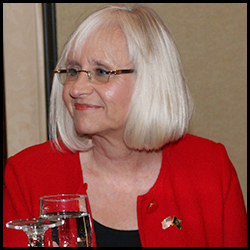
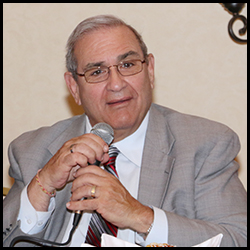
North Hempstead Supervisor Judi Bosworth said her constituents can agree that affordable senior housing is a pressing issue in their community. Two affordable senior housing developments are in the works, including a 72-unit development near North Shore Hospital. "These seniors built our town and we want to make sure they are able to stay here," she said.
Huntington Supervisor Frank Petrone said it'll never be "easy" to talk about Smart Growth since each successful step forward brings with it new challenges. He used the example of apartments above stores, saying it was taboo 10 years ago and is now generally accepted, but brings new challenges such as parking to accommodate additional downtown residents.
"Every time you do something positive and try to make a change there's an additional challenge that follows, but it's what keeps us going," he said. "The challenges can be solved not only at the town level and other levels of government, but through networking with the private sector and other communities."
Brookhaven Supervisor Ed Romaine said the challenge of Smart Growth lies not in new ideas, but in escaping the orbit of old ideas. Projects such as the Ronkonkoma Hub, the AVR at exit 68 are moving forward and the town has been lobbying the MTA to move the Yaphank LIRR station to East Yaphank to improve connectivity with tech and industrial centers. Siting recent successes in Patchogue Village he said, "There is a path forward for remaking suburbia and redefining what it used to be." Romaine added that two areas in the Town of Brookhaven - along the Patchogue River and the Mastic Shirley peninsula along the Forge River - will be sewered through a large state grant. The state may spend $190 million at the Forge River site and the town will contribute 15 acres just north of Sunrise Highway at the airport to facilitate a sewage treatment plant.
Southampton Supervisor Anna Throne-Holst said she's seen a change in sentiment toward certain aspects of Smart Growth among her constituents over the past year, particularly in the area of affordable housing. A new 30-unit affordable housing development was recently approved, although it is now fighting an article 78. She said projects like the Sandy Hollow Cove Apartments, designed to look like a farmstead, is an example of affordable work force housing that blends right into the neighborhood.
Suffolk's shortage of sewage systems remains a critical Smart Growth issue although steps are being made to make progress. Islip Councilman Steve Flotteron said results of a study will soon shed more light on his town's sewering options. Flotteron also said the Town Board recently adopted the environmental impact statement for Heartland Town Square, opening the project to seek a change of zones, although it will likely be a couple of years before it goes through the town and Suffolk County planning authorities.
Hempstead Councilman Ed Ambrosino discussed the exit of the Islanders and a major investment in the retail sector between Nassau Coliseum and the Marriott Hotel which he said will be a destination for young Long Islanders as well as visitors throughout the country. The Marriott will undergo an approximate $95 million-renovation and a large Bass Pro Shops store will be part of nearby development.
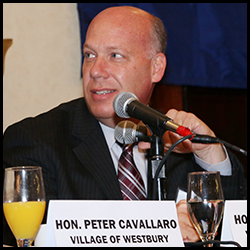
Mineola Mayor Scott Strauss discussed how construction on multiple housing projects in his village, especially near the LIRR station. About 890 units are expected to open in the next few years and Village Hall is working closely with developers and residents to keep everyone in the loop. Once open, he expects them to help keep young residents in Mineola and add to municipal coffers when vacant buildings were a burden on the community.
"Every village, town and county is going to change," he said. "We have to control and manage the change. If you don't control it, it's going to control you."
Babylon Mayor Ralph Scordino said infrastructure has been rebuilt since Sandy hit two years ago, giving residents a sense of security. The Village pool, for example, was up and running eight months after the storm, the marina was rebuilt and the bulkheading was raised to improve infrastructure around slips. They also purchased property with the County to raise the bulk head and hold back water from the Great South Bay. Scordino said it was all done through a great sense of community and volunteerism.
Freeport Mayor Robert Kennedy said his village experienced financial stress as a result of Sandy and as a result the Village Board decided to increase revenue by developing along Sunrise Highway. A professional and retail complex is being developed right by the LIRR station. The village is seeking improved walkability and a professional retail complex is being developed near the LIRR station. The village is undergoing numerous infrastructure projects along its waterfront.
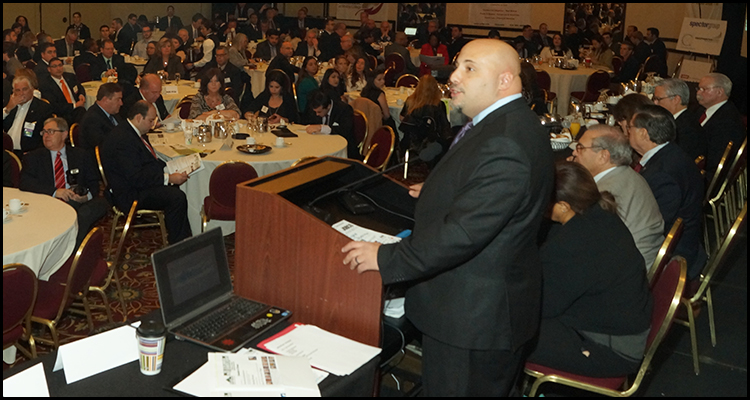
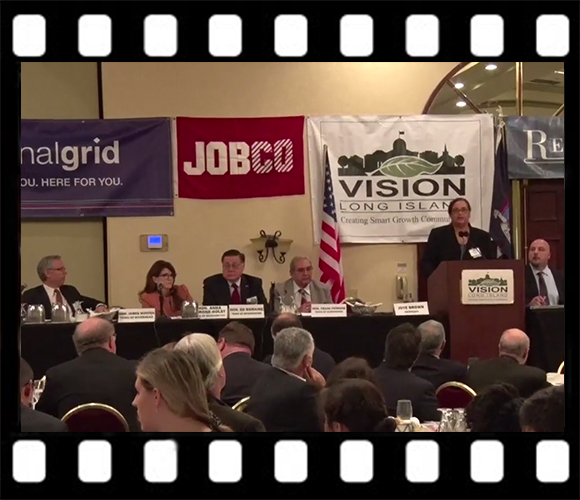 Check out the full video of this panel here.
Economic Development & Infrastructure Suffolk

Infrastructure is one of the key ways government can help spur economic development and allows businesses to thrive by permitting growth, providing efficient transportation between locations and creating public spaces that enhance the value of their surroundings.
Suffolk County Legislature Presiding Officer DuWayne Gregory; Joanne Minieri, Suffolk County IDA; David Calone, Suffolk Planning Commission; and George Tsunis, George Tsunis Real Estate, discussed ongoing initiatives and smart growth planning issues facing Suffolk County in a panel moderated by Long Island Business News Publisher John Kominicki.
Gregory said the legislature has pushed for funding for transportation improvements and service expansions, such as the bus service. He also discussed progress on improvement initiatives to Nicolls Road and the 110 corridor. Progress is being made on smart development infrastructure projects in Wyandanch Village, the Ronkonkoma Hub, the Heartland Project, East Farmingdale and Huntington village that will attract and create jobs.
“Community based planning is critical in everything,” said Minieri. “People have the right to know what the long-term vision is for a location...When you do a regional plan and do the proper community outreach and come together with good planning and great design, it can eliminate some of the concerns or fear of the unknown. Then you implement and modify as times change."
Panel guests agreed that affordable housing is the most pressing issue facing not only Suffolk County, but all of Long Island. Affordable housing is required to house the aging population and to entice young professionals to stay and invest in the communities they grew up in.
Young professionals of the Millennial generation are attracted to connected communities with vibrant downtowns where they can live, work, and play all in one spot, Tsunis pointed out. “Amityville, Mineola, Westbury, Valley Stream, and Patchogue are getting it right," he said. “Millennials are not in a position to buy homes, they rent.”
County leaders hope that Suffolk’s transit-oriented development, water quality initiatives and tax incentive programs will provide the infrastructure to attract businesses and developers provide job opportunities and build affordable housing for the young workforce and their future families.
Minieri discussed County initiatives to extend the LIRR's further north and south to R&D hubs and create transit-oriented districts, as well as initiatives to connect MacArthur airport with the Ronkonkoma hub. Calone added that zoning flexibility around new transportation hubs can be used to both entice developers and drive the use of public transportation by residents.
The panel also discussed shifting population demographics in Suffolk County. Currently the fastest growing age demographic is ages 55-75, according to Kominicki, with the largest growth in ages 0-2 being among minority populations. Gregory said the majority of people in America will be people of color by 2042, and considering that many of those people live in and are served by failing schools, a sincere effort should be made to invest in our schools. Calone added that underserved schools should be better funded and for investment in STEM programs.
Tsunis said communities should embrace diversity because many new entrepreneurs are from minority groups and will hire local workers.
Calone said that the county will soon unveil its first comprehensive plan since the late 70s. The document has been in the works for two years and is expected to be wrapping up within the next two months, he said.
View highlights of this panel here.
Complete Streets
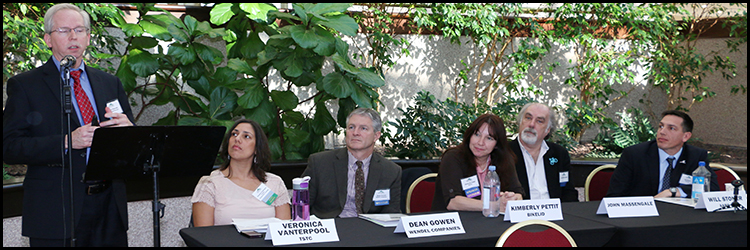
On the Complete Streets panel, AARP’s Will Stoner, Wendel’s Dean Gowen, BikeLid’s Kimberly Pettit, Greenman Pedersen’s Frank Pearsen, author John Massengale and moderator Veronica Vanterpool from the Tri-State Transportation Campaign looked at Long Island’s roads and how to make them safer for all uses.
Vanterpool touched on Sunrise Highway tours this summer with walkability expert Dan Burden before moving on to Tri-State’s report of the most dangerous roads. The most deadly road for pedestrians in 2013 was Jericho Turnpike, supplanting Hempstead Turnpike.
Gowen said the island needs to upgrade roads with new utilities and design them for accessibility if traffic flow is to improve. He recommended projects like creating separate bike lanes, planting trees, installing smart LED traffic signals and moving overhead utility lines underground.
Pettit, whose company created a 200-pound bike shelter they hope to sell to municipalities across the northeast, focused heavily on bicyclists. She emphasized the need for segregated bike and walking paths. BikeLid shelters are currently available for downtowns and train stations, and other potential sites.
Massengale is the author of “Street Design, the Secret to Great Cities and Towns.” The government is responsible for building roads in both urban and rural communities, he said. Back in the 1990s, they funded bike roadways. Earlier in that century, he added, many New York City roads were one-way, making them a place where people wanted to be.
AARP has 33 million members, Stoner said, and 200 municipalities have 200 Complete Streets policies. When senior citizens can no longer drive, they become isolated. He also touched on the state Department of Transportation’s plans to spend $3.8 million on Sunrise Highway improvements in Nassau County without any local involvement. AARP was a part of the Burden tours, which called on uniform, narrower lanes to calm traffic.
Pearsen worked for the state Department of Transportation until leaving for Greenman Pedersen. In the Summit, he touched on the Newbridge Road project in East Meadow. They put the thoroughfare on a road diet, turning a two-lane road in each direction into a one-lane road each way with a central turning lane. Pearsen also said streets must be designed to accommodate bikers and pedestrians.
View highlights of this panel here.
Renewable Energy
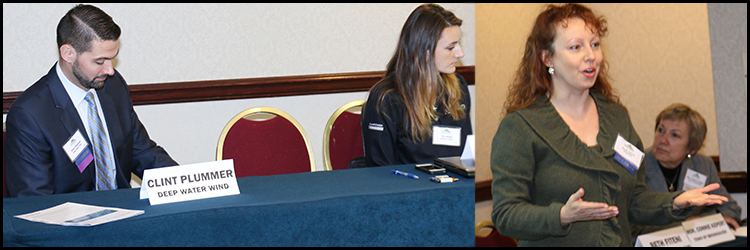
The Renewable Energy panel was moderated by Brookhaven Town Councilwoman Connie Kepert, who worked closely with Caithness to bring one of the cleanest power plants in the northeast to Long Island, and featured three people well connected with Long Island’s efforts to grow clean energy sources in our region: Clint Plummer from Deepwater Wind, Beth Fiteni from NYSERDA, and Tara Bono from EmPower Solar.
The panel opened with Plummer speaking on the challenges of energy infrastructure East of Riverhead that Deepwater has been confronting. Due to aging infrastructure it has become difficult to keep up with the needs of a growing population. He noted that wind could go a long way in counterbalancing that, especially during some of the peak times of the day when the strain on the local grid grows enormously. He also said the turbine technology has improved to the point where they can be placed so far offshore that they would not be visible, which could help to quiet some of the resistance to placement. Plummer also noted that offshore wind is a growing industry with Long Island’s geographic location positioning it to be a leader in employing the 13,000 Americans projected to be in the inustry by 2030.
Next, Fiteni spoke on NYSERDA’s efforts to incentivize solar and renewable energy in the region. She identified lowering costs not generally associated with installation such as training and the price to manufacture the panels as potential challenges. NYSERDA has been working to help lower those while incentivizing installation and streamlining the process for lower income communities. New York State also has a program called K Solar that is administered by NYSERDA and provides rebates for those who need it while offering loans at a lower interest rate to off set the cost of installation. They’ve also been working to change local zoning codes to help incentivize residents while offering free energy audits to those interested in switching over to renewable energy. She also briefly touched on other smaller renewable energy programs that provide small scale wind, geothermal and solar thermal energy.
Finally, Bono spoke on EmPower’s efforts on the island, noting that Long Island’s energy is usually provided National Grid and aging, older power plants. However, that is changing, with Long Island being home to the largest solar power plant east of the Mississippi. PSEG has also been growing its solar infrastructure, more than doubling their units from five to 10,000 in the past few years. As a source of energy solar is an excellent alternative, especially considering that Long Island is the second most expensive energy consumer in the country. The number of incentives is also on the rise in the form of tax credits, flexible financing options, high lifetime savings, amenable zoning codes, and solar ready homes having a higher home value.
View highlights of this panel here.
Financing Transit-Oriented Developments

The Financing TODs panel dug into some of the more pragmatic issues in getting Transit-Oriented Development (TOD) built. Anthony Manetta of Standard Advisors Group began the panel by acknowledging that elected officials are beginning to understand that Transit-Oriented Development is one way to help mitigate the "brain drain" trend that has been occurring on Long Island without completely changing the suburban landscape but rather adapting to economic and social trends. He then introduced the panel of speakers from both the public and private side of TOD financing.
Bob Paley of the MTA explained how TODs need to be conceived from a neighborhood perspective. They need a higher degree of coordination to stitch together all of the elements including the public realm. Parking garages are a major component of suburban TODs and can be financed publicly through federal programs or privately through increased land value and lease-able space that wraps the structure.
Gerry Bogacz of NYMTC explained the "T" in TOD is key. There has to be local desire and a local government that can help coordinate local, state and federal programs and agencies to fund different elements of the development. Municipalities have to learn a lot to accomplish this and having a mix of transit services can improve the success of the development.
Matt Frank of the Richman group pointed out the two issues that impact the financial feasibility of a project which are infrastructure and density. The private elements will be able to get funding, but paying for the public infrastructure can be difficult whether it's a plaza or a parking garage. The developer can only pay for it is there is enough density in the project to cover the cost-there needs to be public private partnerships to make things work.
Andrew Saluk of NEFCU explained how the more local nature of credit unions can sometimes be more flexible with financing than larger institutions. Having employees familiar with the local economy can help a credit union assess the viability of a project and offer insight that may not be available to national banks. He also explained how residential development is always the lowest risk to finance, particularly apartments- people always need a place to live, and mixed use makes sense from the perspective of the "economics of life."
Bill Purschke of Zodiac Title Services explained how the title process factors into the development process. Mixed use, transit oriented projects aren't completely new or different than conventional development, just more complex. They work behind the scenes with developers government and owners to help facilitate the process - many times transfer of ownership and easements are needed to create the development that is a mix of private and public.
Fair Housing/Segregation On LI
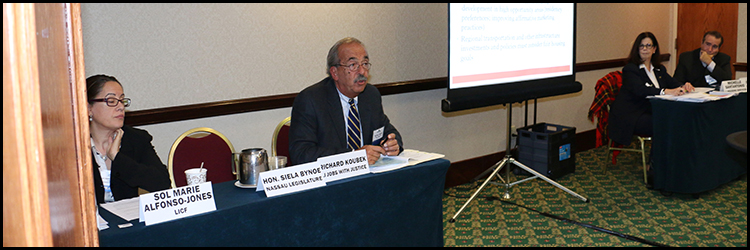
Quoting Reverend Goodhue, Huntington Township Housing Coalition's Dr. Richard Koubek started the Fair Housing/Segregation on LI panel by saying "Let's pray for a welcoming community," which inherently comes down to welcoming zoning reform, racial diversity, different household types and affordable (local AMI-based) opportunities on Long Island. Joined by Michelle Santantonio of Long Island Housing Services, Sol Marie Alfonso-Jones of Long Island Community Foundation and moderated by Lawrence Levy of Hofstra University, the panel covered the history of housing segregation, current discriminatory practices and efforts to combat it.
As the third most segregated suburb in the United States, U.S. Census data shows that school segregation and housing-cost burden has gotten worse over the past five years. Tracking school district scores shows the worst effects of these practices on LI's youth; it is evident in the test scores, numbers attending four year colleges and the concentration of poverty by school district in the region. Yet despite the data, there's been no shift in the conversation to race and social justice from elected officials or Albany. Only the economics of failing to diversify the housing stock resonates with voters. Panelists agreed that stronger enforcement of anti-discrimination housing practices and population planning in Nassau and Suffolk are needed to arm allies and elected officials with the facts, and confront Long Islanders with harsh truths.
View highlights of this panel here.
Downtown Showcase Nassau
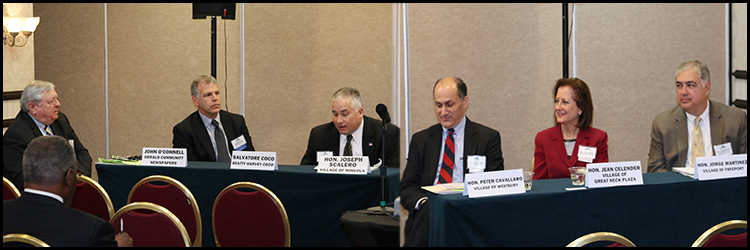
The Downtown Showcase Nassau County panel, moderated by John O'Connell of Herald Publications, focused on the successful Smart Growth projects in a few key Nassau County communities. Leaders of these communities, many of whom spoke on the panel, have overcome and continue to overcome the challenges of parking, retaining millenials and aging baby boomers, pedestrian safety, infrastructure, and attracting tourists and customers. The primary theme of this panel was gaining community support and only implementing projects that made sense in the community. They also agreed on the importance of building a partnership within all levels of government to keep projects making steady progress despite political shifts.
Jean Celender, mayor of the Village of Great Neck Plaza, highlighted some of the major successes of redesigning the village's downtown corridor, including complete streets elements to make the area more appealing to the changing face of Long Island. There are more than 90 apartment buildings next to the train, safer streets for pedestrians, traffic circles to ease traffic congestion, and a textbook example of a successful road diet.
Peter Cavallaro, mayor of the Village of Westbury, spoke about the need for taking negatives in a downtown and turning them into positives. He led the way in transforming many underutilized spaces in his village into condos, co-ops, public green spaces, and cultural destinations such as The Space at Westbury. The performing arts center has been the single most successful project they have done, paving the way for the creation of the Greater Westbury Council for the Arts and other ongoing arts-based community events.
Joe Scalero, clerk from the Village of Westbury, spoke on the need for community support in all aspects of downtown revitalizations. It's no longer about fighting, he said, but about the question “does this fit our vision and the community's needs?” Individual projects add up, but it helps prevent people from feeling like they're being trampled by redevelopment. They have been able to secure nearly half a billion dollars of private investment since the approval of Jack Martins' master plan for the village almost a decade ago.
Jorge Martinez, trustee from the Village of Freeport, is also a small business owner and a member of the Long Island Hispanic Chamber of Commerce. He noted it is crucial that leaders work together on all levels of government, without complaint, to get things done. As a trustee of one of the largest villages in New York State, Martinez also said he and his fellow board have to be active within the community.
Sal Coco from Beatty, Harvey, Coco Architects highlighted some of the projects they have developed around Long Island, including a “Superblock” of apartments, boardwalk retail, access to the LIRR, and parking in Long Beach; and a TOD in Valley Stream with apartments, mixed-use retail buildings, and parking.
View highlights of this panel here.
Public Safety

Former Suffolk County Police Chief Robert Moore, now the directory of Security with Astoria Bank, moderated a panel on Public Safety. Police can prevent crime, but so can communities, youth programs and private security companies. Greg Ohanessian, of I-Tech Security; Lionel Chitty, of the Hicksville Chamber of Commerce; and Dr. Elizabeth Isakson, of Docs for Tots, were part of the discussion.
The panel, which represented various organizations across Long Island, discussed the public safety needs of Long Island communities and how to implement proper strategies pertaining to downtown revitalization and smart growth.
Many of the panelists concluded that positive “curb appeal” not only helps with the economic impact of the area, but deters vandalism, burglary and other undesirable action. Panelists agreed that planning properly is important. If an area is not maintained, well lit and walkable, problems can emerge.
Technology has increased the public safety aspect dramatically in many business improvement districts. Use of surveillance cameras in downtowns, schools and faith-based organizations have not only aided in prosecution on crimes, but as a deterrent as well. Implementation of proper lighting, Wi-Fi access and cell booster systems continue to improve the general quality of life as well as assist with public safety concerns.
Education has been proven to be a formidable tool in combating crime. For example, the Nurse-Family Partnership program provides nurse home visits to pregnant women with no previous live births, most of whom are low-income, unmarried, and teenagers. The nurses visit the women approximately once per month during their pregnancy and the first two years of their children’s lives. These nurses teach positive health related behaviors, competent care of children and maternal personal development (family planning, educational achievement, and participation in the workforce). Studies have shown that this dramatically decreases crime for both the mother and the upcoming generation. More can be read about this program here.
The overall message and take back from the discussion was to increase collaborative efforts between the police department, local municipalities, businesses, nonprofit sector and community stakeholders. An example was given where a chamber of commerce had made a purchase of surveillance equipment that would be installed at a local business adjacent to a vacant, poorly-lit building. The “set up” ended up catching vandals in the act, and also sent a message that the area is being watched. There will never be enough funding to curb all public safety issues, but through a collaborative effort significant improvements are possible. By creating a “storefront omnipresence” of concerned stakeholders giving the illusion that all is being cared for, issues such as trash, loitering, vandalism and overall public safety can be dealt with more effectively. This will only help business districts and the community in general thrive.
Retail Opportunities
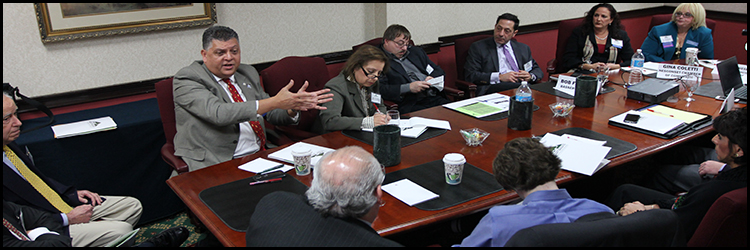
During the Retail Opportunities workshop, Gina Coletti of the Nesconset Chamber of Commerce; Molly McKay, of Willdan Financial Services; Julie Marchesella, of the Nassau Council Chambers of Commerce; and moderator Bob Feldman, of Basser-Kaufman discussed what makes a successful downtown, what attributes towns have to make it work, and how retail can be used to make the community a destination. Retailers who are thriving help to create a great active downtown. Huntington and Rockville Centre are some examples where a focus on retail helped in the making of a great downtown. Some of the components to this success include parking, entertainment, food and bars. Merrick has a higher occupancy rate after downtown revitalization. One of the tools they used to create a vibrant storefront is to have two retailers within one store front.
Panelists talked about some questions to ask before renting out a store front like getting an idea the business and what their long term goals are, and what makes their store different from five of their competitors. Successful downtowns need retailers driven to compete to be unique. Internet causes a lot of competition so as a retailer, awareness of online competition is important. Encourage all retail stores to get on the internet and participate in social media. Successful independent merchants can offer things Wal-Mart can’t do. Activating people who put themselves out in a unique manner to reach out to others on the Internet. Nassau County’s advertising campaign is an example of a commercial. Post-Sandy, it allowed for a focus on businesses affected by Superstorm Sandy as they came back online. The main idea of “shop locally” shows the importance of retail and Main Streets. The speakers in the commercial are all local merchants whom each offer a unique set of skills and area of expertise.
Coletti talked about the Suffolk County Downtown Revitalization Board where one of their projects focused on an old armory. As part of the revitalization efforts, the armory projected looked at how that space can be used to fill the void in retail and community needs. The project now includes a new library, new gazebo, summer concert series, tennis courts, and created a hub of activity. Store fronts around area saw an increase in business, and a decrease in taxes and vacancies. Although they took years to achieve, it created something that completely changed the town.
Eighty to ninety percent of downtown retail is not unique, however uniqueness is great but not necessary. Entertainment had become a real driver and replaced simple retail.
In regards to the the type of retail, Victor Dadras said “main street as retail in a 19th century old model.” Main streets cannot compete with big boxes. Big boxes serve a certain purpose however, small businesses and a vibrant downtown can do more to create a vibrant community. In looking at what needs to be done to attract independent retailers and retain them, speakers mentioned, the need for a mall manager, downtown manager, or bid manger. This person can provide oversight to the types of business that are coming in. For instance, a local bakery as opposed to a Dunkin Donuts. Both are small business owners, but one is simply part of franchise.
Feldman added that as a human is it is our nature to “perceiver, reinvent and thrive.” Within vacant store front- downtown managers can host open houses to educate young prospective retailers/buyers . They can highlight the potential to prospective retailers of being in their downtown.
McKay encouraged retailers to look for density. When trying to distinguish a business, it’s all about the façade. Having clear answers and direction is also important. “When issues are out of our control as a developer you will walk away” said McKay. Developers prefer municipalities that want to work with them. A thriving downtown culture can be achieved by using social media as a promotional tool.
Youth Vision for LI's Future

Those attending the Youth Vision for LI's Future panel heard from four young professionals with advice to keep college graduates and Millennials on Long Island. The panelists included Jeff Guillot, founder of the Suburban Millenial Institute; Meghan Sullivan, a student at St. Joseph's College; David Viana, president of the Baldwin Civic Association and a student at SUNY Stony Brook; and Elisabeth Muehlemann, the Americorps Community emergency preparedness coordinator for the Long Island Volunteer Center. Questions were posed to the panelists by moderator Dr. Nathalia Rogers from Dowling College. Questions included: What are some of the issues young people face? How can we keep young people on Long Island? How can we increase diversity and immigration on Long Island? Common themes included a discussion on affordable housing, increasing transportation options, making downtown areas with activities to do and incentivizing corporations to create jobs on Long Island so that our college graduates don’t move to other locations.
Each panelist was asked to draw on their own personal experiences to bring a unique perspective to the conversation. As Guillot spoke about the importance of incentivizing employers with tax benefits to employ millennials just as Baltimore incentivizes employers to employ immigrants. Guillot also discussed the importance of encouraging immigration and emigration to this area so increase the number of people paying into the tax base. Viana focused on the importance of young people becoming involved in local government so that their interests are represented. He also articulated the necessity of creating downtowns around colleges that are inexpensive and will cause college graduates to want to stay in the area.
Sullivan has been studying Recreational Therapy at St. Joseph's. She was able to explain the importance of creating unique recreational facilities on Long Island that make people want to visit for the one of a kind activities they can do and places they can go to. Sullivan also described cultural centers as a necessity to help make those with diverse backgrounds feel more welcome. Muehlemann was an environmental geography major and works very closely with communities on Long Island so her concerns were the public health issues related to the environmental degradation of our land and waterways. She said the lack of community spaces that facilitate collaboration between organizations and make people feel connected to the people around them.
It was clear from the opinions of these millennials that decision makers and developers need to listen to our young people because if the suggested changes aren’t made we will continue to lose bright young people to more affordable areas that provide the infrastructure for the lifestyle that young people are looking for.
View highlights of this panel here and here.
Economic Development & Infrastructure Nassau
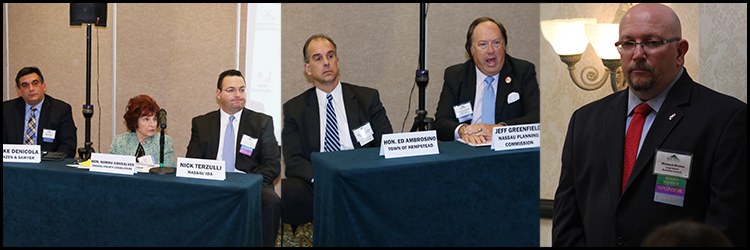
The Economic Development & Infrastructure Nassau panel, moderated by Long Island Business Council Nassau Chair Rich Bivone, focused on increasing the appeal of Nassau County as a place for business. With New York City becoming increasingly unaffordable for most businesses, including film, manufacturing, and international companies' world headquarters, it is crucial for the vitality of Long Island that we attract these businesses here. By bringing in good jobs, young professionals are more likely to work here, live here, and shop here. Nassau County Legislature Presiding Officer Norma Gonsalves, Nassau County IDA's Nick Terzulli, Town of Hempstead Councilman Ed Ambrosino, Nassau County Planning Commission's Jeff Greenfield and Mike DeNicola of Hazen & Sawyer sat on the panel.
Gonsalves highlighted some of the recent movies and TV shows that have filmed in the area and how they provided a huge influx of cash into the local businesses. She also said a major impedance to further development is a lack of cohesive public transportation.
Terzulli gave some examples of the red tape that many businesses now face in trying to relocate to our region. He explained the IDA works with everyone, not just businesses themselves, and provides tax incentives, advice and resources. More than 1,200 units of transit-oriented development have received IDA financing in Nassau County.
Ambrosino talked about the broken zoning system that makes it increasingly difficult to build and accommodate the changing needs of businesses and residents in the area. Zoning codes, he said, need to be amended so that people can come in and infuse their money into the community. Having proactive zoning codes leads to positive developments such as the Courtesy Hotel becoming Mill Creek Residential, an adaptive re-use of existing property.
Greenfield touched on the Nassau Coliseum lease to Forest City Ratner. The next step in the Coliseum project will be approval from Nassau County, once negotiations are completed between the Town of Hempstead and Ratner. They are attempting to work out the kinks before meeting with the county and the public, but said they will hold separate meetings with the public if demand is there to discuss the plans.
View highlights of this panel here.
Healthy Communities
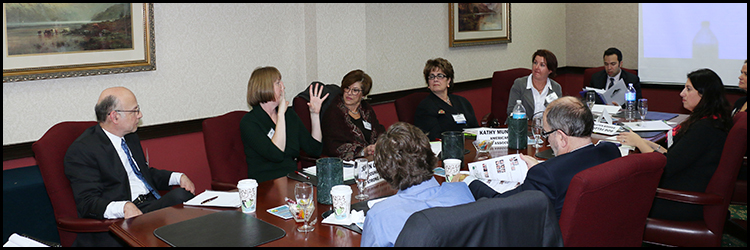
The Healthy Communities was moderated by Bernadette Martin of Friends & Farmers, who began the panel by announcing that she is currently applying for six more community gardens across Long Island in the coming months. She then introduced the rest of the panelists: Nassau County Legislator Laura Curran; Kathy Munsch, of the American Heart Association, and Jenn O’Conner from Council for a Strong America.
Curran spoke first, saying Smart Growth can be a tool to keep young people on the island by encouraging activities such as walking and biking, activities which encourage healthy lifestyles. She also spoke about an organic supermarket set to open in Baldwin thanks to the efforts of its local civic association. She ended by reminding people that though legislation can be a tool for healthy communities, there are also simple responsibilities that community members have such as picking up litter and keeping neighborhoods clean.
Munsch spoke on how the American Heart Association has set a goal of improving the health of 20 percent of Americans by 2020. She presented several ideas for achieving this, including using gardens as a teaching tool, encouraging businesses to adopt “fit friendly” policies, encouraging friends to reduce sodium intake, raising health awareness by encouraging people to move and engage in physical activity, and more. Munsch also spoke about "food deserts" and the lack of choice in poor communities, causing people to eat more from chains and convenience stores.
Finally, O’Conner spoke on the need for a policy lens to leverage the voices of messengers for women and children in the country. She spoke on the need for education as a tool for encouraging health. Children are often targeted in lower income communities in order to hook them on an unhealthy diet and lifestyle. They become used to the food desert landscape and are often at eye level for cigarette advertisements. This perpetuates a cycle where a sick child cannot be in school often enough to gain the education to encourage him or her to be healthier. She said we have to work to promote the lifestyle and encourage healthier living through local farms, preferably by helping to affray their tax burden or create venues to deliver fresh food to local residents while it’s at its peak healthiness. However, change won’t come unless people push for it, and it’s up to us to encourage our local elected officials to make changes that benefit and encourage our health.
View highlights of this panel here and here.
Tourism and Downtowns

The Tourism and Downtowns panel featured speakers Kim Kaiman from the Town of North Hempstead, Dr. Janice Scarinici, a hospitality and tourism professor at St. Joseph’s College; Karen Harding of THEM Media; and moderator Gregory Zeller, of the Long Island Business News.
Tourism is a topic that is very important to consider during the planning of downtown revitalizations. The panelists emphasized the need to capitalize on the unique experiences available on Long Island and market them both nationally and internationally to draw people in to our area.
Jobs in the hospitality industry are increasing and more education programs in tourism management and hospitality can create the knowledge base necessary to increase the amount of travel to Long Island. Kaiman and the Town of North Hempstead were able to create a marketing video to draw people to the amenities available in Port Washington. Knowledgeable members of the industry and effective marketing are all ways to begin to draw people to downtown areas. Harding has made over 10 promotional videos for areas such as Glen Cove, Wyandanch, Hempstead, and Patchogue to highlight the downtown revitalization work they are doing and make people aware of the benefits of visiting these towns and villages. Areas that want to attract visitors should find a way to create themes for the experiences they provide which will help draw people to try visiting a new place. Increased bus access both public and with private tours will also make people for more inclined to visit Long Island as it will make visiting both easier and more enjoyable.
Tourism dollars are very important for local businesses because they bring in outside revenue that doesn’t come from local shoppers. One of the panelists touched on the importance of attracting Chinese tourists to our downtown areas. Chinese tourists travel regularly to New York City and spend up to $7,000 per person per day on entertainment and shopping while they are in America.
Long Island needs to take advantage of the historical and water based amenities that can attract visitors and be ready to market the unique activities that are offered.
View highlights of this panel here.
Downtown Showcase Suffolk
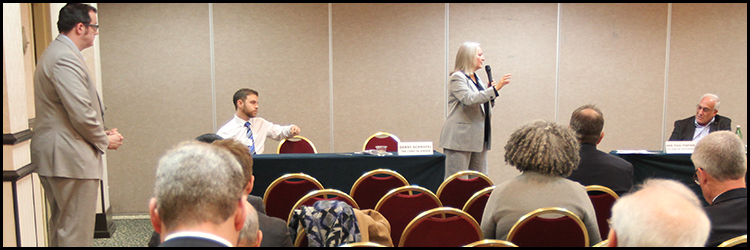
In a panel moderated by Long Islander News' Danny Schrafel, Village of Patchogue Mayor Paul Pontieri, Mastic Beach Village Trustee Maura Spery and Zach Rapaport of Zucaro Construction and House Lifters discussed notable strengths in their downtowns.
Pontieri touched on Patchogue’s new housing and entertainment options, like the Emporium and Patchogue Theater for the Performing Arts. He said each community should build upon its assets to create vibrant downtowns. He said he was blessed with great infrastructure and design upon taking office, including a train station, plentiful parking, sewers, restaurants and a revitalized theater. The problem was bringing people into Patchogue to patronize those businesses. He solved it by welcoming new affordable housing developments like Copper Beach, ArtSpace and Tritec’s New Village.
Mastic Beach incorporated into a village only four years ago and Spery said it has a laundry list of projects to tackle for their downtown and the surrounding area. She believes her village’s greatest asset is its over 6 miles of walkable parkland waterfront which can be used for eco-tourism. The village recently resolved to do a comprehensive plan to revitalize downtown and connect it to the waterfront and is now working on a plan to sewer the downtown. Spery said she’d also like to see the development of a transportation hub to connect the downtown with the train station.
Many homes are vacant in Mastic Beach because of Hurricane Sandy damage and the village is working to have viable homes occupied. Many of the homes were salvaged with help from organizations like Zucaro House Lifters, which raised homes in flood-compromised areas free of charge. More than 160 homes have been raised since Sandy, said Rapaport.
Both Pontieri and Spery emphasized the importance of taking a long-term view when planning development in their communities. When asked about concerns over possible burdens to the school district with an influx of children should new housing developments be built, their responses differed.
Spery called an increased enrollment in schools as a result of well-planned development “part of having a healthy community,” but added that previous steep increases in school taxes have been a burden for the largely low- to moderate-income community.
Pontieri said that well-planned developments can bring in additional tax revenue to offset any increase in school enrollment over a period of time and used the Tritec and Copper Beach developments as examples. He said tax abatements were used to incentivize the Tritec development and that it brings much more revenue to the community than the property did in its previous state.
View highlights of this panel here.
Water
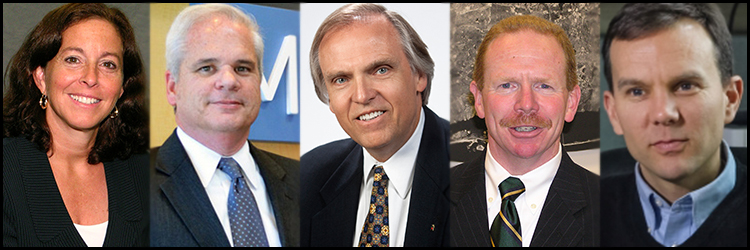
Adrienne Esposito, executive director of Citizens Campaign for the Environment, served as moderator for the Water panel. She was joined by H2M's Dennis Kelleher, GEI's Gary Rozmus, Peter Scully from the NYS DEC and Dr. Chris Gobler, from SUNY Stony Brook.
Ensuring that Long Island continues to move forward with improving water quality and conservation issues is not only important, but crucial for Smart Growth and sustainability. In some areas of the country, drought, contamination and lack of conservation have the potential to shutter towns and drastically affect the local economy. Water and its recreational value is also a compelling reason for families to move to and stay on Long Island. With a panel of experts, this thought and concern was posed to the standing room only workshop: Water is the new oil. How do we sustain?
The quality, usage and conservation of our water is an issue for all residents of Long Island and is a complex situation with many moving parts. In many parts of the island, there has been more progress towards the issues in the past two years than the past three decades. Over $1.3 billion has recently been allocated for improvements for the Bay Park Sewage Treatment Plant, funding for alternative septic systems in Suffolk County and improvements in Babylon.
Nitrogen levels in our bays, due to 360,000 parcels in Suffolk using cesspools, overuse of fertilizers and other factors have significantly damaged our waterfront and ground water. In Suffolk, nitrogen levels have increased up to 200 percent from 1987 and continue to rise. This creates a higher rate of algal blooms, brown tide, rust tide and other undesirable conditions. Not only does this affect the quality of the drinking water - Long Island sits on its aquifers, but has a significant impact on retention of coastal wetlands and the resiliency of the area toward future natural disasters. The loss of wetlands since 1974 has ranged from 12-80 percent in some areas, more so in those areas that do not have proper disposal of nitrogen. The continual loss of wetlands, compounded with impending sea level rise over the next ten years puts residents and businesses in dangerous situations.
Since 1930 there has been a 90 percent loss of Long Island’s seagrass, which is imperative for shellfish and fin fish populations - extinction is slated for 2030. Beyond the ecological loss, the economic losses have been staggering. Long Island fisheries have lost $6.3 billion in revenue since 1980.
Beyond sewage upgrades, increased preservation of open space, decrease in irrigation usage for lawns and golf courses - where 85-90 percent of water is used - and replacement of antiquated water infrastructure is imperative. As Long Island continues to develop and redevelop, proper usage of one of our most valuable resources cannot be looked at as a wish, it’s a necessity.
Transit Opportunities
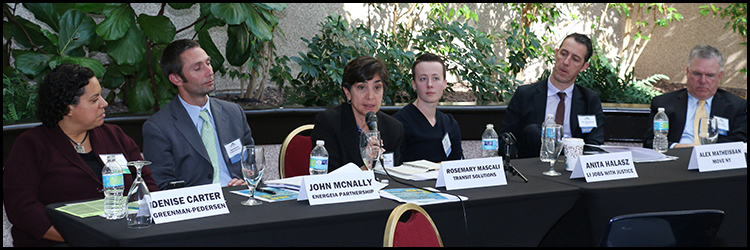
Mass transit was the primary focus of the Transit Opportunities panel at the Summit among MTA’s Mitch Pally, Move NY’s Alex Matthiessen, Anita Halasz from LI Jobs with Justice, Transit Solutions’ Rosemary Mascali, Energeia Partnership’s John McNally and moderator Denise Carter from Greenman Pedersen.
Pally talked about the MTA’s Double Track project on the Ronkonkoma branch of the LIRR. Two full tracks should be open between the Pinelawn and Ronkonkoma stations. That project may also pave the way for the reopening of the Republic Station in East Farmingdale, Pally said, while the Town of Babylon rezones the area for mixed use development. The MTA officials also touched on some LIRR improvements, including plans to replace diesel trains with electric counterparts and adding half-hour service on Port Washington lines.
The LIRR sees more than 300,000 commuters every day, McNally said. Despite the high demand for service, the MTA has not upgraded the tracks since the LIRR was originally built. McNally also looked into the East Side Access project, which eventually will connect the LIRR with Grand Central Station. He said that project will increase the value of 400,000 homes.
When solid transportation options are available, Mattheissan said, property values rise. Meanwhile, he said Long Island drivers fight through potholes and traffic jams. His Move NY plan calls for tolls at all New York City bridges and crossings as a source of revenue for transit; he also said the MTA should lower future fare hikes for LIRR riders.
Halasz has been an active advocate for bus riders across Long Island. Until very recently, riders have not had a representative on Nassau County’s Bus Transit Committee. Nassau Inter County Express (NICE) Bus riders have, however, had fare increases in the past two years. In Suffolk County, she called on continued improvements for the Suffolk County Transit system. Ridership skyrocketed after Sunday service was implemented on 10 routes last year; weekend and evening service is still heavily requested.
Many Long Islanders, Mascali said, are not familiar with the bus services available on the island. Meanwhile, 10 percent of LIRR ridership is actually reverse commuting. More Long Islanders will tap mass transit if pre-tax transit benefits are restored. Her organization also backed Car Free Day in September, an event designed to reduce the amount of commuters driving along in cars.
View highlights of this panel here and here.
Jobs, Taxes and Small Business
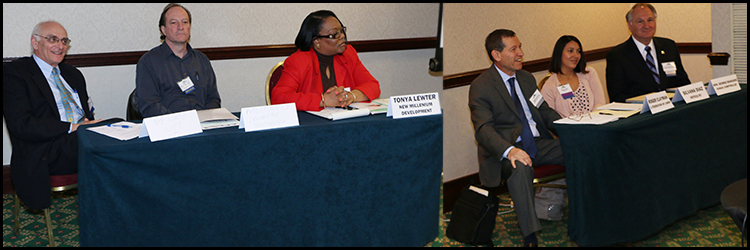
The Jobs, Taxes, and Small Business panel was moderated by Roger Clayman of the Long Island Federation of Labor, who spoke on the how Long Island is currently behind the eight ball to continue with job creation, with the need to find and implement good ideas on both a local and regional stage. Clayman was joined by five other panelists: Bob Curtis from LIST, Philip Rugile of eGifter and Launchpad Huntington, Tonya Lewter from New Millennium Development Services, Silvana Diaz from Noticia NY and Nassau County Comptroller George Maragos.
Curtis spoke first on LIST’s ongoing efforts to support manufacturing in the region. Tthey have provided professional services, operational improvements, and industrial engineers, as well as a development center in Plainview. The big message was the need for facilities on the island to help keep local workers while working with New York State to continue pushing for more grants the support manufacturers.
Rugile spoke next on Launchpad Huntington and how they have worked to create space and training for local, hi-tech entrepreneurs. Born of a need to create a collaborative environment conducive to training and growing local small business, Launchpad has provided this while also providing a downtown environment that is desirable for young professionals. This has also helped to draw in the young talent that is usually so difficult to find on the island.
Next, Lewter spoke on her non-profit New Millennium Development Services and their annual expo, which has become a large procurement conference in the region. With over 150 small businesses slated to appear at the next event, it has grown exponentially in the two years of its existence, providing a way for minority-owned small business to speak directly to their customers and procure the contracts needed to help them thrive.
Diaz spoke on her small business as the owner of Noticia NY, a local Spanish-English newspaper that was formed in order to provide the news and happenings to local immigrants. She mentioned the newspaper’s struggle with the recession and the need to try to get their message less to the original audience of immigrants but to the newer “second generation” of immigrant’s children. As a company they have been seeing advertisement on the rise as companies have bounced back.
Finally, Maragos spoke on his recent report to help improve Nassau County’s financial picture. He spoke on the need to focus on a particular industry and then provide resources to grow that industry. Health Care seemed like the most likely, with an existing infrastructure already in place and the industry itself trending towards high growth and profitability. He hoped to guide it’s growth in the county as well as attract smaller, orbital industries that can breed success and attract younger professionals who want to work in that industry.
View highlights of this panel here.
Education & Economic Development

Moderated by Mark Grossman of Suffolk Community College, the Education & Economic Development panel discussed the dynamics between schools and economic development. As the basis for the region's tax base and a major employer, higher education and K-12 enrollments directly impact planning for future growth. Dr. Mary Kelly, of the Amityville School District, and Dr. Patrick Harrigan, Half Hollow Hills School District, spoke about their district's changing enrollments and populations' needs. Steve Krieger, of Engel Burman, also discussed the relationship between demographics and development, particularly the frequent opposition from school boards to any development that generates school-age children. Constrained by unfunded mandates from the State and a 2 percent school tax cap, many schools are in a quandry when it comes to planning for the future.
Dr. Al Inserra, president of Dowling College, pointed out, the region will need teachers who can serve the growing population - multi-lingual, ESL trained - and places for them to live; it doesn't behoove communities to oppose investing in their educational institutions. Broader demographic trends, such as birthrate declines and later births, compound the challenge of aging public facilities that do not respond to the cyclical nature of demography. More flexible financing structures and leasing of publicly owned spaces, may help alleviate the financial burdens, but the panel agreed that overall, the status quo must change in Albany so Long Island can be more responsive to change.
View highlights of this panel here and here.
Future of Energy on Long Island

The second energy panel of the day focused on how Long Island is going to meet it's energy needs in the future. Neal Lewis of the Sustainability Institute at Molloy College introduced the panel of industry experts. Michael Voltz of PSEG explained their Utility 2.0 plan which focuses on decentralizing supply resources through solar installations and other sources. The integrated plan looks at distributed resources and baseload generation when determining the economics of future energy generation.
Sean Mongan, of National Grid, explained how they are working to harden their infrastructure in the wake of Superstorm Sandy. They are also adding 10,000 new customers and 50 miles of new main line every year. Their challenge is how to plan to further expand the gas system on Long Island.
Ross Ain, of Caithness, gave a history of power plants on Long Island. After World War II, plants were built to first burn coal, then oil and then natural gas. During the 1980s and 1990s nothing was built leading to a shortage and the construction of several "peakers." Caithness I was the first new baseload plant built on the Island in decades. It is a state of the art gas turbine plant that has saved millions in fuel costs. Caithness II as proposed would be even more efficient than Caithness I and more flexible and able to ramp up and down with the fluctuating power supply of renewable sources
Richie Kessel reminded the audience that we still have a lot to do. Though demand has been flat for the last few years with slow economic growth and mild summers, he said, it isn't going to stay that way. Since major energy projects take many years from conception to completion, we need to start now to plan for the future. There are four areas that need to be addressed to meet our energy needs: demand side management to minimize peak loads; greater investment in renewable energy; modernizing the old power plants; and new generation and transmission.
Lunch
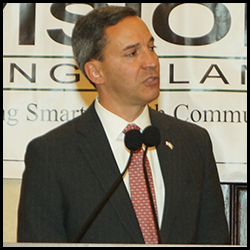 State Senator Jack Martins opened the lunch session with news that New York State advocating for infrastructure projects to be prioritized in the expenditure of this year's New York State surplus.
Martins also pledged to continue supporting Small Business Savings legislation, supported by the Long Island Business Council, it passed in the state Senate but failed in the Assembly. If approved, it would create accounts for businesses to invest; they could then withdraw those earnings tax-free to create jobs or in times of economic downturns.
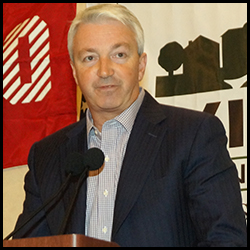 State Senator Phil Boyle also advocated for infrastructure projects, particularly in response to Superstorm Sandy, in this year's surplus said, which come out to more than $5 million.
Meanwhile, Boyle said Smart Growth is taking hold across Long Island. A Bay Shore resident, he shared a story from his recent campaign for the 2014 elections. One individual had been particularly vocal and anti-Smart Growth a decade ago. When the senator knocked on his door now, he found the individual changed his mind after seeing his children leave.
“If we can change this guy’s mind, we can change anyone’s mind,” Boyle said.
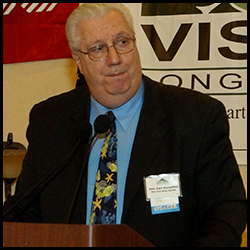 State Senator Carl Marcellino highlighed Nassau Comptroller George Maragos' study, especially the findings that Long Island is rapidly losing it's young populations. A lack of affordable housing is chasing them away, the senator said, and the good jobs that are here will go with them. Keeping the young professionals older generations spent "fortunes" educating requires investing in infrastructure like sewage and mass transit.
“Working together we’re going to make a change. We’re going to bring our young people back,” Marcellino said.
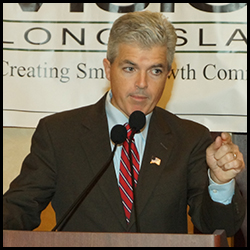 Suffolk County Executive Steve Bellone reminded the crowd that young people leaving Long Island are the "canary in the coal mine." Long Islanders cannot build an innovative economy where young people are leaving, he said, and that entails building places that young people want to live in with access to transportation. In order to get the private sector to invest, government has to lay the foundation with infrastructure. The Wyandanch redevelopment which is a part of the broader Connect LI plan is a public private partnership with Albanese.
Bellone also premiered a
video highlighting the next phase of Wyandanch redevelopment.
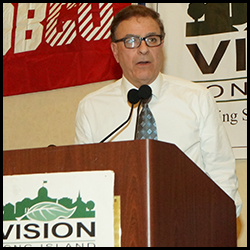 Don Monti of Renaissance Downtowns spoke briefly on potential action items for 2015. First of all, there needs to be bipartisan support; both sides aren't going to agree on everything, but should capitalize on the 25 percent that they do agree on. Second, there needs to be legislative reform in a sort of grading matrix that rewards municipalities for good development. Third, there should be Article 78 and SEQRA reform, a longer process doesn't equal a better process. California has legislation for a 90-day review process for Smart Growth projects, why can't New York do the same?
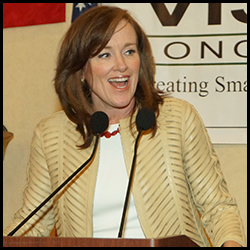
Funding for Complete Streets to aid with downtown redevelopment can help support these businesses and boost Long Island's economy. Recovery from Superstorm Sandy was another important focus for Rice. There are still many that are not back in their homes and infrastructure needs to be hardened to resist the next storm when, not if, it comes. She finished by letting the room know to call her - jokingly saying she still has the same cell phone number she's given to thousands of Nassau residents through the year - and is "here to serve you." She looked forward to working with the Long Island delegation to bring resources back to the island.
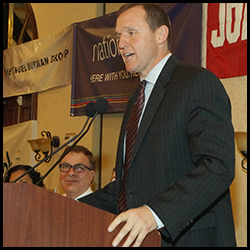 Towards the end of the lunch program, Ken Daly of National Grid spoke about National Grid's efforts to help small businesses affected by Sandy. They gave out more than 20,000 grants for boilers and rebuilding businesses. Daly announced Grid's plans to spend $700 million in the next three years to help convert neighborhoods from oil to natural gas, which he said will help save over $200 million on energy bills, reduce oil consumption by 2 million barrels and provide 1000 jobs.
Town of Islip Councilman Steve Flotteron gave a quick update about the new playground Town of Islip, Vision Long and Kaboom helped plan and build in the new park in Central Islip. They needed 100 volunteers in order to build the playground and more than 500 showed up!
Vision Director Eric Alexander closed lunch, highlighting that across the island municipalities are getting things done, there is increased community support for projects and we are starting to get our fair share of state and federal funding for infrastructure. He reminded the room that we are all citizen leaders getting things done and despite the challenges, the best gift we have is each other. Lastly, we are not here to simply build the development, but create great places that are embraced by the community of communities that is Long Island.
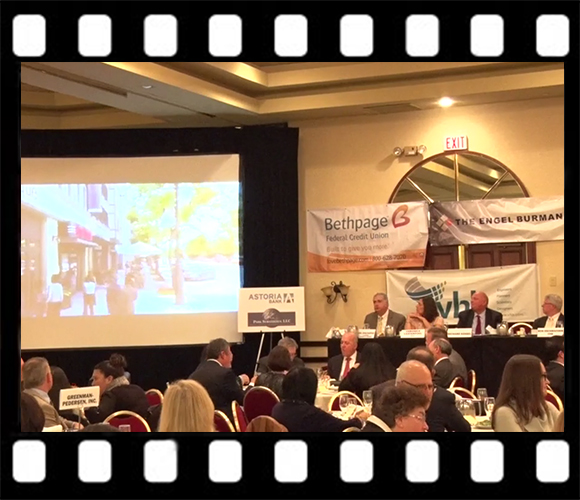 Check out the full video of this panel here.
Sandy Recovery
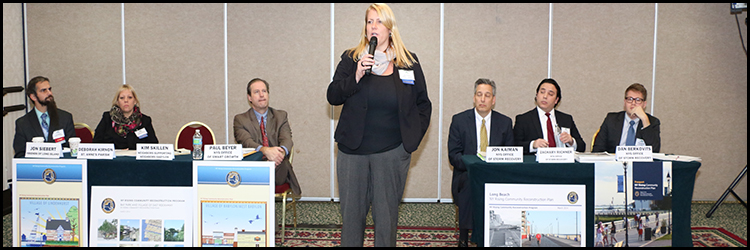
It’s been two years since Sandy devastated Long Island. Tens of thousands suffered damage to their houses and businesses, millions without power for extended periods of time, and thousands are still trying to recover in some aspect, ranging from housing repairs, replacement of property, economic and employment loss and health concerns. Sandy affected and continues to affect every Long Island resident and business owner. This panel discussed the effects post-Sandy, the ways that the areas have improved and what can be done to move forward as we continue the recovery process and look towards building back with smart growth principles in mind.
Jon Siebert, of Friends of Long Island, moderated the panel of Zachary Richner, from NYS Office of Storm Recovery; Paul Beyer, of NY Rising; Dan Berkovits, of NY Rising; Deborah Kirnon, from St. Anne’s Parish Outreach; and Kim Skillen, of Neighbors Supporting Neighbors Babylon.
To date, more than $750 million has been awarded to individual homeowners, $23 million to small businesses, as well as substantial sums to rental owners through the New York Rising program, which receives funding through CDBG-DR funding. Additionally, over $2 billion has already been allocated for infrastructure improvements including the Bay Park STP, improvements to the electrical grid, and work on 105 bridges. The substantial amount of funding being awarded is unprecedented and crucial, but also not the only aspect of recovery in our region.
The NY Rising Community Reconstruction Program, which has 22 reconstruction zones across Long Island is a community driven process that will fund communities between $3-25 million each to focus on reconstruction and resilience. This program allowed community stakeholders to decide which projects are important to the area, have a plan written by engineers, and receive funding. The funding at this point needs to be spent by 2019 and ensures that the projects do not sit in the planning stage indefinitely. Additionally, having the plan for the individual regions written and in the funding stages allows the areas to apply for additional grant opportunities. One of the highlights of the program is how communities had a voice as toward how they would like their communities to redevelop.
Through Governor Andrew Cuomo’s Community Risk and Resiliency Act, $250 million has been allotted to collaborative planning projects on Long Island, with $100 million of those projects currently moving forward. The approach is a participatory planning process which allows people to become resiliency leaders in their communities by forming citizen planning committees and supplying intimate knowledge of their community.
Representatives from NY Rising, a state agency formed to assist Sandy recovery and storm mitigation, are on the ground in Long Island to help these projects move forward. Projects underway using this funding include water quality projects, microgrids in Babylon, transit-oriented development in Island Park, projects that will protect shorelines such as north shore bulkheading projects in Long Beach and drainage projects throughout the South Shore.
Skillen said a collaborative effort is essential to proper resiliency planning. Her organization and many others like it, including St. Anne’s Parish Outreach, helped some of the larger national aid organizations and state agencies get help exactly where it needed to go. These grassroots organizations banded together to share resources and information after Sandy and have since led the charge in community disaster planning, many becoming designated as FEMA Community Organizations Active in Disaster.
Parking, Design & Codes
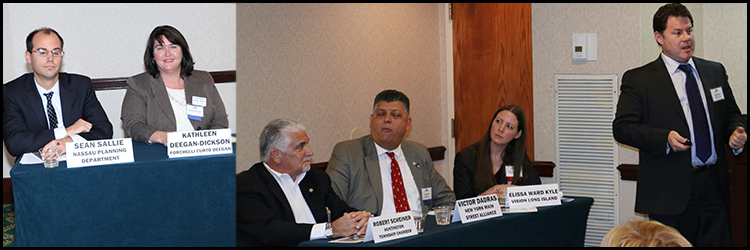
The Parking, Design & Codes panel brought diverse the diverse perspectives through Mark Gander, of AECOM/Green Parking Council; Robert Scheiner, president of the Huntington Township Chamber of Commerce; Victor Dadras, of the New York Main Street Alliance; Kathleen Deegan Dickson, of Forchelli Curto Deegan; Sean Sallie, of Nassau County Department of Public Works; and moderator Elissa Kyle, of Vision Long Island.
While a seemingly straightforward subject, parking codes and design are incredibly important for creating successful downtown spaces. Parking can contribute to climate change in a significant way, but the U.S. Green Building Council would not include parking lots in LEED certification. A new code has been created with a 12-step process for making “green” parking spaces that includes permeable pavement and creating lots under surface green spaces. More than 11,000 spots have been created under this new standard in the past three months, creating better parking.
Nassau County and the Town of Huntington have also been working very hard to address complicated parking. Representatives from Nassau County highlighted the role that town parking codes can play in limiting or facilitating parking. Codes often vary by location so it is important to understand what those are before any development occurs.
Dadras, an architect, pointed out that in many cases it is not that there is a parking problem but a management problem. He cited cases in Douglaston, Ossining, and Great Neck where once parking was managed better it increased downtown business and made it easier for pedestrians to navigate the town.
The Town of Huntington is currently beginning to implement management strategies including improving parking sites and considering the possibility of maintaining free valet parking on Friday and Saturday. Various strategies such as making parking more expensive near business districts, creating localized parking zones, preventing shop owners from parking in front of their business, and creating shared or structure parking are all ways to parking easier and less invasive in communities. The panelists emphasized the importance of this often overlooked issue and that managing parking well can really make or break a downtown district.
View highlights of this panel here.
Arts & Destinations
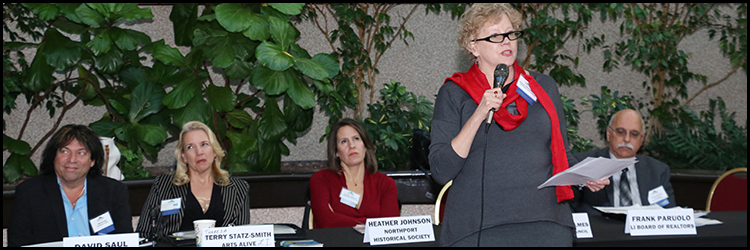
The Arts & Destinations panel touched on some of the many great places to eat, drink, shop, experience art and music and otherwise enjoy yourself on the island’s Main Streets. Theresa Statz-Smith from Long Island Arts Alliance, Diana Cherryholmes from the Huntington Arts Council, The Electric Dudes’ David Saul, LI Board of Realtor’s Frank Paruolo and moderator Heather Johnson from the Northport Historical Society also examined the role arts play in communities.
The arts and culture are integral to keep young people on Long Island, said Paruolo. The real estate expert said people want to live in vibrant downtowns like Huntington, Babylon and Rockville Centre. The Village of Westbury is an emerging downtown, with the median price to buy a home in Westbury at $356,000. The Village of Patchogue has been revitalized; the Greater Patchogue Chamber of Commerce’s Alive After Five event continues to attract crowds on downtown weeknights for live music and entertainment for 13 years.
When he's not performing with his rock band The Electric Dudes,
Saul handles public relations for the Village of Farmingdale. The Smart Growth push in the village helped fill 26 vacant stores, leaving just two empty on Main Street. The challenge, he said, is getting everyone on the same page. Saul performed during the Farmingdale Music Fest in September, after pushing for its creation. Despite rain that Saturday, the inaugural event was a success, attracting 10,000 visitors.
Long Island often gets underestimated, Statz-Smith
said, because it lies in the shadow of New York City. She said the region should be doing more to attract cultural tourists looking for a night out with dinner and entertainment. Her organization created a portal to find artsy activities at little-to-no-cost for the listing organizations.
Cherryholmes oversees the Huntington Arts Council, an organization promoting arts and culture created by Long Island artists. They teach children in schools and support community events. Every year they participate in the Huntington Summer Arts Festival, a week-long event in downtown Huntington with free concerts. They also oversee SPARKBOOM, a state-funded program that organizes musical gigs, art productions and even a Zombie Walk for the island's emerging creative talent. The council also distributes three grants every year. Art is essential these days, Cherryholmes said, as young professionals ages 18-35 hire artists.
Smart Growth Around the Region
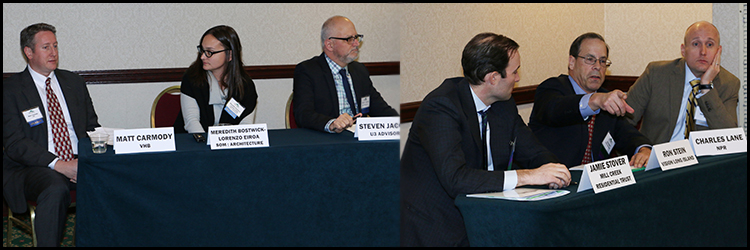
The Smart Growth around the Region panel was moderated by Charles Lane of NPR, who helped to guide the conversation concerning what sort of projects have been done in the area surrounding Long Island that we can take lessons from. The panel brought together Steven Jacobs of U3 Advisors, Meredith Bostwick-Lorenzo Eiroa from SOM:Architecture, and Matt Carmody of VHB, Jamie Stover of Mill Creek Financial and Vision Long Island founder Ron Stein from Good Harvest Financial.
Finally Jacobs, Bostwick-Lorenzo Eiroa and Carmody all spoke on their collaborative efforts on the progress of the Cornell NYC Tech campus currently slated to be built on Roosevelt Island. A product of a contest by the Bloomberg administration to grant land to a university looking to build a high-tech campus, Cornell has pursued an aggressive campaign to make the first phase net zero while also providing as little impact to the local residents as possible. The campus is located on the old site of the Goldwater Hospital and will provide an area for people seeking graduate degrees in technical fields.
The first phase involves creating a sense of place for the building and the community. As part of this process SOM : Architects went to great lengths to find painted over murals in the original hospital, scrape the paint off and restore them, and will place them on permanent display. There will also be a dedication to transit, ensuring that the island can accommodate extra traffic and people during university hours, with VHB conducting an in depth study to assure the residents will not be adversely affected.
All throughout the process U3 Advisors has worked closely with the university and local population to ensure that they can keep the new campus as low impact as possible, even agreeing to barge in materials in order to keep truck traffic to a minimal, even going so far as to building a pier to accommodate them. The new campus is slated to open in 2017 and has already been dubbed “Silicon Island” by "The New Yorker."
Stover spoke on Mill Creek’s recent acquisition and construction on a building located at 350 Warren Street in Jersey City. The building provides a sense of desirability thanks to its central location to three rail stations as well as being surrounded by a quickly growing retail and residential scene. When purchased the building did not have much of an aesthetic quality, however Mill Creek has been working to improve that. They have lengthened windows in order to bring in more light, sand blasted the original columns to reveal the original wood underneath, created long, railroad style apartments the provide a higher number of aesthetically functional units, and will provide public and retail space on the first floor. The company is confident that these improvements will go a long way in reactivating the street life surrounding the building.
Stein focused on the need to rebrand Long Island as a version of itself that appeals towards a younger demographic. He spoke about how Brooklyn has transformed itself from a perceived undesirable location in the 1970s into its current incarnation as a location that young, single professionals are flocking to. However, it doesn’t provide amenities for young families, and this presents an opportunity for Long Island. If we can rebrand ourselves and provide some of the more desirable amenities that Brooklyn can, we can attract those young families. It will, however, take a concerted effort on the part of our municipalities and can only be done if we can commit to lowering the high cost of living on Long Island while partnering with places like Brooklyn to create linkages.
View highlights of this panel here.
New Town Centers
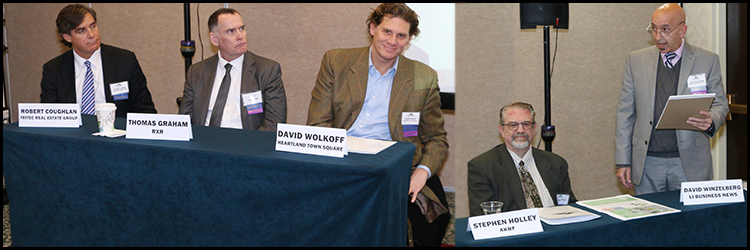
There has been a lot of progress on the area's mega-projects, as highlighted in the New Town Centers panel moderated by Long Island Business News' David Winzelberg. Much of the red tape surrounding public support and zoning changes has been removed and things are moving forward.
TRITEC's Robert Coughlin gave an update on the Ronkonkoma TOD project as an opportunity to keep a young, talented workforce and aging baby boomers with disposable income here. It will utitilize 55 acres of blighted property near road, rail, and air connections in an “18-hour community.” They want to focus on Long Island-based amenities, such as breweries, vineyards, and iconic restaurants. He hopes that the project will use Long Island's first approved form-based code.
Tom Graham from RXR provided details on the Garvies Point development on the Glen Cove Waterfront revitalization. Phase One received approval just last week and they hope to have phases two and three approved by the end of 2015. The project will bring in condos, apartments, a boardwalk, a revitalized marina, shops, restaurants and connections to transit.
David Wolkoff showed an updated video highlighting the latest plans for Heartland Town Square. Discussion revolved mainly around building smart and addressing the brain drain. If a shop is open but there isn't anyone around to spend money, he said, the owner is going to miss out on a lot of valuable revenue. He said they would do none of the building until 250,000 square feet of retail were leased. It has to be exciting and urban to attract the changing face of Long Island. Concerns have been raised about traffic mitigation and will be addressed as the project develops. Another lane might have to be added to the Sagtikos Parkway to accommodate visitors, though he hopes that the community is mostly self-sustained. Since there is no more horizontal space, there is no choice but to build vertically.
Stephen Holley, of AKRF, provided an update on Wyandanch Rising. Winzelberg noted that Wyandanch is still dangerous and that in order for projects to be successful, there has to be cooperation with the police and other local entities. Holley noted that part of the reason that they built the residential elements of the project first was to get eyes on the streets.
Winzelberg also posed a question about stalled projects that take a backseat to politics. Many elected officials are wary to move controversial projects forward in a short election cycle. A lively discussion ensued about involving the public so that it no longer feels like projects are being forced on people and that everyone is an active part of the process that will improve the entire community. He said that if we don't change the way we approve projects and make it more attractive, people are going to leave and the region will become a giant retirement community. The office park is a dying breed and New York City is becoming prohibitively expensive for businesses and residents. Long Island has great access to the city and its jobs. Even commuters who live here spend money here: they shop on nights and weekends, frequent the shops around the train stations, and eventually could own their own businesses here.
The recesssion, they said, re-focused a lot of attention on the need for affordable and multi-family housing. Communities with the most challenges are the ones who are most aggressively seeking ways to revitalize their downtowns. They want to bring people back into their communities by changing uses and getting money for infrastructure.
View highlights of this panel here.
LI REDI
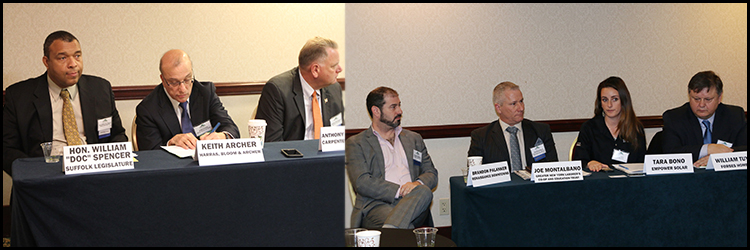
LI REDI stands for Responsible Economic Development Initiative. It’s a campaign to invest in critical infrastructure and gain public support with the goal of reversing the unsustainable living environment prompting many to leave. At the Summit, Brandon Palanker, of Renaissance Downtowns; Tara Bono, of Destination Long Island; Joe Montalbano, of the Greater New York Laborers Cooperative and Education Trust; Anthony Macagnone, of the Northeast Regional Council of Carpenters; Keith Archer, of Harras Bloom & Archer; Dr. William Spencer, Suffolk County Legislator; and moderator Bill Tuyn, of Forbes Homes, talked about the youth exodus and remedies.
The panel discussed the formation of Destination LI by a group of young professionals focused on the needs of the Millenial generation. They identified a need to change from "developer comes in and builds and community resists" towards 'engaging community first and seeking input and ideas, and working together to get a positive and mutual benefit for all stakeholders.' This can be done with crowdsourced place making, engaging stakeholders on social media, and using facts and data provided by other organizations and government to educate people who are unaware or misinformed.
On Long Island, the Smart Growth movement has expanded to involve community-level development with a major focus on infrastructure needs. Palanker and Archer attested to the importance of building important infrastructure to be able to handle responsible growth. Macagnone and Montalbano spoke about the support from the building trades in favor of infrastructure development as it puts Long Islanders to work with responsible ways to improve our communities.
Spencer touched on the need for infrastructure projects not only for economic development, but for public health. He referenced the success of Northport Harbor Water Quality Protection Committee, which worked together to identify problems with sewage and secure funding sources. 2014 marked the first in recent years the red tide was not present in the harbor.

Thank you to all of the attendees of the 2014 Smart Growth Summit!

This year featured our biggest trade show ever! Here are photos from this year's participants:

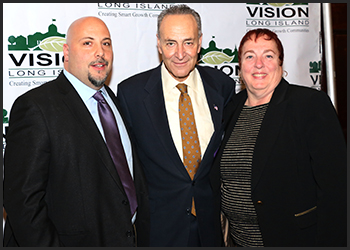
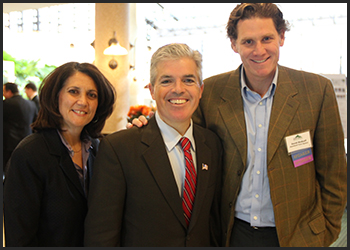

















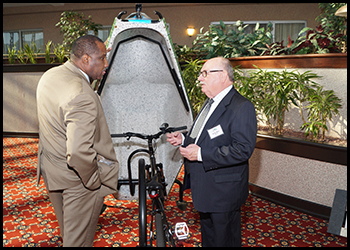
Check out some of the press coverage for the 13th annual Summit!
Check out some of the press coverage for the 13th annual Summit!
Newsday

Long Island Business News

Vision's Summit Message/LIBN OpEd
Long Islander News

Times of Huntington

Additional press coverage was provided by News 12, Herald Community Newspapers, WRHU Radio Hofstra University 88.7 FM and NPR.
Save The Date!
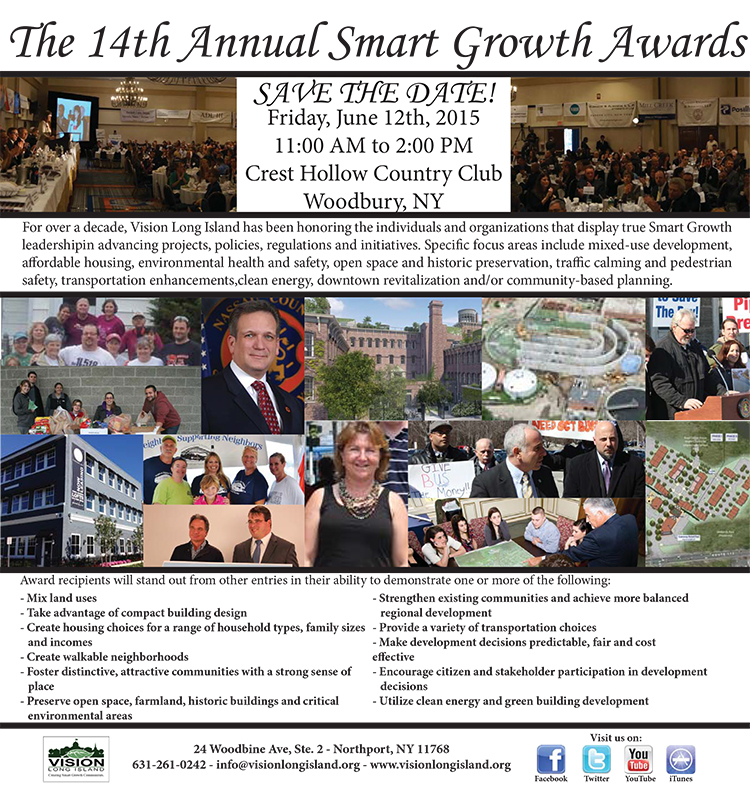

Vision Long Island advances more livable, economically sustainable, and environmentally responsible growth on Long Island through Smart Growth. Smart Growth focuses on infill, re-development, and open space preservation. It supports mixed-use, mixed-income communities that are convenient, attractive, pedestrian-friendly, and that make affordable housing and public transportation desirable and realistic.
Over the past 17 years Vision has counseled downtown Villages and Towns, and has been a resource for the County, State, and Federal governments, as well as the business and civic community on downtown revitalization, planning and infrastructure. Vision has made over 1,900 presentations, performed 20 community visionings and advanced nearly 100 public and private planning projects towards implementing the goals of Smart Growth on Long Island.
Vision Long Island
24 Woodbine Ave., Suite Two
Northport, NY 11768
Phone: 631-261-0242. Fax: 631-754-4452.
Email: info@visionlongisland.org
Website: www.visionlongisland.org
 Facebook | Facebook |  YouTube YouTube |
 |
 Twitter | Twitter |  iPhone app iPhone app |
Home | Contact Us | Newsletter Archive | Donate | About Us
