
Wishing everyone a Happy New Year and Thank You for your support and robust turnout for the LI Smart Growth Summit last month and support each year for our work in local communities and downtowns.
The 24th Annual Smart Growth Summit, held on December 5, 2025, at the Crest Hollow Country Club in Woodbury, brought together over 115 speakers, 19 work sessions, over 1,100 participants, dozens of updates from different Long Island Main Streets and a Youth Summit. Attendees and speakers included elected officials, small businesses, chambers of commerce, design and infrastructure professionals, community friendly developers, property owners/investors, community leaders, high school students, human service and labors leaders, local municipalities, environmentalists, and more. Happy also to see 100 elected officials from all levels of government join us to focus on strategies and policies to make Long Island more affordable.
The theme of the 2025 Smart Growth Summit was Making Long Island Communities More Affordable. We received over 50 recommendations in multiple policy, regulatory and project areas that will help stabilize costs while providing economic growth for Long Island’s local communities. We will be taking these recommendations to Albany and to our Federal officials in the coming weeks and months.
We had great press coverage from News 12 Long Island who filmed their “Power and Politics” show at the event, LI Business News, the Herald, LI Life and Politics and many local papers as well.
The summary blast with write ups, images, videos and media links is below.
This event would not be possible without you so again THANK YOU ALL and please save the date for upcoming events!
You can lock in your sponsorship and support for the Smart Growth movement for 2026 now:
- Vision Long Island’s Staff and Board
State of the Towns and Villages Plenary Session
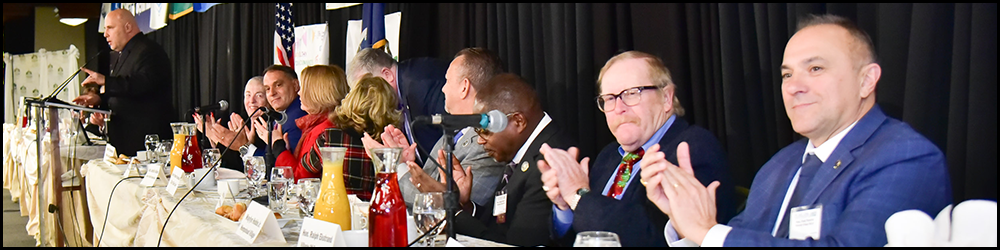
The Summit’s traditional State of the Towns and Villages Plenary Session brought to the dais elected officials from all across Long Island. The panel was moderated by Eric Alexander.
“Today, we are focusing on affordability,” Mr. Alexander emphasized. “It is on everyone's mind. People cannot pay their bills, particularly the working class. What are we talking about? We are talking about housing, energy, helping small businesses, streamlining regulations, efficient services, reducing regulations, getting our fair share of dollars from Albany and Washington, and what we can do in our communities to support our local business.”
Mr. Alexander took a moment to thank the sponsors of the event, “Without them, this event cannot happen,” he explained. He thanked the Platinum Sponsors, National Grid and TRC; Gold Sponsors, Amazon, PSGLI, M&T Bank, B2K Development, RXR, and AT&T; Silver Sponsors, Terwilliger & Bartone, Breslin Realty Development Corp, Concern, VHB, Altice, IMEG, H2M Architects + Engineers, Heartland Business Center, Gotham, The Shops on Broadway, Beechwood Homes, Mill Creek Residential, Southwest, Third Street Associates, NYS NY Power Authority, New York Transco, and Veolia. Mr. Alexander also thanked the many Bronze Sponsors who are invaluable to this event year after year.
On the dais were Hon. Paul Pereira, Mineola Village Mayor; Hon. Ralph Ekstrand, Farmingdale Village Mayor; Hon. Waylyn Hobbs Jr., Hempstead Village Mayor; Hon. Ed Fare Valley Stream Village Mayor; Hon. Pamela Panzenbeck, Glen Cove City Mayor; Hon. Jennifer DeSena North Hempstead Town Supervisor; Hon. Joseph Saladino, Oyster Bay Town Supervisor; Hon. Richard Schaffer, Babylon Town Supervisor; Angie Carpenter, Islip Town Supervisor; Hon. Dan Panico, Brookhaven Town Supervisor; Hon. Ed Smyth, Huntington Town Supervisor; Hon. Michael Lavorata, Lindenhurst Village Mayor; and Trudy Fitzsimmons, Chairwoman, Vision Long Island.
Mr. Alexander opened the discussion by stating, “On Long Island, local municipalities have approved 19,000 units of transit oriented development in the last 18 years. It has been happening, maybe not as fast as people want, but it is happening.” He also praised the NYS Governor Kathy Hochul and her Long Island team for moving past mandates and providing an effective incentive program to help advance housing in local communities.
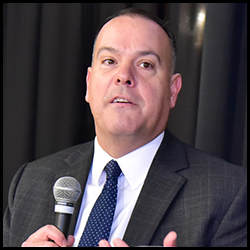
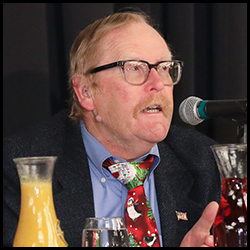
Babylon Town Supervisor Richard Schaffer – “Our three villages work collectively to figure out how to do the best transit oriented development in our town. We have a great track record in revitalizing the hamlet of Copiague, where we put 91 affordable housing units right at the train station. In Lindenhurst, we put 260 units directly across from the train station. Just north of Republic Airport on Conklin Street and 110, we are about to announce a mix of affordable and market rate rentals on about 17 acres. There is also the possibility of reopening the shuttered Republic Train Station.” The Supervisor also praised the Governors office for incentives on housing that now embrace local home rule.
Mineola Village Mayor Paul Pereira – “In the last 12 years we have built about 1200 units and we have about 1000 units in the pipeline, most of this is transit oriented development. When you talk about affordability, in full disclosure, most of our development would not qualify, although they do have the 10% or 12% set aside. What we have begun to do is to approve different scales, different size projects with less amenities, therefore it will be much more affordable. Affordability can go both ways. It could be affordability for the people who are renting these apartments, but it could also be affording our residents stable taxes and making capital improvements to our pool, parks, bandshell and adding a wide array of programs throughout the year as part of the PILOT negotiations.”
Brookhaven Town Supervisor Dan Panico – “I think it is pretty simple actually, you just listen to the people who elected you. Geographically, Brookhaven is bigger than Nassau County. There are areas that are clamoring for redevelopment and that is the name of the game. You incorporate housing to achieve redevelopment, vitality and vibrancy in downtowns. What may be right in Shirley may not be right in Setauket. You do not push and you try to work with developers who do not try to put 10 pounds of potatoes in a 5 pound bag. We have a ton of redevelopment going on in communities that welcome it.” The Supervisor also raised the need for cooperation on the pending crisis on solid waste and the need problems with NYS Cannabis regulations.
Farmingdale Village Mayor Ralph Ekstrand - “Last year we opened what I believe is the first 100% affordable housing development in Nassau County. We have 70 units and every single one of the units is 100% affordable. It has been great for the community and great for our downtown. Over the years, we have built just over 500 units, of which we now have a total of 94 affordable units. We are on track for transit oriented development. Regarding PILOTS, they really help downtowns.” The Mayor also spoke about funding needs for water infrastructure due to the high cost of regulations.
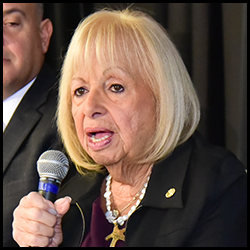
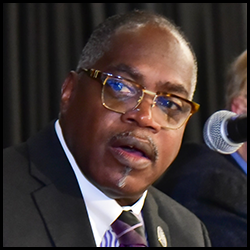
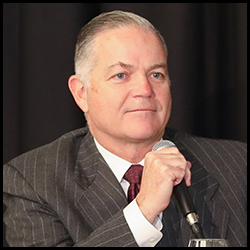
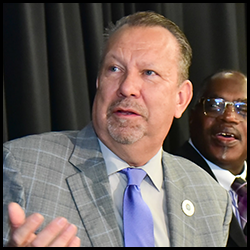
Islip Town Supervisor Angie Carpenter – “We have been involved in affordable housing for decades. One of the first major affordable housing projects happened in CI and is still thriving, College Woods. Development continues in downtown Bayshore with the TRITEC development. In CI, at the north end of Carlton Avenue, from Suffolk Avenue to Smith, we have a project going on which is 100% affordable, nearly 100 units. It is mixed-use, with some retail below, and some art space. A local arts organization will be operating it. All along that corridor a lot is happening, as it is in downtown Bayshore. Housing is an issue we are addressing and have been for a long time.”
Hempstead Village Mayor Waylyn Hobbs Jr. – “We have a lot going on in the Village of Hempstead. We just completed a 300 unit project right next to the train station. We have another 260 unit project that is almost completed in our downtown, and another developer is just finalizing his approval for another 300 unit project in the Village. Regarding housing, I think it is important to have community engagement. Letting your community know what is going on. The word PILOT has always been a bad word, but it is important to inform your community about PILOTS, then have the ability to negotiate with developers to put some community benefit programs in their pilot deal.”
Huntington Town Supervisor Ed Smyth – “Starting with Melville, it has been a two or three-year project. It was not terribly complicated, even though it took a while to get these things moving. The town set out an ambitious plan to created a vibrant, walkable downtown. There is a lot of affordable housing available in the town of Huntington, but the flip side is you have to bring up salaries. Affordability is not some fixed number. It is relative to income. We have a very strong open door policy for businesses and attracting business to Huntington. We have a lot of affordable housing coming online. We also we have a program for our volunteer first responders in the Town of Huntington, they get priority for affordable housing.”
Valley Stream Village Mayor Ed Fare – “One of the interesting things when you talk about affordability is the is the cycle of life. One of our goals in the Village of Valley Stream is keeping our seniors here. You need programs, you need things to keep them active and involved in the community, you need reasons for them to stay, but you also need affordability. The senior housing that we have now has an over four year waiting list and that is unacceptable. We want our seniors to stay. We want people to enjoy their children and their grandchildren and the Village. Regarding affordable housing, we are working on adding another 100 units, give or take, to our current senior housing.”
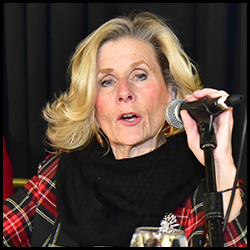
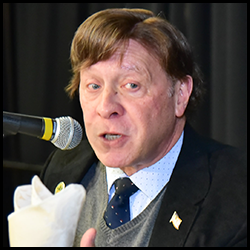
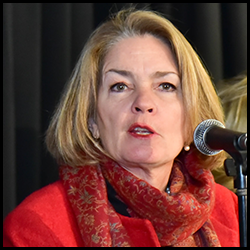
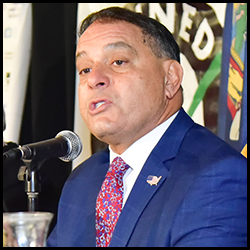
Glen Cove City Mayor Pamela Panzenbeck – “We have built a lot of housing in Glen Cove. We have developed the Garvies Point area, which is not in the downtown, but it is walkable to the downtown. The project was stalled for a number of years but two buildings are going up now by the traffic circle. We have 55 units of all affordable housing, walkable down to our water. We have a very long stalled project called the Villas on Glen Cove Avenue. We are hoping this will be the year it moves forward. We have 36 apartments going up directly across from our Senior Center. We are now looking at a transit oriented development at our Glen Street station. We are currently discussing the zoning change. So we have so much going on.”
Lindenhurst Village Mayor Michael Lavorata – “There is always pushback from community when something innovative comes along, especially from a bunch of elected officials. They sometimes do not quite understand it. I think several of my colleagues have said that we have to educate our residents as to what we are doing. We did this with the TRITEC project. Government on all levels can work together. Since I have been mayor, my goal has been to keep people here. I also understand that in order to make things affordable, you need to keep the taxes low. If I could at least do my part as a village mayor and keep the village taxes reasonable, that is one less thing that they have to worry about. We have done a lot of senior housing in our area and transit oriented development. We just are looking to continue doing what we have been doing in the downtown.” The Mayor also spoke of the design improvements that were made for pedestrian safety in his Village”
North Hempstead Town Supervisor Jennifer DeSena - “We want to let everyone know that the Town of North Hempstead is open for business. We need your proposals and the most important thing is that we need our building department to be open to you. So we have made some wonderful changes. Our staff is being trained as we speak on Open Gov, which has been very successful in other towns on Long Island. We have broken down the wall. Builders can come in and meet our building commissioner before they even start a project. On the subject of affordability, taxes are very important. We have cut taxes by managing our costs, by finding efficiencies, and by increasing our revenue. We have 31 mayors in the Town of North Hempstead and we work together very well. We know that each village is different.”
Oyster Bay Town Supervisor Joseph Saladino – “We are very proud of what has been going on in the Town of Oyster Bay. Hicksville is a perfect example. In Hicksville, we won the DRI, the downtown Revitalization Initiative, and we are building out a fantastic new community. Hicksville is the most diversified community in all of Long Island and we are very proud of that. Hicksville Railroad Station is the busiest railroad station on Long Island and we understand that. We are building over 500 units in six major projects, and there are also many smaller projects being built for mixed-use housing, walkability, and safe roads. We are becoming one of the templates for the state and we are very proud of this. We support the developers and we are building in our town.”
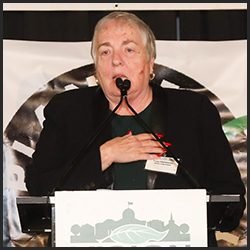
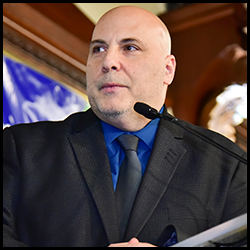

Student Question – A well informed senior from Amityville Memorial High School asked the elected officials, “I am graduating in June 2026, I would like to ask, with the rising energy prices, the constant building of new infrastructure, and college debt, is there a possible five year plan as to how we would be able to afford housing in the future?”
Babylon Town Supervisor Rich Schaffer stated the expansion of the programs that are available from both New York State and the federal government which allow incentives to be used by the developers to lower the costs is one way to make housing more affordable.
Islip Town Supervisor Angie Carpenter noted the town has a 10% affordability requirement on any project, however, if they bump it up, the town will increase the allowable density. The idea of utilizing state property for housing and the concept of portable mortgages are two ideas worth pursuing she added.
Glen Cove City Mayor Pamela Panzenbeck discussed the idea of ownership units to help alleviate high rents.
Oyster Bay Town Supervisor Joseph Saladino stated Jack Kulka came up with a great idea, private investment. If you have employees that you want to hang on to, you give them an incentive. You help them pay a portion of the down payment and then every year they are with the company, after a certain point, you forgive part of that payment. It gives an incentive for people to stay with a company instead of jumping from company to company.
You can view the complete State of the Towns and Villages Plenary session here.
Affordability: Addressing Human Needs
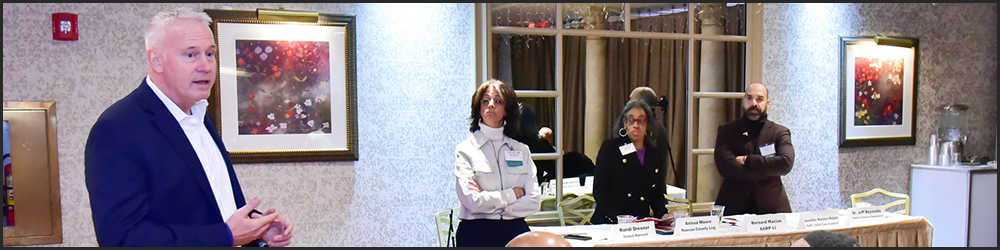
Participating in the Addressing Human Needs panel were Randi Dresner, Island Harvest; Anissa Moore, Nassau County Deputy Executive; Bernard Macias, AARP-LI; and Dr. Jeff Reynolds, Family & Children's Association, Moderator.
Each speaker discussed the importance of the services their programs provide to the residents of Long Island. The bright connecting theme during this workshop was the need for advocacy, engagement, and support in communities. The discussion was framed by moderator Dr. Jeff Reynolds, President and Chief Executive Officer of Family and Children's Association. “I think it is important what we do here today is ensure the organizers understand the importance of lifting up the health and human services conversation so we are not relegated to a plenary report of just a few people.”
Anissa Moore, Nassau County Deputy Executive, began by not only listing available programs offered by Nassau County government, but also confronted the challenges government often encounters when dealing with the issues of affordability and health and human services. “Affordability is who actually has access to the information regarding resources, education, seminars and services,” Ms. Moore explained. “The government plays a particular role, and that role historically has created silos, which means we are not always coming together to create reasonable solutions. The way I envision health and human services is that we have to see everything together. It has to be comprehensive. We have to have partners to reach wholeness.”
“When you talk about affordability with health and human services,” Dr. Reynolds stated, “You are also talking about the fact that social workers who are really good have to work at Amazon for the holiday season because they can make more money. When you talk about affordability, that is something you have to address. There needs to be an increase in funding for not-for-profits.”
Bernard Macias, Associate State Director of AARP-LI, discussed several areas AARP focuses on, including accessible and affordable healthcare, pharmaceutical, energy, and housing needs for our growing aging population. “We have been doing state and federal advocacy for a number of years,” he explained, “But this year in particular we are dipping our toes a little bit more into local activity, working with local legislators.” He discussed the need for complete streets, tax credits for family caregivers, and how small businesses employers can make sure employees are prepared for retirement.
“Island Harvest has lost $4 million dollars in federal funding in the past six months,” President and CEO of Island Harvest, Randi Dresner, stated. “$4 million dollars is a lot of money. $4 million dollars buys a lot of food and feeds a lot of people, fills a lot of bellies, and changes a lot of lives. We have learned through lots of crises that we are the sector that has to pivot all the time to figure out how to do more with less. We felt the effects of the federal shutdown and the loss of SNAP. We lost federal funding when more people were coming to Island Harvest for services. What was happening at the same time, our staff has begun to be harassed by people in the community. The general population has started to believe the language that is being put out about people and human services.” This is something that must be addressed, Ms. Dresner explained, and it starts with local and federal leadership at the top.
Discussing the issue of anger in our communities, Dr. Reynolds added, “We have to address this issue in a more holistic way. We need to work together to frame our priorities and foster bigger conversation with bigger audiences than we have in this room.”
You can view the complete Affordability: Addressing Human Needs session here.
Affordability: Creating Affordable Housing
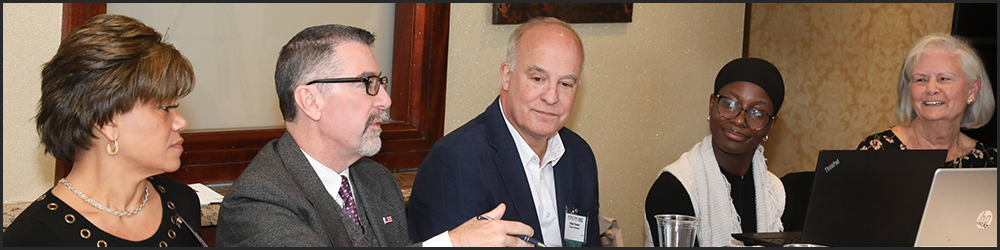
Participating in the Creating Affordable Housing panel were Ralph Fasano, Concern Housing;
Jael Ferguson, Georgica Green Ventures; Leah Jefferson, Suffolk County Affordable Housing and Community Development; Kevin Crean, Town of Islip CDA; and Sharon Mulon, Ll Housing Partnership, Moderator.
“We all know developing housing on Long Island is not easy,” Ralph Fasano, Executive Director of Concern for Independent Living, began. “There is a lot of opposition to what we do. If everything goes well, the state does not need to get involved, but everything does not always go well. I am neither opposed to nor not supportive of local communities losing the ability to do it, but there needs to be more work around communities that refuse to do affordable housing.” He also discussed the growth of faith-based housing and a recent initiative in New York State to help religious organizations use their land and buildings to create supportive and affordable housing and to ease some of the zoning regulations here. Examples included St. James Church in the Bronx and Sisters of Saint Joseph’s in Brentwood.
Jael Ferguson, Georgica Green Ventures Assistant Project Manager, discussed the company’s existing affordable housing projects, which includes modular construction, such as in East Hampton and East Patchogue.
Examining funding opportunities, Kevin Crean, Town of Islip Director of Affordable Housing and Project Development, discussed federal funding sources which are available to municipalities in New York State for affordable housing. These include HUD entitlements, which refers to federal funds from programs such as the Community Development Block Grant (CDBG) and HOME Investment Partnerships Program, both providing flexible funds to states and localities for housing and community development. At this moment, the future funding for these programs is in question. They are presently operating on a temporary continuing resolution that will expire on January 31st. He noted that CDBG money cannot be used for actual housing construction, except in very limited circumstances, but it can be used for related purposes, such as the acquisition of property, which then can be used for affordable housing.
Two issues identified by Mr. Crean which would help the success of using HOME funds include enacting amendments which would help communities meet spending targets of the program, which has been difficult.
Mr. Crean also explained New York State has developed what is called “Pro-Housing Communities” certification. This designation helps the state target its discretionary funding to communities who are acting to address local affordable housing problems. “Localities must achieve the Pro Housing Designation certification to apply for discretionary funding programs, including the Downtown Revitalization Initiative, New York Forward, and NY Main Street Program.”
Leah Jefferson, Director of Affordable Housing and Community Development for Suffolk County, briefly discussed ADUs (Accessory Dwelling Units), as one tool to meet affordable housing challenges. Many homeowners need to update their sewers, which can come with a costly expenditure. The county is developing a funding program to help residents upgrade their sewer systems.
Ms. Jefferson outlined many programs Suffolk County is engaged in to promote affordable housing, including the Affordable and Workforce Housing Infrastructure Program, New York State General Municipal Law §72-h Transfer Program, and the Suffolk County Land Bank.
On a positive note, Ms. Jefferson expressed optimism when it comes to the growth of affordable housing in Suffolk County. “I really am excited to talk about it because I'm seeing a lot of progress being done and a lot of units being completed. I think the stigma of affordable has kind of diminished a little bit within our communities.”
You can view the complete Affordability: Creating Affordable Housing session here.
Fixing Long Island's Dangerous Roadways
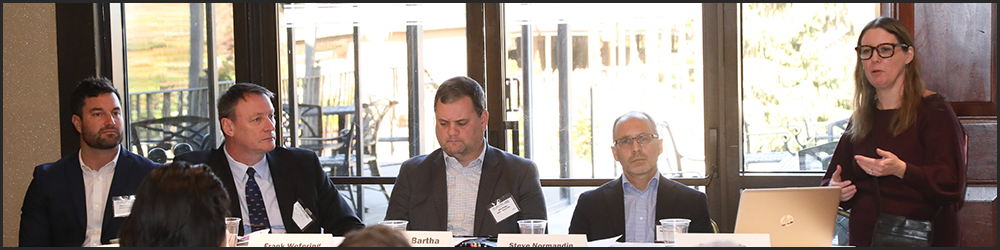
Participating in the Fixing LI's Dangerous Roadways panel were Stephen Normandin, NV5; Mike Lieberman, Trust for Public Land; Alex Prego, Suffolk County Department of Public Works; Frank Wefering, GPI Engineering; and Elissa Kyle, Vision Long Island, Moderator.
“Today we are going to look at our roads and focus on positive solutions to make them safer to serve our local communities,” Elissa Kyle, Placemaking Director at Vision Long Island, began.
Stephen Normandin, Managing Director at NV5, discussed the federal government’s Safe Streets and Roads For All Program. “It is a wonderful program in which municipalities can apply and receive federal funding to create a comprehensive safety action plan, basically a master plan for a municipalities, villages, towns, and counties,” he explained. “Several communities on Long Island have done this, but not a lot of them. All municipalities should participate. The program is a holistic and new approach.” The approach includes safer people, vehicles, speeds, roads, and post-crash care.
Alex Prego, Chief Engineer at Suffolk County Department of Public Works, spoke about Suffolk County’s Strategic Safety Action Plan, which he noted is similar to the Safe Streets and Roads For All Program. “What the county is looking at are two different parts. We are looking at previous accidents, as one of the best predictions of the future is what has happened in the past four or five years. We are also looking at risk, basically looking at the highway elements and doing a risk based assessment. From this information, the county is generating projects to address identified specific issues."
Roadway safety and fixing dangerous roads go hand and hand with revitalizing downtowns and providing economic growth to communities, Frank Wefering, Director of Sustainability at GPI Engineering, explained. Regarding affordability, Mr. Wefering stated, “A lot of people cannot afford a car on Long Island. Actually, I think 1/12 of Long Islanders do not have access to a vehicle, so they rely on cycling, walking, or transit. These have to be made easier and safer. This is often related to infrastructure. Road safety is not only an affordability issue, but it is also an equity issue. The share of people from low income communities that get hurt, or even killed, by crashes is much greater than in higher economic communities.” Regarding cycling, Mr. Wefering noted in order to cycle safely, you must have a network of bicycle lanes.
Mike Lieberman, New York State Trails Director at Trust for Public Land, explained the Trust connects people to nature. “Today, we are talking about affordability. What is affordability exactly, it is quality of life. Long Island was not exactly designed around people. The network on Long Island was designed around cars. So how do we design a little bit smarter? How do we put people where they work? How do we give them alternative modes of transportation so homes do not need to have two cars, three cars? This needs to be the conversation. The Trust is working with municipalities to figure out how we can do this through the Long Island Greenway. We see ourselves as part of that solution." Mr. Lieberman added, the Greenway is intended to be a multimodal path.
You can view the complete Fixing Long Island's Dangerous Roadways session here.
Clean Energy Resources
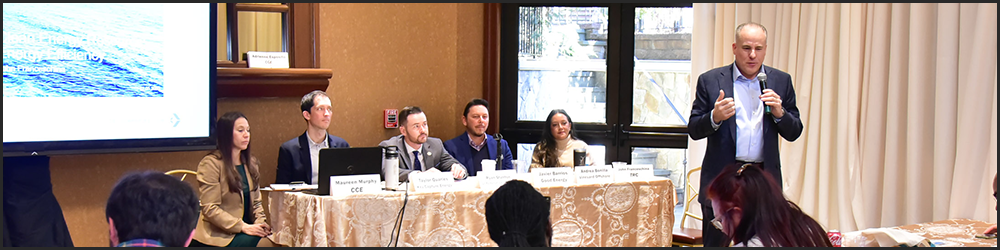
Participating in the Clean Energy Resources panel were John Franceschina, TRC Companies; Andrea Bonilla, Vineyard Offshore; Taylor Quarles, Key Capture Energy; Ryan Stanton, LI Federation of Labor; Javier Barrios, Good Energy; and Maureen Murphy, Citizens Campaign For the Environment, Moderator.
Maureen Murphy, Executive Programs Manager at Citizens Campaign for the Environment, started the panel by framing the discussion in terms of what is happening on Long Island in the field of renewable energy, including offshore wind and solar, along with the need to examine the transmission system to support these renewable energy sources.
Taylor Quarles, Executive Vice President of Development at Key Capture Energy, stated the company focuses on standalone battery energy storage systems. As more intermittent renewable energy continues to come online, it is critical the electric grid keep pace. One aspect Mr. Quarles touched upon was energy storage safety. “New York was a leader in this subject matter,” he stated. It is now one of the safest technologies out there, he added. “Since 2018, the rate of incidents have plummeted significantly. That was largely driven by new business standards that have come out since that time frame. Towns should feel comfortable that the state has developed an extremely rigorous system that not only has significant codes and standards, but also requires third party verification.”
Managing Partner of Good Energy, Javier Barrios, spoke about distribution and global resources and how distribution projects in New York State can help augment and improve private public partnerships.
Speaking about solar, Mr. Barrios explained what is difficult about a solar distribution project on Long Island is that it is limited to 5 megawatts. The New York State Energy Research and Development Authority (NYSERTA) incentivizes developers and investors to develop projects wherein they get certain adders. “There is potentially a slowdown in solar since a lot of the tax incentives have been taken away, but if it is paired with different technologies, it can be quite strong on Long Island.”
Good Energy works to bring distribution projects and energy efficiency solutions to municipal governments, such as the Town of Brookhaven. Mr. Barrios noted, “I think about on the topic of affordability, community solar is one of those things that addresses local affordability because it is giving discounts to local residents.”
Andrea Bonilla. Director of External Affairs, East Coast, at Vineyard Offshore, discussed the reasons why additional energy is needed. “We need to upgrade our transmission and we need more energy as a region in general,” Ms. Bonilla explained. Why do we need different types of clean energy, such as wind? “Because we are just using more energy. If you started 50 years ago with your suburban house on Long Island with one refrigerator, one TV and two lamps, now you have 10 times more consumption.” We need to plan for both present and future consumption needs.
John Franceschina, Senior Director at TRC Companies, discussed the role of energy efficiency on Long Island. TRC manages the energy efficiency programs for PSEG. Mr. Franceschina discussed weatherization and heat pumps. “Weatherization has to do with not only just health and safety, but also air sealing, insulation, and duct sealing,” he explained. “We have some great rebates coming up, starting in January, through PSEG,” he advised. Discussing Air Source Heat Pumps, Mr. Franceschina explained they are energy-efficient systems that provide both heating and cooling by transferring heat between indoor and outdoor air, like a reverse air conditioner. The pros and cons of several other heat pumps were also examined.
“I represent the union workforce on Long Island and our mission and our responsibility is not just to the members of local unions, but to every working person in the region,” Ryan Stanton, Executive Director of the Long Island Federation of Labor, began. “Historically, it was thought that the labor movement and the environmental movement do not agree. On Long Island, that could not be further from the truth. We have worked collaboratively. We made a pivot in this region in particular to support energy, infrastructure and environmental policies which are going to make a cleaner environment which we know is a good return on investment, while creating good union jobs on these energy infrastructure investments.”
Discussing why union jobs matter, Mr. Stanton explained it is not just because union jobs bring good wages and good benefits, but because local union members live in our communities so when union jobs are created, we know that person is paying taxes. “Collectively, we all benefit,” he noted. “We will continue to champion things like offshore wind and battery energy storage.”
“The union movement’s belief and philosophy is we do not have to choose between technologies, which will deliver affordable, reliable energy for the future and hopefully create some good new jobs,” he concluded.
Ms. Murphy took a moment to recap the theme that ran through the workshop – saving money. Energy storage saves money, community solar saves money, and energy efficiency programs save money.

You can view the complete Clean Energy Resources session here.
Long Island Youth Summit: Job Opportunities
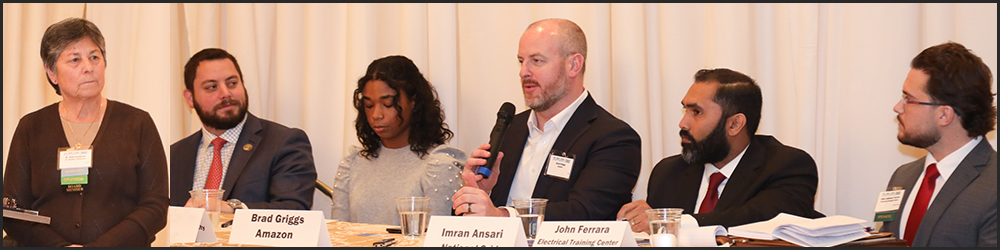
Participating in the Long Island Youth Summit panel, focusing on job opportunities, were Grant Newburger, LI Federation of Labor; John Ferrara, Electrical & HVAC Training Center; Sydney LeGuillow, Haugland Group; Brad Griggs, Amazon; Imran Ansari, National Grid; and Dr. Gail Lamberta, St. Joseph's University. Moderator.
When it comes to affordability, Long Island needs to have high paying jobs to enable people to stay here, Dr. Gail Lamberta, Associate Dean of Community Development at St. Joseph's University opened. “What we are going to talk about today are some of the pathways available to achieve these jobs.” Some pathways include getting a college degree, others do not. “There are other positions that require different skill sets,” Dr. Lamberta stated. She highlighted the fact that not everyone goes to college, and if you choose to, not everyone goes right out of high school. “You are going to make some changes and that is ok.”
Grant Newburger, Political Director. Long Island Federation of Labor, agreed and noted there are many jobs on the other side of the college spectrum, including plumbers, electricians, nurses and everything in between. “My job is to make sure that people have real pathways to a job here on Long Island and that the industries driving our economy here provide opportunities for the communities that we actually live in.”
“I get the pleasure of meeting with the communities, connecting with community based organizations, meeting with elected officials so that they know there are opportunities and careers for all their constituents,” Sydney LeGuillow, Government and Community Affairs Coordinator, Haugland Group, told the audience of mostly high school age students. It is important to make sure that we are investing locally in the workforce, in the communities, so that when we leave, we are leaving it better than we found it. “This includes building roads, highways, bridges and a large scale energy infrastructure so that everybody can get to their jobs every day and that our economy can thrive. uplifting the community,” Ms. LeGuillow said.
Brad Griggs, Director, Economic Development at Amazon, advised the students that Amazon has expanded on Long Island to over 2,000 employees. The breadth and depth of Amazon’s workforce is remarkable, Mr. Griggs stated, “Approximately 50% of those employees coming to work at Amazon are coming from unemployment or even distressed employment situations.”
Imran Ansari, Lead Representative, National Grid, told the students there are a lot of ways to end up at a company like National Grid, including internships and career development grants. ”There are a lot of ways to work for a utility,” Mr. Ansari advised. “You need folks out in the field, engineers, lawyers, people in finance, designers, and more.”
John Ferrara, with Electrical & HVAC Training Center, recounted to the students how he went from a pre-med program to becoming fourth generation Local 3. “I moved toward being diversified, working as an electrician, going to school during the afternoon, and working in finance at night. I now oversee all the finances of an elite trade school.” Having diverse training helped make this happen.
The panelists described substantial areas of employment opportunities on Long Island, including healthcare, utilities, and energy. On the issue of affordability, the panelists discussed the need for available affordable housing, good wages and benefits, and work development and diversity.
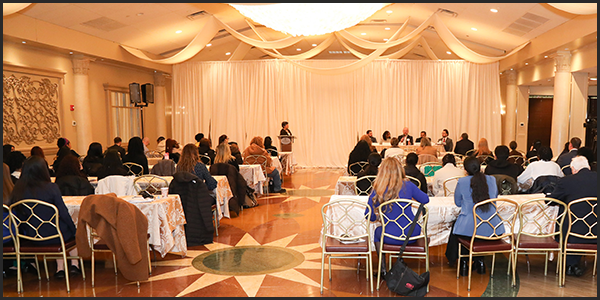
You can view the complete Long Island Youth Summit: Job Opportunities session here.
IDA's & Economic Opportunity

Participating in the IDA's & Economic Opportunity panel were Kelly Murphy, Suffolk County IDA; William Rockensies, Nassau County IDA; Lisa Mulligan, Town of Brookhaven IDA; and Sean Cronin, Cronin & Cronin, Moderator.
At the start of the panel, each panelist described their respective Industrial Development Agency’s (IDA) reach, noting that there are towns within their counties which have their own IDA’s. The speakers stated they all work very closely together.
Regarding advice to developers and businesses, the panel agreed the first thing they encourage everyone to do is to reach out. “We encourage everyone to pick up the phone and just give us a call. You know, it's really the easiest way. We do not want to waste your time and money. We want to make sure that you are eligible,” Kelly Murphy, Executive Director/CEO of the Suffolk IDA, advised the audience.
Lisa Mulligan, CEO of the Town of Brookhaven Industrial Development Agency, stressed the need for a conversation at the onset. “You cannot assume your project is not a good fit until we have a conversation,” Ms. Mulligan noted. “If it is, then you start the application process.”
William Rockensies, Chairman of the Nassau County Industrial Development Agency, added there has to be a financial justification for the IDA to be part of the project. “It does not always have to be a 500 unit building. It does not have to be big. It could be a small project,” he added. "It has to be creating jobs, and if it is housing, there has to be an affordable component to it."
Ms. Mulligan stated, “We are seeing a lot of housing projects coming in, along with our usual manufacturing/distribution/energy projects.” With regard to housing, she noted, “If we are incentivizing businesses to come to this region, there needs to be safe, affordable places for their employees to live. So we need all different types of housing. We need all options for people. I think that is where the IDAs come in as far as housing is concerned.”
All panelists agreed that investment in blighted areas, on blighted properties through adaptive reuse, brings new tax dollars and acts as a catalyst for investment in surrounding properties and businesses.
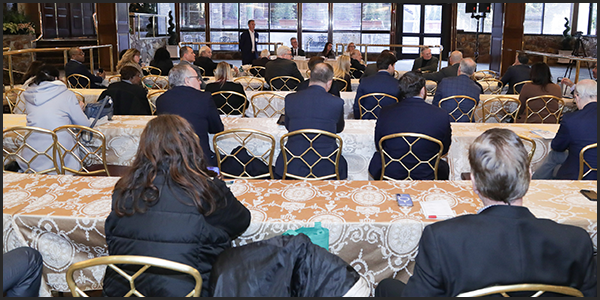
You can view the complete IDA's & Economic Opportunity session here.
Small Business Resources

Participating in the Small Business Resources panel were Misolino Silva, Vision Long Island/Ll Main Street Alliance; Harry Malhotra, NY South Asian Chamber; Luis Vasquez, Ll Hispanic Chamber of Commerce; Lionel Chitty, Nassau County Office of Minority Affairs; Bob Fonti, Suffolk County Alliance of Chambers; Joe Garcia, Nassau Council of Chambers; and James Madore, Newsday. Moderator.
Mr. Madore, Senior Economics and Business reporter at Newsday, began the panel by framing the importance of small businesses on Long Island. “There are 300,000 businesses on Long Island,” he informed. “Ninety percent of them have 20 or fewer employees.” He added, “As my beloved father would say, it takes courage to start a business, build a business, and run a business. So I salute all of you today for the courage you have in starting and running a successful business.” Referring to the individual panelists, he advised that each have amazing resources available to help make small businesses successful.
With small businesses facing a number of affordability issues, from inflation to employee costs, each panelist discussed how their organization can help businesses deal with these issues through various resources or programs.
Misolino Silva, Small Business Outreach Director, Vision Long Island, explained, “We want to see businesses stay. We want to see businesses grow. When I go knocking on doors on a daily basis, people say to me, I cannot afford to be here. I need more resources. I need more cash flow. I need to keep my employees. We let businesses know about grants, such as those available from National Grid and PSEG, and loans available through various financial institutions. We ask if they belong to the local chamber. We advise them not to be afraid to be a part of the community and to get to know their elected officials. If they do not know what problems exist, they are not going to be able to help resolve them.”
Summing up the perils of owning a small business, Harry Malhotra, Founder and President of NY South Asian Chamber of Commerce, told the participants, “There is no plan B for businesses, you either fall forward or you are out.” He outlined what the South Asian Chamber of Commerce does to help small businesses. This includes holding informative meetings and networking events with government officials, chambers, and businesses, exploring the resources which will help them succeed.
Bob Fonti, Chairman of Suffolk County Alliance of Chambers, told those in attendance there is money out there, you just have to know how to find it. “I think it comes down to one thing. It's communication. So we are here today and you should be looking to the left and to the right. Each person has an ability to provide you 250 contacts. In small business we have a rule of thumb - sometimes you can't control what you make, it's the economy, but you can control what you spend. How do you do that? It is with the people sitting next to you.” He also discussed the need to be creative, such as how the Alliance created a mobile app for chambers.
“Most of us up here kind of do the same thing and that is to shortcut your problem,” summarized Joe Garcia, Vice President of the Nassau Council of Chambers. For instance, if the county or PSE&G wants to get information out to small businesses, the council gets the information out. “We hopefully can find some efficiencies for you and drive business to you.”
Luis Vasquez, President of the Ll Hispanic Chamber of Commerce noted, “Use your resources. We all collaborate together up here and we basically have all the same resources. Our goal is to bridge the gap for those who do not speak the language and help them with the process. Many small businesses just do not understand the process. We do a lot of networking and education events.”
“Affordability is you, your network, and the people who you talk to,” Lionel Chitty, Executive Director of the Nassau County Office of Minority Affairs, stated. “If you are in business, take a look at your business, get a consult to have somebody from the outside take a look to see where you can cut and save. You have to network, you have to utilize available resources, you have to have a list of resources. Nassau County has resources and we work with every one of these individuals up here. We will do whatever we can to make sure that you're successful.”

You can view the complete Small Business Resources session here.
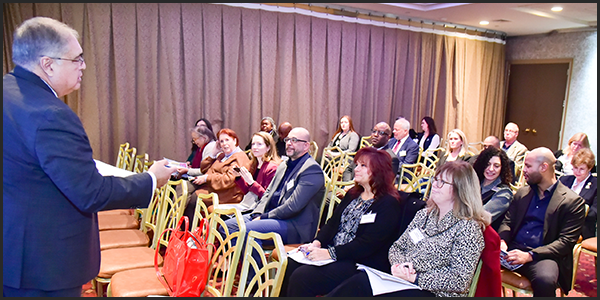
Public and Private Grant Resources
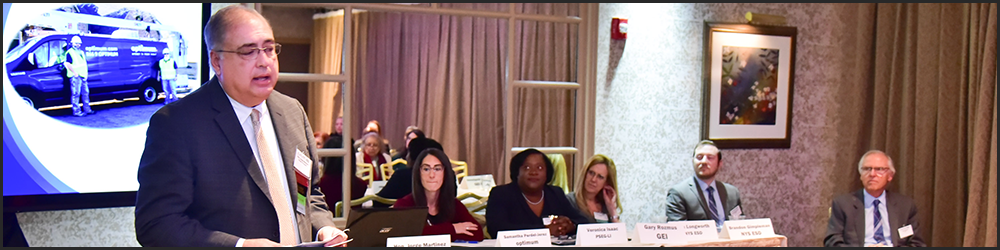
Participating in the Public and Private Grant Resources panel were Samantha Perez Jardel, Optimum; Veronica Isaac, PSEG-LI; Gary Rozmus, GEI; Cara Longworth, NYS Empire State Development; Brandon Gimpelman, NYS Homes and Community Renewal; and the Hon. Jorge Martinez, Village of Freeport, Moderator.
Samantha Perez Jardel, Director of Government Affairs for Optimum, began by discussing a recent Optimum grant program. “Over the last two years, Optimum has partnered with the Long Island Association to administer a small business grant program, and in doing so we helped 25 businesses in Nassau County and 25 businesses in Suffolk County by affording them $5,000 grants because they were able to prove how the money would help them expand their businesses. At the end of that cycle, we did a presentation and awarded two businesses, one in Nassau, one in Suffolk, with a grant of $25,000 each. This is something that we are looking forward to doing again.”
PSEG-LI provides grants and incentives to small and medium businesses throughout its footprint, Veronica Isaac, Manager of Customer and Community Partnerships at PSEG-LI stated. “Our programs have been in effect since 2017 and we have given out over $3.2 million to small and medium businesses, specifically to help them thrive and succeed here on Long Island.”
Ms. Isaac discussed several of the programs, including the Community Thrive program which provides funding up to $10,000 to Chambers of Commerce, Business Improvement Districts, and Civic Associations; the Main Street Revitalization Program which offers financial incentive awards for customers undertaking renovation or expansion projects to startup or grow their business; the Vacant Space Revival Program which is designed to encourage occupancy of commercial space in a business district or in an area of existing commercial businesses that has been vacant for a period of one year or more; and business attraction/expansion rate discounts.
Gary Rozmus, Senior Consultant at GEI, addressed the many benefits of New York State’s Brownfield Cleanup Program (BCP) which encourages private-sector cleanups of brownfields. It promotes their redevelopment as a means to revitalize economically blighted communities. The BCP is an alternative to greenfield development and is intended to remove some of the barriers to, and provide tax incentives for, the redevelopment of urban brownfields.
You can view the complete Public and Private Grant Resources session here.
Affordability: Jobs & Economic Development
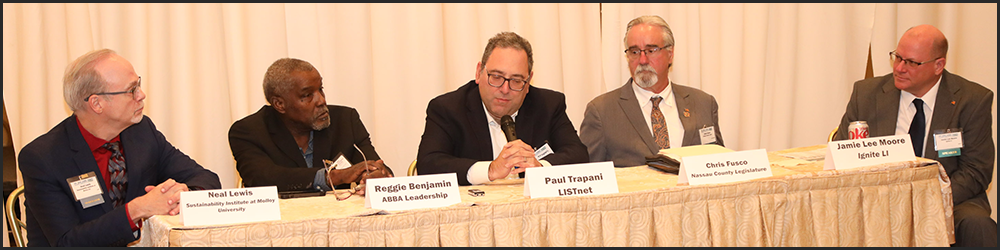
Participating in the Affordability: Jobs & Economic Development panel were Jamie Moore, Ignite Long Island; Chris Fusco, Nassau County Commissioner of Labor; Paul Trapani, LISTnet; Pastor Reggie Benjamin, ABBA Leadership Center; and Neal Lewis, Molloy University, Moderator.
Jamie Moore, President of Ignite Long Island, discussed a widely circulated myth regarding manufacturing on Long Island – since Grumman closed, it does not exist. According to Mr. Moore, there are 3,500 manufacturing companies on Long Island. The issue with this field centers around a declining workforce. “One of the things we are missing is an actual talent pipeline, which fell by the wayside over the last 20 years. We are now in the process of rebuilding that and we are finally getting local, county, state and federal support. We have about 70,000 to 72,000 employees in manufacturing, with 8,000 to 10,000 open jobs.”
Chris Fusco, Nassau County Commissioner of Labor, discussed the details surrounding Long Island’s labor force. He advised that the Island's labor force grew slower in New York State than around the country due to the changes in the composition of its population, with a smaller share participating in the labor force. “One of the problems is that we have an aging population,” Commissioner Fusco noted. “My conclusion is a robust and growing labor force is critical to support a growing economy. There is a great opportunity right now for not only our youth, but for people in their 30s and 40s, in manufacturing and the trades. A hurdle we are facing now is how do we get the word out about these jobs.”
“We work to create a strong technology ecosystem here on Long Island and that includes connecting universities with people looking to hire,” Paul Trapani, President of LISTnet explained. “This includes helping startups by connecting them with the people they need.” Discussing what he described as the world of change happening because of AI, Mr. Trapani advised, “If all you are doing is having AI write the program, you are replaceable by AI. You want to be in the position that you could learn from AI how to do things and understand it, then you are a person that is of value to a company.”
Pastor Reggie Benjamin, Executive Director at ABBA Leadership Center stated, “We just celebrated 20 years of training people right in our community, giving them the training they need so we can place them into the job market. We provide them with basic training and then we reach out to the various contractors that are doing work in our community and ask them to hire these young people in entry level jobs. Not everybody is going to college.” Pastor Benjamin also added, “We lose a lot of young people because once they get their skills, they have to leave. We also need to focus in on affordability.”
Moderator Neal Lewis, Director of Community and Government Affairs at Molloy University, summed up one of the biggest problems for people on Long Island, housing affordability. “Housing affordability is such an important part of the equation. You get a job, it has a future, you're on a career path, but the numbers are just not there to live on Long Island.”
On the issue of AI, Mr. Moore added if you come into a job just to coast, a robot can do your job. “We have got to train people how to utilize and manage AI.” On the subject of housing affordability, he said, “We don't have graduated housing here. We are at an inflection point and we have got to advance on multiple levels.”
You can view the complete Affordability: Jobs & Economic Development session here.
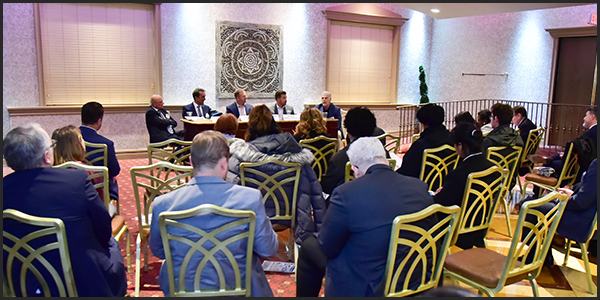
Affordability: Streamlining Red Tape
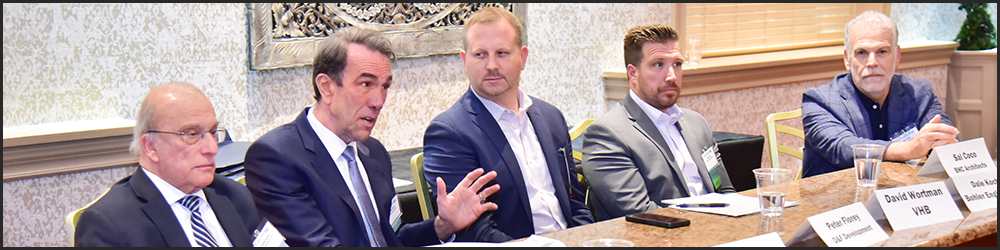
Participating in the Affordability: Streamlining Red Tape panel were Peter Florey, D&F Development; Sal Coco, BHC Architects; Dale Koch, Bohler Engineering; David Wortman, VHB; and Keith Archer, HBA, Moderator.
Moderator Keith Archer, Partner at Harras Bloom & Archer, began by explaining to the audience that all the panelists have extensive experience in navigating governmental approvals to build or renovate affordable and market rate housing on Long Island.
When discussing the initial steps of moving a project forward, Peter Florey, Founder of D&F Development, stated the first act is to sit down with the local elected officials to get a fairly honest assessment of what the probability will be on moving the project forward. “Next, we reach out to the community to start a conversation to explain what we are developing.”
Dale Koch, Partner at Bohler Engineering added, “My advice is to get your team together internally, look at the project, start putting together what you know, start figuring out what you don't know. Bring together project community partners, council people, the architects, and put all the pieces together in order to get a really good understanding of where the project is going. There are always multiple layers of approvals needed. Talk to all the departments and address what they say they need. Get a good understanding of the critical work flow. ”
David Wortman, Director of Environmental Services at VHB, added that during the initial approach, it is important to have a handle on the extent of the environmental review which will be needed during each layer of the process and which state or local agencies will be involved. “It is important to focus your energy on the environmental process. You start to build your project strategy here.” He added that environmental is a tremendous umbrella, not just hazardous waste, but also traffic impacts, air quality impacts, noise impacts, and more. It is very broad.
Mr. Florey stated environmental reviews add time to the process. He spoke about a movement in New York to allow projects that are not huge to avoid a lengthy SEQR process. “This is one of the actions we can take to help cut the problem of red tape and move things forward,” he explained.
Sal Coco, Partner at BHC Architects, noted that when the zoning is already in place, development is easier, especially when it comes to housing. “We should be looking at better zoning which would promote and enable further development.”
Mr. Archer summed up that a lot of the issues surrounding red tape have to do with the municipality and the priority it gives certain projects. “The politics of the day dictates that depending on where it is and the level of support, that’s how quickly issues get addressed.”
You can view the complete Affordability: Streamlining Red Tape session here.
Water & Wastewater Infrastructure
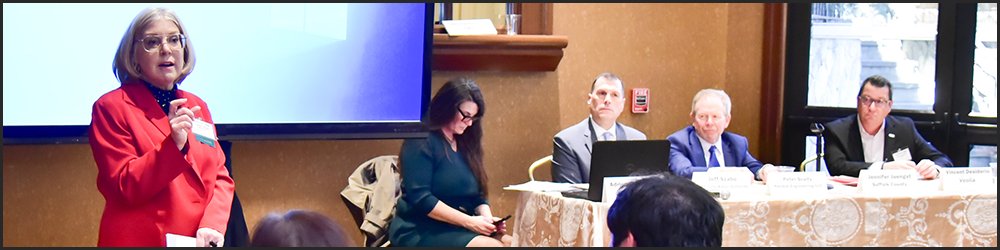
Participating in the Water & Wastewater Infrastructure panel were Jennifer Juengst, Deputy County Executive, Suffolk County; Jeff Szabo, Suffolk County Water Authority; Peter Scully, Hayduk Engineering; Vincent Desiderio, Veolia (Nassau County); and Adrienne Esposito, Citizens Campaign for the Environment, Moderator.
Adrienne Esposito, Executive Director of Citizens Campaign for the Environment, opened the discussion by framing the panel’s topic, “We have a fabulous panel meeting today to talk about the issue of water. We are on Long Island, and in both Nassau and Suffolk County, 100% of our drinking water comes from aquifers. That means 3 million people live, work and play on top of our aquifers. What could possibly go wrong? We have brought together the experts who can give you that answer. They know how to fix it and they are fixing it. It takes a lot of work, it takes a lot of effort, it takes a lot of technology, it takes a lot of money, but it also takes a lot of public support.”
“We are in quite a predicament now given the amount of waste flowing into our surface waters and ground water,” Jennifer Juengst, Deputy County Executive, Suffolk County, began. “We have about 360,000 parcels in Suffolk County that still utilize cesspools and old fashion septic tanks and this leads to a lot of pollution in our waters and degrades our surface and ground water. On November 5, 2024, more than 70% of Suffolk County voters decided that they want to reach into their pocket and pay another one-eighth of a penny, all from sales tax, to take care of an enormous problem that is easily going to exceed $8 billion. Since we started collecting the one-eighth of a penny on March 1, 2025, to date it has raised $33.9 million. There are a couple more steps before we can start tapping into that money, but it will be collected through February of 2060 and the anticipated revenue generated over the life of the program will be $2.6 billion, which will be split 1.3 billion for advanced septic systems and 1.3 billion for sewer projects.” Ms. Juengst discussed Suffolk County’s Comprehensive Water Resources Management Plan, Subwatersheds Wastewater Plan, and Septic Improvement Program.
Nassau County is contracted with Veolia Water Long Island, a global water management company, to manage the three biggest wastewater treatment plants across Nassau County, namely Cedar Creek, Glen Cove, and South Shore. Vincent Desiderio, Vice President of Veolia (Nassau County), stated the company has about 3,000 miles of sewer they operate and maintain. He explained that most of Nassau’s wastewater infrastructure was built in the 1950s. The infrastructure is aging. Over 2,500 piping areas have been identified as having defects. Of that number, about 990 have been assessed as being high priority. “Implementing the needed capital improvement has been slow going because of the funding,” Mr. Desiderio advised. What happens when you have a failure of a sewer system, you get dangerous sinkholes such as what happened in Lido Beach, Baldwin and Hewlett. “We need the funding to fix the assets which have been identified with defects,” he concluded.
Jeff Szabo, Chief Executive Officer of the Suffolk County Water Authority, gave an overview of the Suffolk County Water Authority (SCWA), noting it is separate and apart from the County, established by the state legislation in 1937. It serves about 1.2 of the 1.5 million Suffolk County residents to ensure they have safe drinking water. “Everything starts and stops with water,” Mr. Szabo stated. “Several of our challenges include our aging infrastructure and [the fact that] emerging contaminants have emerged, they are here, such as PFAS and 1,4-Dioxane. Fortunately, regarding PFAS, we have rolled out treatment.” Regarding 1,4-Dioxane, there was no effective removal system, so the SCWA created the technology needed. Speaking about local government and environmental advocates, Mr. Szabo concluded, “We all work together to solve our water quality issues.”
“Hayduk Engineering is a full service civil engineering firm. We do a lot of site design, wastewater, and transportation,” explained Peter Scully, Director of Business Development at Hayduk Engineering. “Although we face challenges in Suffolk County, we are at an historic moment in time.” There can be no density without wastewater infrastructure. There is a difference between Suffolk County and Nassau County. Nassau County is about 75% sewered, while Suffolk County is 75% unsewered. “I think the good news is that for the first time Suffolk County now has a long term plan that calls for sewering many of the downtowns. The people of Suffolk County in 2024 voted to approve a new funding source to make wastewater infrastructure happen,” Mr. Scully stated. “This is a very exciting period, we have never been in this position at all in Suffolk County. This is a great time to be involved.”
You can view the complete Water & Wastewater Infrastructure session here.
TOD & Downtown Revitalization

Participating in the TOD & Downtown Revitalization panel were Anthony Bartone, Terwilliger and Bartone; Joe Gitto, The Gitto Group; Dylan Vitale, Vitale Properties; Justin Breslin, Breslin Realty; James McCabe, Alpine Residential; and John Chillemi, RMF, Moderator.
Anthony Bartone, Managing Partner of Terwilliger and Bartone, began by discussing the transit oriented development (TOD) in the Village of Farmingdale. “Its success is self-evident. Before we started, Main Street was dying,” Mr. Bartone stated. “In 2006, the vision we had was very difficult because no one knew what transit oriented development was, there were only out of state studies. It was pioneering. Now it is not studies, it is empirical data. You can go and see for yourself. The success is self-evident.”
Discussing the area of the company’s main focus right now, Joe Gitto, Vice President of The Gitto Group, explained, “We have done development in the uptown area of Port Jefferson, as well as the downtown area. We pride ourselves in starting the revitalization of that spot near the train station, near Stony Brook University, and it is continuing to grow. It is a bridge between Stony Brook University, the hospitals, and the train in Port Jefferson. It is giving housing to a lot of people.”
Dylan Vitale, Partner at Vitale Properties, spoke about how owning bars and restaurants in Island Park led to building apartments. “My family has owned property in Island Park for about 40 years. The restaurants and bars had a long run in the area, but were destroyed by Super Storm Sandy. Due to TOD zoning, we were able to build our first project, The Channel Club, in Island Park. It was a great success for us, for the area, and for the community. This led us to realize that there was a major need for this type of project and that the community was underserved. We just broke ground in April on our next project, The Bridgeview Apartments in Island Park. Our TOD properties set us apart because we are on the water.”
Justin Breslin, Vice President at Breslin Realty discussed the company’s shift from shopping centers to TODs. “In 2018, I saw Modell's, Sports Authority and Pier One go out of business. We decided to start going after some of these transit oriented developments that people were talking about. Since that time, we have gone after properties on transit oriented sites that we thought would absolutely fit with the area.” Mr. Breslin spoke about The Langdon in Lynbrook, which is feet away from the LIRR station and sits on the site of the former Mangrove Feather factory. “Hopefully this is sparking revitalization of this downtown area,” he added.
James McCabe, Senior Project Manager at Alpine Residential, discussed two TOD developments. The first, which is presently under construction, is in Hicksville. “It is going to come online in early 2026. It is 189 units with 7,500 square feet of retail. Our next project is in Westbury, 187 units, and is looking to break ground in 2026.”
The panel discussed some of the challenges of developing on Long Island, from zoning restrictions to construction costs. Mr. Bartone addressed New York’s Scaffold Law, which imposes strict liability on the building owners and causes insurance rates to sky rocket. “We did a comparison of the cost of two identical buildings, one here and one in North Carolina. The insurance costs in North Carolina was $300,000 on the project, our insurance costs was 1.2 million. Light that money on fire because it is totally useless,” Mr. Bartone exclaimed. “We are starting to get a little momentum on this issue as we lobby against the trial lawyers. We are all suffering due to this one archaic law, which all of the other 49 states have abolished.”
Regarding the zoning issue, Mr. Bartone noted that about eight percent of Long Island has zoning in place that will allow for multi-family housing. “Zoning laws are antiquated and developers need to seek a zone change, which is a legislative act. To get to a point where you are applying, you have to have plans and file. These are six figure applications on something that is completely uncertain.”
Finally, every panelist agreed that community outreach is important, which counters one of the most important problems when it comes to get projects done, misinformation. “Listening to the community is the secret sauce to getting a development done,” Mr. Breslin underscored.

You can view the complete TOD & Downtown Revitalization session here.
Transportation Update
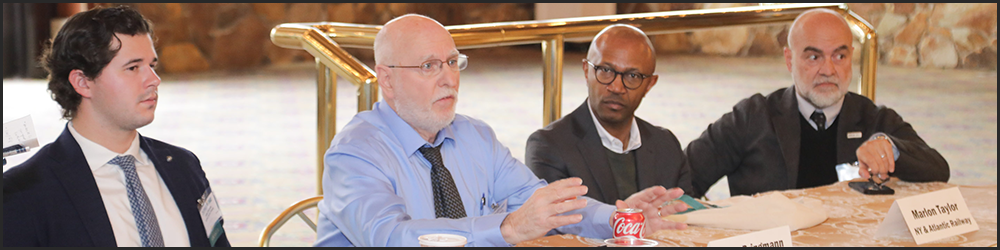
Participating in the Transportation Update panel were John Corrado, Suffolk County Transit; Gerry Bringmann, LI Rail Road Commuters Council; Marlon Taylor, NY Atlantic Railways; Jack Khzouz, NICE Bus; and Aryeh Lemberger, WSP, Moderator.
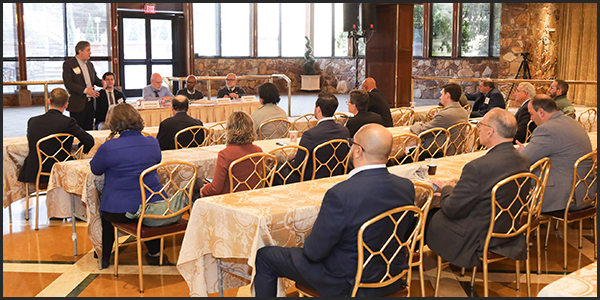
John Corrado, Vice President at Suffolk Transportation, spoke about Suffolk County Transit, which provides public transportation service throughout Suffolk County. Presently, there are 25 fixed routes and 2 On-Demand zones, operating 7 days a week. Mr. Corrado discussed its most recent transformation, Reimagine Transit, which originated in 2021. The initiative evaluated the county’s transit challenges, including declining ridership, escalating operating costs, and a lack of diverse transit options. “Since its implementation in 2023, we have seen ridership numbers getting very close to pre-pandemic levels. We consider this a success,” he stated. GPS software has been implemented and there are plans to purchase 12 battery-powered buses.
Gerry Bringmann, Chairman of the LI Rail Road Commuters Council, spoke about changes the LIRR is making to its ticket policy starting January 4, 2026. Round trip tickets are being replaced with one day unlimited tickets. “This really doesn't help you as they are reducing the validity of the ticket. Basically you have to use it the same day you bought it,” Mr. Bringmann stated. He did note there are pluses which included expanding half fare for seniors, disabled and Medicare eligible riders to the AM peak hours and children 5 to 17 years are able to ride with their parents for just one dollar, up from 12 years old. “The electrification to Port Jefferson, which would cost two to three billion, is on the back burner, but we would like to move the Port Jefferson Station west of Route 112,” he advised. “Regarding the current state of the railroad, the metrics are very good. On time performance was 95% this year, which is the best it has ever been. Ridership is at about 90% of pre COVID levels.”
Speaking about affordability and transportation, Marlon Taylor, President of New York & Atlantic Railway, noted that when people talk about affordability, they don't necessarily think about transportation. They think about housing or taxes. “We will tell you that affordability has a lot to do with transportation. Affordability has to include transportation choices and options. You can get products from Mexico by rail, adding trucking across the country would not work. There is a cost to bringing goods from the mainland and items we take away from the island,” Mr. Taylor explained.
Jack Khzouz, CEO of NICE Bus, stated, “NICE Bus is a private company doing public work. The benefit there is twofold. I am allowed to run that agency the way I see fit to better serve the residents of Nassau County and if we have an idea, it gets to the street within 30 to 60 days, not two to three years.” NICE Bus is a big system. It is one of the biggest in the Northeast. It transports 80,000 people a day, over 1,000,000 miles a month, with a fleet of about 500 vehicles. “We run more like a train or subway on our biggest routes. You do not need a schedule in the AM peak, you are running 6 minutes every bus, 8 minutes, 10 minutes. 85% of our Nassau County clients now have access to frequent buses. Frequency means 15 minutes or less during peak hours. We have instituted mobile ticketing and we just launched an AI agent.”
You can view the complete Transportation Update session here.
Clean Energy Projects

Participating in the Clean Energy Projects panel were Tom Locasio, LIPA; Rich Delaney, National Grid; Dan Zaweski, PSEG-LI; Quentin McMahon, NYPA, Propel; and Brian Sapp, National Grid, Moderator.
Quentin McMahon, Senior Director for the Propel Program at NYPA, discussed the collaboration between the New York Power Authority (NYPA) and New York Transco – called Propel NY Energy.
It is an electric transmission solution aimed at bolstering grid reliability and resiliency, while delivering clean energy into the statewide electric grid through system improvements on Long Island, in New York City and in Westchester County. It involves three ties connecting Long Island to the statewide grid, an estimated 90 miles of new transmission, and three new electrical stations. It is estimated to be in service in 2030. “We are going to do all we can to minimize any impacts,” he assured.
Tom Locasio, Vice President of Corporate Affairs and Chief of Staff at LIPA, focused on primarily three topics, power supply resources and clean energy, reliability and affordability. LIPA is a public authority created under New York State law and it owns the transmission distribution system on Long Island. “We work closely with partners,” Mr. Locasio stated. PSEG-LI is its service provider. LIPA relies on different sources of power. These include the vintage workhorse generators, such as in Northport, a mix of renewables, a handful of large solar arrays, two battery projects, and the South Fork Wind farm. LIPA’s current resource mix is overwhelmingly coming from fossil fuels. “We have an obligation to New York State law CLCPA [to reduce emissions] and LIPA is transitioning to meet these needs and requirements.”
Regarding matters of affordability, Mr. Locasio stated, “Affordability is top of mind. We are at a point where many of the power purchase agreements are actually coming due within the next couple of years. This is going be a key focal point of LIPA to make sure they are landing contracts that focus on affordability.” He also spoke about the benefits of Time of Day Rates, where customers can save money by moving heavy usage to cheaper, off-peak times. Regarding reliability, LIPA is investing one billion dollars in the grid, creating a very reliable grid. “Reliability is what matters most,” Mr. Locasio acknowledged.
Rich Delaney, Vice President of Gas Pipeline Safety & Compliance at National Grid, discussed its energy policy and the changes that have occurred over the last year. “We are starting to see an approach for supporting the all of the above energy approach which includes natural gas. I know there were some points in the last couple of years where we thought that natural gas would be exiting, but it continues to be a very important player in energy,” Mr. Delaney stated. “We are working to develop significant new infrastructure to support both traditional and renewable resources to help meet the energy demands of the future.”
“We are addressing affordability as best as we can, while still meeting the goals of New York State,” Dan Zaweski, Senior Manager of Planning & Evaluation at PSEG-LI, stated. “We are going to be focusing on free energy assessments this upcoming year. We will probably try to do at least 7,000 of these, which is a gateway to getting customers involved in moving forward to where they need to go next.” Mr. Zaweski also discussed PSEG’s available rebates, its fleet and charging program, and how PSEG is doing with the CLCPA goals. Spoiler alert, PSEG is doing a good job.

You can view the complete Clean Energy Projects session here.
Solutions for Solid Waste Crisis
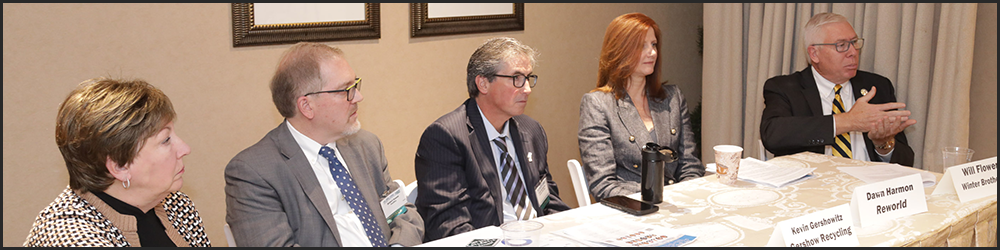
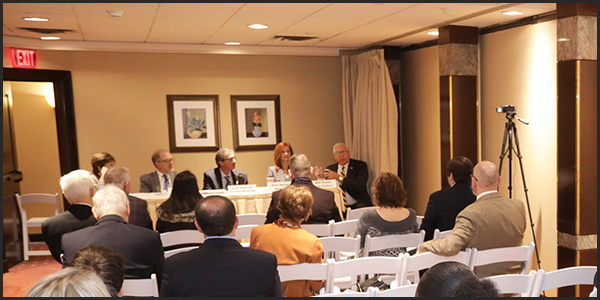
Participating in the Solutions for Solid Waste Crisis panel were Robert Keane, Posillico; Dawn Harmon, Reworld; Kevin Gershowitz, Gershow Recycling; Will Flower, Winter Brothers; Pat Del Col, H2M Architects and Engineers, Moderator.
Will Flower, Senior Vice President of Corporate and Public Affairs at Winter Brothers began, “Obviously we live on an island and we have a lot of people here, 2.8 million people are living in Nassau and Suffolk County, which underscores the scope of the challenge that we have to face regarding solid waste management. We have to use every tool in the toolbox and that requires all the experts that are sitting up here, their facilities, and new and innovative projects. There is a tremendous amount of municipal solid waste and construction waste. It has to go somewhere and that is a big challenge and not an easy task.”
Dawn Harmon, East Region Area Asset Manager at Reworld, discussed the present 350,000 tons of ash residue produced on Long Island and the question of what we are going to do with it once Brookhaven Landfill closes to it. “If we don't find an on-island solution we will end up having to transport that ash off-island to landfills, which will take about 32,000 trucks. That would be 16,000 trucks going and 16,000 trucks coming back. No one really wants that.” Ms. Harmon spoke about Reworld’s current attempt to create a facility where they could process and extract the aggregate from the bottom ash. “We are in active conversation with the DEC on this.” Regarding the top or fly ash, Ms. Harmon noted, “There is technology that can utilize CO2 and water that can mix with the fly ash and create a stabilizing material that can then be mixed with sand, palletized, and turned into a manufactured limestone aggregate that can once again be used in construction applications.”
Robert Keane, Senior Environmental Engineer Manager at Posillico, discussed Posillico’s innovative effort to help ease the burden of having to move more waste off Island. He stated they built a soil washing facility which processes up to 3,000 tons daily. “We basically take dirt and separate it into the four parts that make up dirt - stone, sand, fine clays and silts. We separate the clays and silts and we recycled the sand and aggregate, which we can use in our asphalt production or sell it for cement. Sand is a vital asset. We invested probably $20 million to build this facility.”
Kevin Gershowitz, President of Gershow Recycling, discussed the world of scrap metal as it exists today. “There is metal everywhere, steal everywhere. In the United States, 86% of all steel produced is produced with the electric arc furnace. The electric arc furnace can only use scrap steel, it only can use recycled items, it doesn't use virgin products. The most integral link in the manufacturing cycle in the United States is the scrap meta industry. The industry I represent supplies the raw materials to the steel mills, to the copper mills, and to the aluminum mills to make the products that we all use every day in our lives.” He explained that mills cannot melt down a car or a refrigerator, but his company can shred a car in six seconds. “We then separate it. This is where we have focused our investments over the last 30 years. I will tell you today, my company recovers 100% of metal that technology allows us to recover. That means about 25% of what we take in ends up going to a landfill. Thirty years ago it was close to 40%. This is what we are constantly investing in and retooling.”
You can view the complete Solutions for Solid Waste Crisis session here.
Commercial Redevelopment

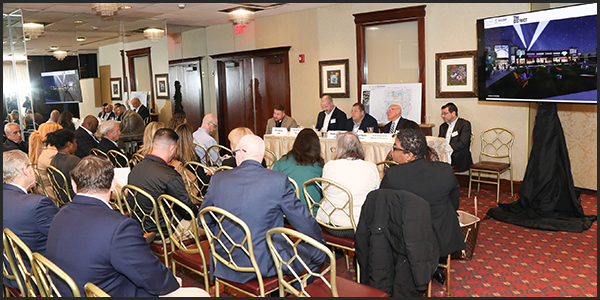
Participating in the Commercial Redevelopment panel were Brad Griggs, Amazon; Andrew Saluk, Jovia; Ken Schuckman, Schuckman Realty & Shops On Broadway; Phil Butler, Forcelli Deegan Terrana; and Michael Sahn, Sahn Ward, Moderator.
Phil Butler, Land Use Partner at Forcelli Deegan Terrana, discussed commercial/industrial trends emerging on Long Island. Mr. Butler stated, “What we were seeing in the commercial industrial sector a few years ago were large format warehouses going in, with a lot of them now partially vacant. We have seen the switch to what is called small bay, which is just a smaller format, but it is more accessible to both contractors and local distribution.” Another trend he spoke about was true mixed use development where you have residential in very close proximity to retail and restaurants.
Andrew Saluk, Business Loan Officer at Jovia, explained that the refinancing he is getting lately is in multifamily. “The Levittown model does not work in today's economy. You can't build 800 square foot houses and make a living off the land. It is too expensive. So everything is on the vertical. That is why we see town homes and multifamily developments. There is definitely a demand for them, especially by 20 somethings who come out of their parent’s home. They get two or three roommates and they can afford three to four thousand in rent.” Discussing affordability, Mr. Saluk explained, “On the economics of it, almost every development in order for it to be economically feasible for the developer has to have some affordability component to it because they need some type of either IDA or PILOT program. To qualify, you have to have so many percentage of affordable units.”
Discussing the redevelopment of the former Broadway Commons Mall in Hicksville, Ken Schuckman, President of Schuckman Realty, explained, “Around the train station there are several 100 units being developed, along with other projects in the planning stages. The Shops on Broadway is basically going to be walkable to these projects. It is 68 acres which will be transformed into an open-air center. Multifamily and retail, even though they are not on top of each other here, is a beautiful thing.”
Brad Griggs, Director, Economic Development at Amazon, stated, “In our expansion post COVID, we figured out how to reconfigure our network. The convenience aspect of life now post COVID is paramount. I want to be able to have this delivered to my house in a day, an hour, 30 minutes. It's coming, whether it's us or whether it's DoorDash. Convenience is paramount right now. We are now focused on getting closer and closer to our customers to help bring down drive times, be more sustainable, be more effective in delivering to the local community. I think it goes somewhat hand in hand with certain aspects of brick and mortar retail because over 60% of stuff sold on Amazon is from small and medium sized businesses. It's small businesses that are putting their goods up on Amazon. We are now going to have buildings that are going to have to be way more flexible in a space and way more adaptable to what our customer needs locally.”
You can view the complete Commercial Redevelopment session here.
Suffolk County Downtowns
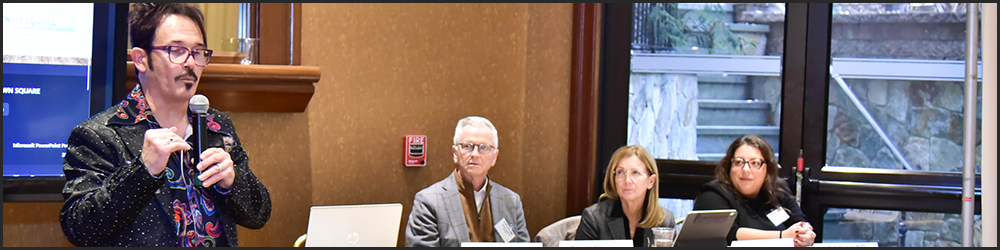
Moderator Rick Ammirati from the Holbrook Chamber opened by spotlighting the 23 rounds of downtown revitalization funding from Suffolk County over the years and the importance of government support for our business districts.
To spotlight Wyandanch Rising Russell Albanese, principal at the Albanese Organization, reviewed his multi-decade investment in the community. He shared the importance of a townled partnership with the developer and the community, and spoke of how housing development drives revitalization. This includes the community plan led by the Town of Babylon and consultants started in 2003 and ran for several years until funding and consensus was in place. Their first building was completed in 2013, and the fifth was completed this year. 600 plus apartments are up, occupied and comprised of affordable and workforce housing with some market rate, and there is an active public plaza component that compliments the retail and residential portions of the space. Mr. Albanese also recognized that the Town of Babylon, Suffolk County, and NYS having put significant investment in the project
He also spoke of how these developments near transit infrastructure reduce car trips as 40% of his residents commute by train with lots of weekend use as well. He touched on the importance of affordable housing for the workforce and misunderstanding some residents have about new developments. He closed by saying the importance of working with local residents as “We don’t want to go into a community where we are not welcome.”
Town of Riverhead Community Development Director Dawn Thomas provided an update on a range of projects that are driving their downtown revitalization. She gave a presentation on the Public Square which opens the Main Street to the waterfront with recreational and commercial uses that compliment the Suffolk Theatre and Aquarium as destinations. She also spoke about the many housing developments that have been approved and built in the downtown over the last few years including efforts around their train station area. Pedestrain safety improvements and numerous downtown events are large components of their revitalization and have been funded by a Federal RAISE grant along with the NYS DRI that they received in recent years.
Patchogue Chamber of Commerce Executive Director Silvana Aloisio gave an update on the many initiatives that the Village of Patchogue, partnered with the Chamber, have had underway. This year the focus was to open up waterfront access with a theme “Storefront to Shorefront” and a new development of 262 units of housing provides walking trails to bring people from the downtown to the water. She shared the many events that Patchogue has been know for that bring thousands of people into town for restaurants, shopping, arts and other programs. She also shared the work of the Chamber of Commerce that is an important voice for local businesses and the broader community.
Ed Carr from Discover Long Island spoke about their programs to attract people to visit Long Island to maximize sales tax revenue through marketing. They have a robust social media and digital marketing for downtowns and have been making efforts in the last year to assist local chambers accessing their platforms. He showed a video they have used for the Village of Greenport and they have done marketing packages for a number of other downtowns as well.
The Q & A discussion included transportation, the economic value of downtown promotion and marketing and the role of community organization assisting the planning process. Rick closed to speak about the importance of time and patience as these projects take years to plan and complete. His downtown has been pushing for sewers for 20 years yet they are finally moving forward. He also praised Suffolk County Executive Ed Romaine for his leadership in supporting Suffolk County downtowns.

You can view the complete Suffolk County session here.
Nassau County Downtowns
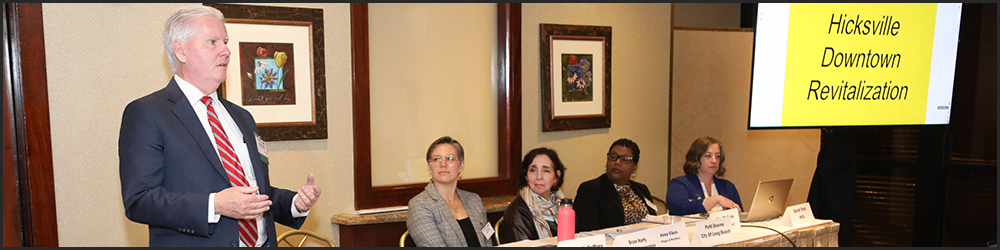
Moderator Hon. Sarah Oral Village of Roslyn trustee and engineer with IMEG started the discussion about the importance of Main Street revitalization. She shared the inspiration over the recent years of significant progress in numerous communities across Nassau County and Long Island including her Village.
Town of Oyster Bay - James McCaffrey, Director of Economic Development and project manager for Hicksville’s revitalization provided an update which included new TOD developments from Alpine and Terwillger and Bartone as well as other redevelopment projects approved and going through the planning process. He also covered the train station area improvements for beautification, enhanced public space and pedestrian safety in coordination with the MTA and NYS DOT. He credited the NYS DRI funding and the plans from the community with Vision Long Island to help start the process and keep the public consensus going. The overall goal is to bring back the downtown that was destroyed through road expansion and you are now seeing that take shape in real time with projects under construction.
Village of Westbury - Village Attorney Anna Vikse provided an update on the five components of their revitalization process. The first is pedestrian safety which included new crosswalks and improvements on Post Ave and Maple Ave. The second was recreation and community center investment which saw major upgrades to local facilities. The third were supporting local businesses with 12 façade improvement projects. Fourth was the public art which included a new Westbury Arts Center with exhibit space right off of Post Ave. Lastly the TOD plan and new zone has yielded multiple projects including one from Terwilliger and Bartone which is built, another from Alpine Development which is approved and soon to be under construction and a new project tied to the MTA. She closed by adding housing stock is good for everyone as part of the revitalization process and the partnership with community organizations during the planning phase is critical.
City of Long Beach - Community Development Director Patricia Bourne presented a background on their progress largely in the backdrop of rebuilding from Superstorm Sandy and moving many infrastructure projects. They embarked on a 2023 update to their Master Plan which brought the community together and also created a Planning Board for increased public engagement and focus on review of projects. For pedestrian safety and walkability they completed a Safe Streets for All grant which will yield traffic calming improvements.For land use projects B2K Development has completed 430 units of ownership and rental housing on the boardwalk with a commercial component – 95% of rentals are already leased out. As for infrastructure a great deal of focus is on the Bayfront and the takeover of the Long Beach sewage treatment plant to Bay Park will helps clean the bay and allow for other waterfront uses in the future. She shared that grants have been critical in all of these initiatives and the NY Forward was helpful as well. Ms. Bourne closed by emphasizing the importance of working closely with residents while having a plan which helps secure grant funds from multiple levels of government.
Baldwin - Kim Malone, President of the Baldwin Civic Association spoke about their revitalization plans and projects that they have had a strong role in shaping. The Town of Hempstead created an Grand Ave Overlay District which provides incentives to new redevelopment approved with leadership of local community. She spoke about three new projects - Baldwin Commons which is 33 units of workforce housing and completed, a local funeral home that is converted into 50 units of housing and a project by Breslin Realty that are both approved and awaiting construction this year. She thanked their representatives at the Town for being partners in their work and closed by speaking of how civic organizations are instrumental in balancing developers interests with needs of the community.
The Q & A discussion ensued about the importance and success of NYS having an incentive based approach to redevelopment as opposed to mandated zoning. The discussion also covered the economic benefits of NYS DRI and NY Forward grants and infrastructure funding to advance development. A question was raised on how the new developments helps small businesses though there are challenges to retail investment given a weakened market.
Sarah Oral closed with the importance of downtown promotion and social media that has been useful in publicizing things as simple as a new coffee shop in her downtown among many other projects and businesses.
You can view the complete Nassau County session here.
Major Development Projects
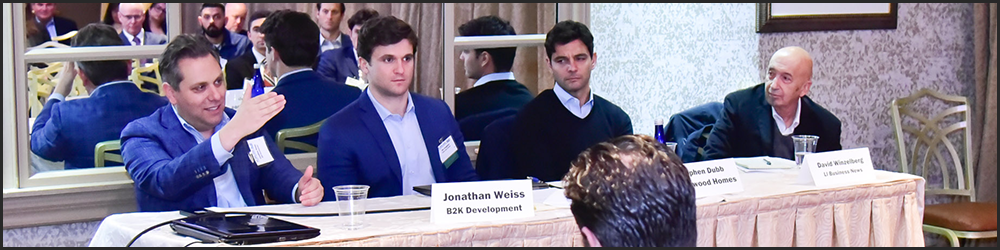
Participating in the Major Development Projects panel were Jim Coughlan, TRITEC Real Estate; Steven Dubb, Beechwood Homes; Jon Weiss, B2K Development; and David Winzelberg, LI Business News, Moderator.
Steven Dubb, Principal of The Beechwood Organization, kicked off the panel speaking about Beechwood’s project in Mastic Beach. “Three or four years ago, we were tapped by the Town of Brookhaven to redevelop the downtown in Mastic Beach,” he explained. “This is a challenging project, but it is exciting. It is 44 acres, in a blighted area suffering from high crime, poverty, homelessness, and drug use. Our plan is to build about 630 homes, a mix of townhomes and condominiums and about 130,000 square feet of commercial, mostly retail space, some office space, and green space.”
Discussing the unique challenges of this project, Mr. Dubb stated, “Unlike many development projects, there is a ton of community support. The challenge is the infrastructure that is required before we can build. A new sewer system is required, new streets with underground electric, storm resiliency, new streetscapes, parking garage, and everything you can imagine. The cost is about $100 million. All this adds up to the need for municipal, county, and state support in the form of subsidies.” According to Mr. Dubb, the organization has been working in tandem with the state, county and congressional representatives to find funding. “Everybody agrees, from residents to politicians at the town, county and state levels that we need change here. We hope that by sometime in the third quarter of next year, we will be breaking ground on the sewer system and our first condominium and retail building not long thereafter.”
Jim Coughlan, Principal of TRITEC Real Estate Company, began by explaining, “We now primarily focus on transit oriented development. We have found there is a lack of young people working and living on Long Island.” Discussing the brain-drain, Mr. Coughlan noted young people want to be in downtowns. “On Long Island, there is a surplus of elderly people, but we lack young people to drive growth in the economy. We have a severe housing shortage, particularly multifamily housing. Our household demographics have changed dramatically, yet our housing stock has not changed at all.” The New Village mixed-use project in downtown Patchogue was TRITEC’s first mixed-use downtown project which focused on downtown revitalization. “Since we built this project, over 50 new businesses have moved in there. High income earners and feet on the street in downtowns will bring businesses back to Main Streets.”
Mr. Coughlan discussed Station Yards, a multi-phased development project on a 53-acre once blighted and dangerous site surrounding the Ronkonkoma LIRR Station. He offered a brief history of the project, from inception in 2011, to breaking ground in 2017, the development of a sewer system’s pump station with 1.5 million gallon capacity, the completion of the Alston in 2019 (489 units), and the Core opening in 2024 (388 apartment units/16,000 square feet of office space).
Discussing the need for infrastructure, Mr. Coughlan noted, “Projects like these require a massive amount of infrastructure. In Suffolk County, sewer is golden in terms of development and economic progress in general.” He added, “Projects like these are obviously the future of residential on Long Island. When Station Yards is done, it will have 1,450 residential units, 195,495 thousand square feet of retail, 360,000 square feet of office and a hotel. It will cost about. $1.3 billion when it is completed. We have invested a little over 700 million so far.” In conclusion, Mr. Coughlan noted, “It has increased home values, but more importantly, I think it has boosted community morale.”
Long Island is aging, and with an aging Long Island we not only need housing for that population, but also the population that will be caring for them, Jon Weiss, Principal and President of Construction at B2K Development, explained. “We probably have about 2000 units of housing and development right now. I would say to you that in over half of those we have been waiting over three years to have a conversation with the municipalities. It is a problem here that we need to figure out how to get past.”
Discussing the Superblock in Long Beach, a 1.2 million square foot development on 6 acres in Long Beach, Mr. Weiss said, “This property sat vacant for 40 years. After we came in and developed it, taxes on the property went from $450,000 a year to $3,000,000 a year. Developments like this are smart and they make sense.” He added we must figure out how to address the exodus of young people from New York. “This is a place we all love and it is a special place and our kids deserve to have homes here, raise families here, have the school system that we have. You cannot find that around the country. We need to protect this island, we need to work together to figure it out.”

You can view the complete Major Development Projects session here.
2025 Smart Growth Summit Lunch Session
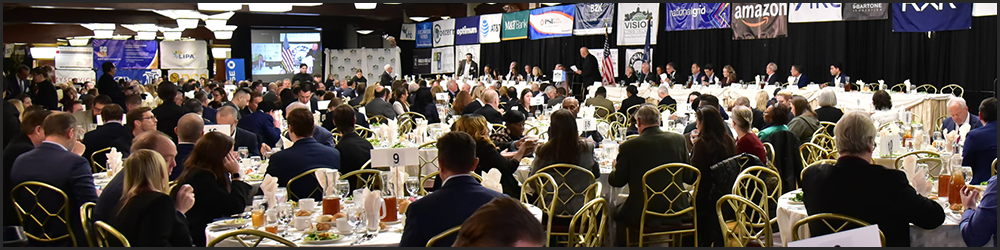
On thedais were Hon. Siela Bynoe, New York State Senate; Hon. Jack Martins, New York State Senate; Hon. Monica Martinez, New York State Senate; Hon. Mario Mattera, New York State Senate; Hon. Ed Romaine, Suffolk County Executive; Hon. Elaine Phillips, Nassau County Comptroller; Hon. Kevin McCaffrey, Suffolk County Presiding Officer; Justin Breslin, Breslin; John Cameron, IMEG; Adrienne Esposito, Citizen’s Campaign for the Environment; Jeff Dorschuck, M&T Bank; Stephen Dubb, Beechwood Homes; Trudy Fitzimmons, Chairman Vision Long Island; Bob Fonti, Suffolk County Alliance of Chambers; Joseph Garcia, Nassau Council of Chambers; Brad Griggs, Amazon; Kim Kaiman, PSEG-LI; Harry Malhotra, South Asian Chamber of Commerce; Bernard Macias, AARP-LI; Brian Sapp, National Grid; Justin Breslin, Breslin Realty, Lauren Sternberg, Veolia and Jon Weiss, B2K.
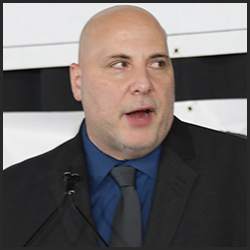
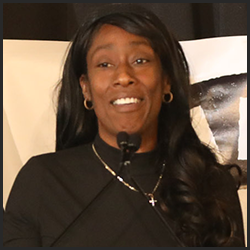
Eric Alexander and Tawaun Whitty took a moment to acknowledge the passing of community leaders that had been mainstays in advancing housing, addressing human needs and implementing Smart Growth planning throughout the years. Remembering Rabia Aziz, Community Leader; Marge Rogatz, Community Activist; Lynn Needelman, Former Executive Director of Long Island Cares; and Michael Levine a longtime respected planning commissioner for the Town of North Hempstead and Nassau County.
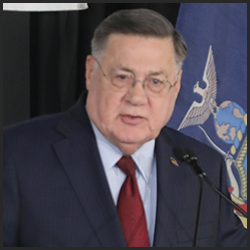
Hon. Ed Romaine, Suffolk County Executive
This is a good time. This is a time when 2025 is coming to an end. We have an opportunity to look back and then to look forward. I listened to our governor who talks about housing, and believe me, I am with her on that. We don't have enough affordable housing for the future of this island. How do you change that dynamic? Government intervention sometimes is not the best thing. One of the ways to change it deals with supply and demand. How do we increase the supply of housing to lessen demand and bring down prices? That is the magic. How do we do that without sprawl? This is why smart growth is so important. People are talking about affordable housing. I am all for it, in the right place. We have to be more careful where we put housing.
We have to take a look at the consequences of the development of this island, including traffic. We really do not have a decent public transportation system in Suffolk County. That has to change. To begin with, we will have a new Department of Transportation in Suffolk County, previously part of public works. We are going to concentrate on that. I'm going to concentrate on our friends at the MTA and the Long Island Railroad. Our bus system also needs to change. We've got to build a better bus system and we have got to tie it into our trains and they have to be tied into downtowns. We should be moving goods by rail. We should have a better recycling system and we need to invest in infrastructure. It is great to talk about housing, but before you do that, the predicate of that is infrastructure. So let's take a look at how we layout communities, how we support downtowns. Where are the overpasses, where are the underpasses from the Long Island Railroad? Let us make sure we have a road map to the future. I need you all to advocate for the future of this island.

Hon. Elaine Phillips, Nassau County Comptroller
Our downtowns are the lifeblood of our communities. Blighted properties do not attract families. We are doing everything we can to keep property values high. Nassau County has over 45,000 small businesses. It is my fiduciary responsibility as an elected official to make sure you stay in Nassau County, stay on Long Island.
So what are we doing to help? We have a whole social media campaign out telling people to shop local. We've also changed our discretionary spending. Anything under $499 we would have to go out for competitive bid or go on to the state listing. Now, we can purchase up to $5000 without going through competitive bid, up to $15,000 each year per business. The last thing I'm going to mention is our seniors. We have a senior discount program where we partner with small businesses. She also spoke about the importance of Shopping Locally in our downtown businesses.
The moderator praised her for her recent report documenting the state of Nassau County LIRR stations with the need for tremendous investment to upgrade them.
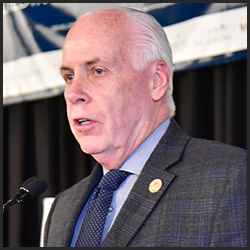
Hon. Kevin McCaffrey, Suffolk County Presiding Officer
Thirty six years as an elected official is coming to an end when the ball drops at midnight on December 31st. I'll be termed out as a county legislator. I served 24 years before that on the village board in Lindenhurst, serving as deputy mayor there. We made transformational changes, we brought housing into our downtown, right across from the railroad station. Every successful downtown on Long Island has started with bringing housing into the appropriate place in their village. Our village went from just managing the decline of the village, to what are we going to do with all these people who want to come into our village. As I'm winding down, I think about a lot of things that we did in the legislature besides smart growth. One of the best things that we did collaboratively was get the Water Quality Restoration Act passed. It will generate $50 million a year for sewers and innovative wastewater systems. That is going to be the driver of development. I just want to thank each and every one of you for all your support along the years. You never know where you are going to end up. Hopefully, I'll have an opportunity to continue to make a difference in people's lives.
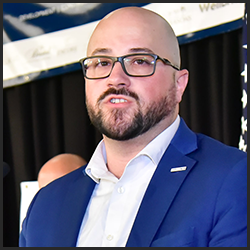
Brian Sapp, National Grid
This year has been exciting and challenging when it comes to energy policy and planning for the future. At National Grid, we remain committed to delivering safe, reliable energy to our customers and businesses across New York State. As we look ahead to the new year, the all-of-the-above approach must stay top of mind. We need continuing investments in traditional energy sources, like natural gas, which remains a critical bridge fuel while advancing renewable projects such as wind and solar throughout the region. We also know that Long Islanders are struggling now more than ever. That's why we have ramped up our community contributions throughout this past year. Our employees love giving back, and I'm so proud to be a part of that team. Over the past few months there have been nearly 30 events from Hempstead to Riverhead, from rehabbing shelters and community hubs, to addressing food insecurity, supporting veterans, and so much more. Just before Thanksgiving, we partnered with Island Harvest and Long Island Cares to donate $75,000 locally to fight food insecurity and help feed nearly 10,000 families through partnerships with Feeding New York and other local organizations. This month, we are focused on providing warm clothing, energy affordability resources, toys for children facing health issues, and spreading hope and joy to families in need. I hope that you all join us in giving back this holiday season. One small donation of time, money, or food can make a tremendous difference.
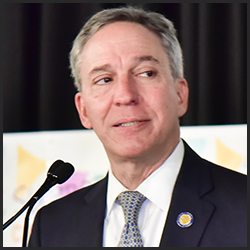
Hon. Jack Martins, New York State Senate
If we could tax our way to prosperity, we would be the most prosperous state, most prosperous region perhaps in the world. If we could get there by spending, certainly we would have the most affordable communities anywhere. We have to lean away from government and lean into the private sector and allow for government to participate, to set policy, but to allow our development community and our small business community to do what they do best, which is provide the jobs, the innovation, and the resources necessary so that we can prepare for the next generation. It is incumbent upon us as policymakers to try and look forward. We are going to be reliant on renewable energy, but it is not going to happen overnight. With regard to housing, I'm going to leave you with a figure. Nearly half of the population of our state lives on Long Island. So when you talk about infrastructure, the need for investment in infrastructure, nowhere is that more self-evident than here. If we are going to build in our downtowns, we have to focus on water, sewer, electricity, and energy.

Hon. Siela Bynoe, New York State Senate
We are here today and on this day I want to focus specifically on the deadliest roads that we face here on Long Island. It was the partnership with Vision Long Island and AARP where we went out and identified some of those roads. We did a walkability study. We went out and we traversed the roads in Hempstead where we knew the accident rates were extremely high. It was using that walkability audit data that my colleagues and I in the county legislature were able to force some items into the capital plan. We got $41 million to come into Hempstead and it is currently targeting the same intersection where 86 serious accidents occurred. We are talking about downtowns. We are talking about making sure that small businesses can thrive. We can only do that if we focus on what we should do to make sure that people can walk, ride and drive through downtowns safely.
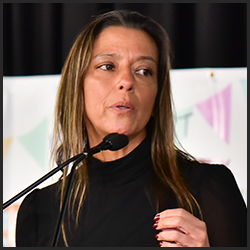
Hon. Monica Martinez, New York State Senate
The main focus we all have on our mind is affordability. It is becoming a buzzword, but I will tell you that we in the New York State Legislature, in a bipartisan way, are trying to find ways we can make life on Long Island a little bit more affordable. This comes through policy, sometimes it comes through budgeting. We make sure our children are eating for free. We make sure that we put money into construction funds for our schools. We talk about our workforce development, not only are we losing workforce, but we are also in need of additional workforce. We need infrastructure money. In terms of affordability, when we talk about building, it has to be built in the right places and the permitting system needs to be streamlined. We need to make it easier for people to build on Long Island. IDAs should all be given the right to participate in housing initiatives. I am chair of local government in Albany and my priority is to listen to the local municipalities across the state. The one thing that we can all agree on is that local zoning should stay local. We know what we want best and we also understand our needs.
Connectivity is also important. The Long Island Greenway will link 27 communities and more than two dozen parks, offering residents new ways to move, explore and enjoy the outdoors. It will close the gap with the current Empire State Trail, connecting over 8 million people in Brooklyn, Queens, Nassau, and Suffolk to a statewide network that runs from Buffalo to the Canadian border. By doing this, we are going to be able to drive recreational tourism. This will support local businesses, encourage physical activity, and strengthen the connections between neighborhoods.
There is a lot we have to do in Albany, but the one thing we can tell you is that we really love Long Island and we will fight for you. However, if we do not know what you need, we can't fight for you. Our doors are always open, come talk to us.
Hon. Mario Mattera, New York State Senate
The one thing I like to discuss is that we care about development, but without our infrastructure we cannot do any development because infrastructure needs to be put in place first. We care about proper growth, we care about the environment, we care about sewering. The key is infrastructure so we can move forward with projects. Another thing that is important is natural gas. The NESE Pipeline will be coming into our area to make sure that we're going to have the natural gas capacity needed for our future. And yes, we need to transition into renewable energy, especially all electric. We need to retool existing power plants and carbon capture is important. Also important is local jobs for local people. I will continue to fight to protect our local developments.
The session ended with a call for bipartisanship and a breaking down of political, community, cultural and economic barriers to encourage folks to work together to solve the problems facing our local communities.
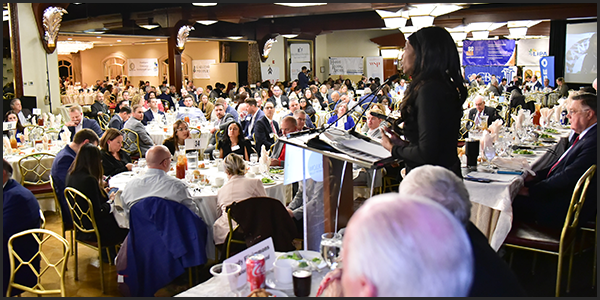
You can view the complete Luncheon session here.
Check out media coverage of the 2025 Long Island Smart Growth Summit at these excellent news outlets

News12 Power and Politics
News12 Preview

Smart Growth Summit to focus on affordability
Alexander: Tackling long island’s affordability and smart growth

IDA PILOTS are Part of Affordability Solutions
Additional Stories at:

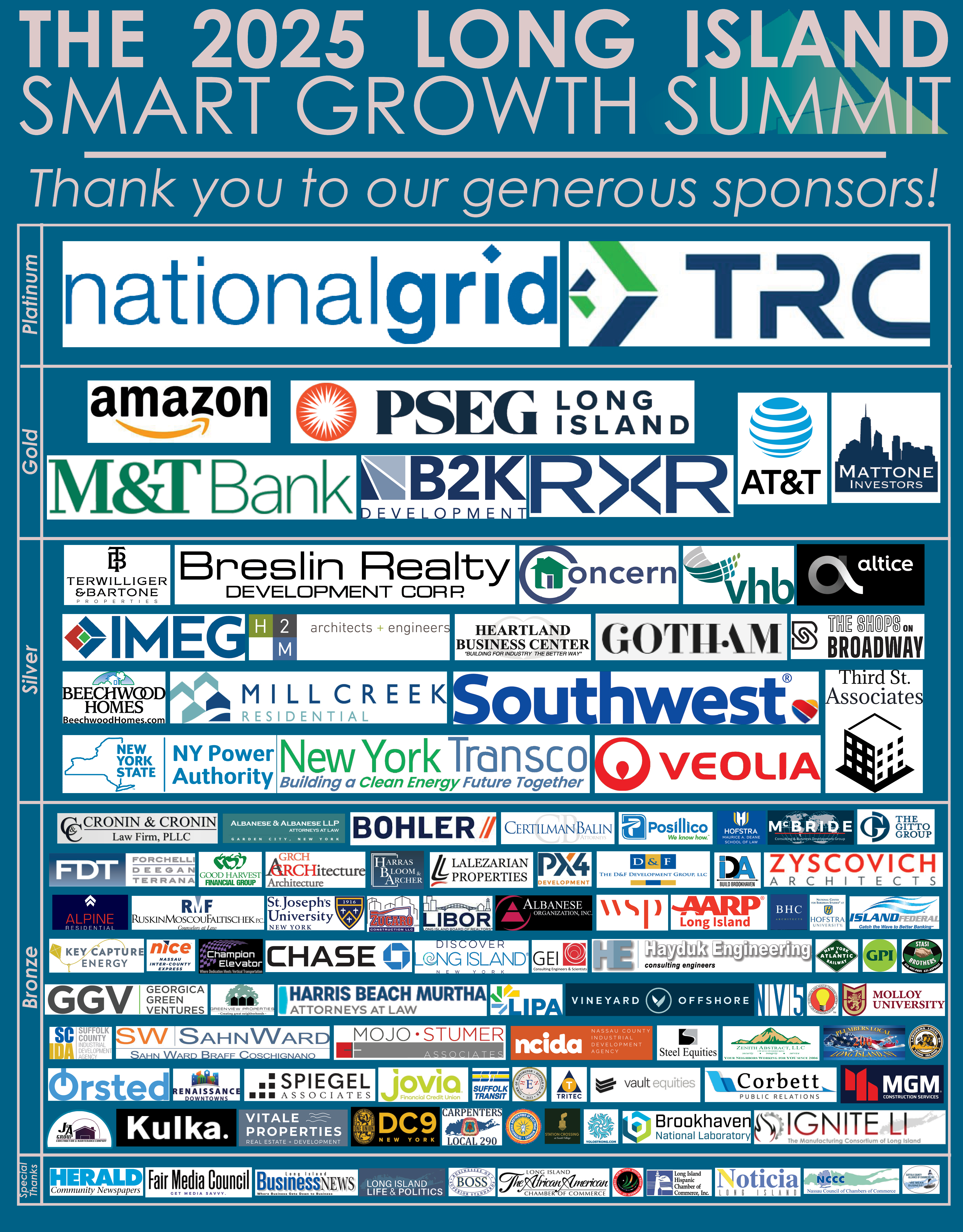
We are now accepting nominations for
the 2026 Long Island Smart Growth Awards!
You can download a PDF version of this flyer here.
Save the Date for the upcoming
Long Island Complete Streets Summit
You can download a PDF version of this flyer here.
Join us for Lobby Day
as we take our message to Albany!
You can download a PDF version of this flyer here.
Help us to improve Long Island!
You can download a PDF version of this flyer here.
You can download a PDF version of this flyer here.
You can view our full online packet for the
2025 Long Island Smart Talk Summit here!
Special thanks to our Board members!

Vision Long Island
24 Woodbine Ave., Suite Two
Northport, NY 11768
Phone: 631-261-0242. Fax: 631-754-4452.
Email: info@visionlongisland.org
Website: www.visionlongisland.org
 Facebook | Facebook |  YouTube YouTube |
 |


Home | Contact Us | Newsletter Archive | Donate | About Us
