Long-term Transportation Bill passes!
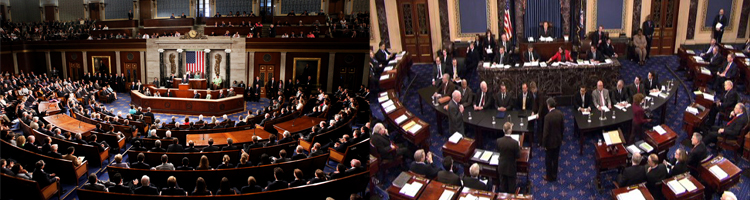
Surprise! The House and Senate have voted in favor of a long-term federal transportation bill! After the conference committee working to resolve differences in the bill came to an agreement Wednesday night, Congress issued last-minute votes in favor of the new H.R. 4348, coming in just before the current extension expired on June 30th. The final bill language was released on Thursday morning, and details emerged slowly as organizations and Congress members sifted through the 599-page conference report. The bill passed both chambers of congress with overwhelming bipartisan support.
Though the bill does not contain every element that we hoped for, we can still celebrate the accomplishment of passing a fairly progressive, long-term bill that provides much more certainty for our nation’s transportation systems. An extra year was added, meaning the bill is set to expire at the end of 2014. It was combined with a plan to prevent student loan interest rates from doubling.
Positives
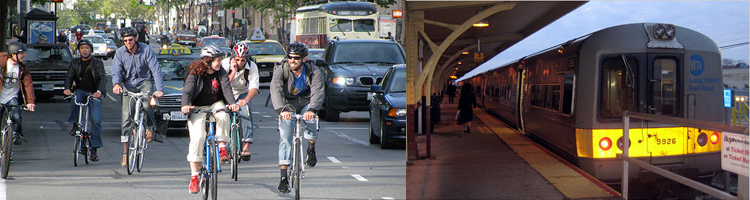
Transit Funding. Overall, highway and transit funding levels were kept more or less the same. The old threat to eliminate all dedicated transit funding has been defeated. And the existing formula that gives 80% of funding to highways and 20% to transit has been altered a few points in favor of transit. This likely means more transit funding for our region.
Local Control. The Cardin-Cochran Amendment that allows for local control over a small amount of bike/ped funding was largely maintained. Thank you to those of you who made calls and wrote memos protecting this important program. Read on for more details.
TOD Planning Grants. A TOD planning program (at $10 million) is included in the bill which will provide grants for municipalities near a New Starts project. Similarly, there are New Starts “core capacity” grants, which for the first time allow transit agencies to use the New Starts program to fund major repair and maintenance projects if they can prove they have ridership, travel time benefits, and other components that would bring similar benefits as an expansion project. This is a big plus for our region.
No Bigger Trucks. Advocates working to block proposals to increase the size limit of trucks (imagine 3 or more containers on one vehicle) were able to celebrate, as the bill authorized a two-year study on the impact of these large trucks. These trucks would add exponentially more damage to both our infrastructure and environment, and the new study will likely show that. Vision worked with these groups when we participated in Railroad Day for freight rail advocacy in Washington in March.
No Pipeline or Coal Ash. It’s a small point for us, but the agreement detached itself from the controversial provisions to authorize the Keystone XL pipeline and reduce restrictions on coal ash from power plants. This was a major problem in coming to an agreement on the transportation bill in recent months.
Unfinished business
Bike/Ped Programs. Three small programs that fund bike/pedestrian amenities, Transportation Enhancements, Safe Routes to Schools, and Recreational Trails, were rolled into one new program called Transportation Alternatives (better than the proposed “Additional Activities” title which would have also included road funding and environmental review). The overall funding level was decreased from $1.1 billion per year to $750 million. Half of the funding will go directly to MPOs (like NYMTC), and will be distributed through a competitive grant process. The other half will go to the states, who have full control over the funding and will have the ability to opt-out and spend the money on different types of projects. The Cardin-Cochran amendment would have required states to distribute their portion in a competitive grant process, as well. But in New York, where bike/ped issues are such a major concern, we do not anticipate the state redirecting these funds.
Complete Streets. The proposal to establish a nationwide Complete Streets program was eliminated. Though this certainly hurts many places in the country where pedestrian deaths are a problem, New York and Long Island can rest easy, as under our new statewide Complete Streets law we are guaranteed to be able to use our road funding for safe streets.
Commuter Transit Benefits. The commuter transit benefits parity was eliminated, which makes the recent failure of the state bill even more profound. This provision would have restored a pre-tax benefit for transit users at $240 per month, the same that drivers currently receive and about the same that was allowed until the beginning of this year when the benefit was slashed to $125 per month.
Transit Operating Assistance. A proposal to allow transit agencies to flex part of their capital funding to operating assistance in difficult economic times was mostly removed, except for a limited way that would assist small suburban bus systems. The details of this are still being released, but there is a possibility that this could help Long Island.
Environmental Review. The House proposal to gut the environmental review process through NEPA was somewhat avoided. The details are still scare and very complicated; according to Transportation for American it is “worse than [the Senate’s] MAP-21 but not HR7.”
Fix-it-First. A piece in the Senate’s bill that would have required that highway funding go to repair and maintenance (a “fix-it-first” approach) was removed.
TIGER Grants. A program to replace TIGER grants will cut funding from $1 billion to $500 million, and will be structured such that local governments and MPOs cannot apply. Project cost thresholds would have to exceed $500 million. Under current awards, no TIGER grant exceeds $300 million. This means different types of projects will be funded.
Freight. A proposal that, for the first time, would have used a formula program to fund freight projects including freight rail was removed.
Reactions
Senator Barbara Boxer, who led conference negotiations, issued this statement:
 I am so glad that House Republicans met Democrats half way, as Senate Republicans did months ago.
The bill is funded at current levels, and it will protect and create three million jobs. This job creation is the critical focus of Democrats, because we know that the unemployment rate in construction is at an unacceptable level.
We speed up project delivery, cut red tape, and do it without jeopardizing environmental laws. For the first time, we send half of the funds for bike paths and pedestrian walkways directly to local entities, and we protect those funds while giving states more flexibility on their share.
Our country needs the kind of economic boost that this bill offers, and I am looking forward to getting it to the President’s desk.
It is ironic that in June 1956 the Senate passed its first highway bill, and thanks to the work of many committees and all parties, we will not allow that great history of our interstate transportation system to disappear.
Transportation for America, the national coalition working to advance this legislation so it supports transit, bike/ped and similar issues, issued a statement Thursday afternoon officially opposing the bill.
From a local perspective, Vision is not as pessimistic. Though this isn’t the policy reform panacea that could have passed, and that we had hoped for, the bill does not spell a major disaster for our region. Funding levels were more or less maintained, and in cases where programs were cut or reduced we can fill many gaps at the local or state level. As we consistently say, planning on Long Island happens at the local level. The federal government can play an important role in helping with resources, but at the end of the day we need to take a “do no harm” approach.
Read more at Streetsblog here and here, and Huffington Post.