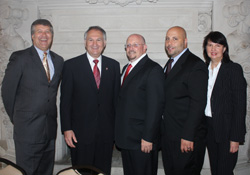
Dowling hosts 1st Small Business Symposium
On Tuesday, June 28th, Dowling College’s American Communities Institute hosted a Small Business Symposium at their Rudolph-Oakdale Campus. The symposium, sponsored by the U.S. Small Business Administration, was held to discuss small business development with experts and share ideas about what can be done to improve the small business climate. Over 100 business, government and community leaders were present to discuss these issues and provide feedback.
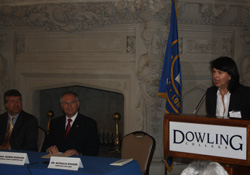
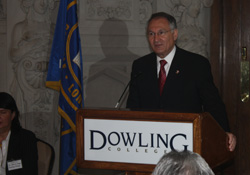

After breakfast, Nassau County Comptroller George Maragos presented the morning’s introductory remarks. He began with a report on positive progress being made in Long Island, as well as the many formidable challenges ahead in a stagnant national economy that is failing to recover.
He shared the following national economic recommendations: 1) coordinate economic policy, foreign policy, tax policy, and immigration policy to regain our manufacturing competitiveness, 2) challenge China’s unfair trade practices, intellectual property theft, currency manipulation, and remove developing nation status, 3) declare a national commitment to energy independence in 10 years, 4) reform the Health Care Law to provide affordable health care through free markets, 5) encourage and stimulate manufacturing and enterprise clusters in strategic industries built around university campuses.
For the state and local level, he made the following suggestions: 1) repeal the Tri-Borough Amendment, 2) control pension and workers comp costs and repeal the MTA tax, 3) encourage and stimulate manufacturing/enterprise clusters in strategic industries built around university campuses, 4) provide an environment where young professionals want to live and raise a family with affordable housing and good schools, 5) provide state-of the-art infrastructure with efficient affordable public transportation.
“We must help our small business grow, attract talent, and compete internationally in target industries,” Maragos emphasized. Framing the day’s discussion, he posed the question, “What can government do to help our small business grow and prosper?”
A copy of Maragos' speech is available here.
The room then broke into four breakout panels: Main Street Businesses; Small Business Financing; Small Business Regulations; and Fast-Growing Small Business Sectors: Health Services, Professional Administrative Services, Financial Services, Technology, and Environmental (Green) Businesses.
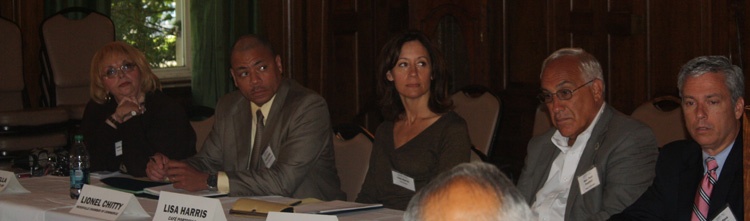
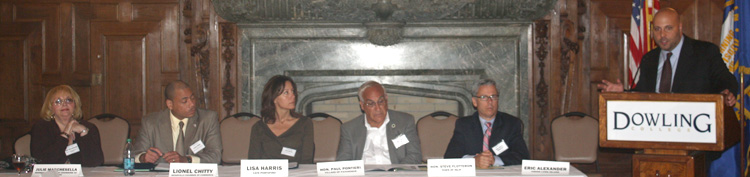
The Main Street Businesses panel was moderated by Vision Long Island’s Eric Alexander, who said that “in a downtown business, you’re selling place and the experience of place, and we sometimes lose that in talks about politics and economics.” Islip Town Councilman Steve Flotteron talked about the challenges of redeveloping our downtowns in a post-sprawl environment, which has predicated a disinvestment in our main streets. Developers must know, and are beginning to recognize, that Long Island’s downtowns are open for business and are ready for apartments and mixed-use buildings. In Bay Shore, a new project with 40 condos allows people to walk next door to shop. This makes the community safer by keeping eyes on the street and also increases activity for local businesses. Mayor Paul Pontieri of the Village of Patchogue presented his Village’s success story. The combination of accessible parkland, expanded sewer infrastructure, new parking and the renovation of the local theater gave the Village the impetus to make further changes to housing and retail, which are helping the Village transition itself into a vibrant place. The Village has been fortunate to receive a great deal of funding. Revitalization can spiral and grow once there is initial investment; local government can play a key role.
Lisa Harris, a small business owner in Northport who runs Café Portofino, spoke about the importance of community events, such as Northport’s “Artwalk,” which brings hundreds of visitors into the downtown. Not only do these events attract more people to the community who visit multiple businesses, they can also bring multiple stakeholders together, including municipalities, business owners and residents. Lionel Chitty of the Hicksville Chamber of Commerce spoke about the importance of listening to and educating people in the revitalization process. There will often be infighting and confusion amongst residents, though when educated and presented with alternatives, community members tend to come together. Speaking with one voice is critical to getting municipalities on board and makes it easier to create a safe, exciting destination with plenty of opportunities to spend money.
Julie Marchesella of the Nassau Council of Chambers of Commerce spoke about her work with the Merrick and Elmont Chambers where, in Merrick, there were many revitalization challenges, but the process was easy because small businesses worked together. To date there have been great results. Meanwhile, Elmont has had a community-generated vision plan in place for 7 years but has had difficulty getting zoning approved due to the local political climate. Now, the Shinnecock Indians are eyeing Elmont as a potential casino site, which would be a welcome addition. She also spoke of the community benefits of Business Improvement Districts (BIDs) and suggested that business owners- especially niche markets- should capitalize on the internet.
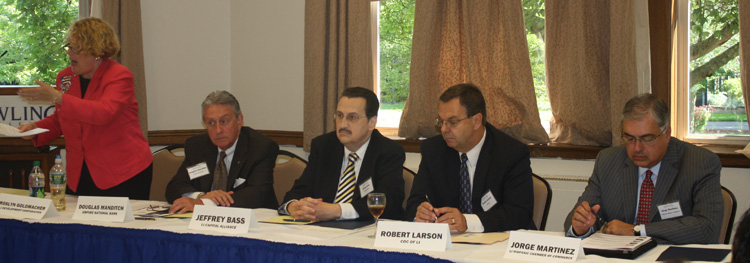

The Small Business Financing Panel featured Doug Manditch of Empire National Bank, Robert Larson of CDC of LI, Jeffrey Bass of LI Capital Alliance, Jorge Martinez of LI Hispanic Chamber of Commerce and Roslyn Goldmacher of the LI Development Corporation as moderator. Panelists discussed the challenges, opportunities, barriers and ideas for small business financing. The panel agreed that small business has been slower to recover from the recent recession compared to other sectors of the economy because small businesses did not receive much stimulus aid. Small businesses’ lack of resources and financial knowledge has also hindered their success and growth. Venture capital investors have not been taking risks on small businesses, especially start-ups, because the incentives to invest have not been present.
Small businesses have also been deeply affected by taxes while larger companies have been entitled to tax breaks and the like. The panel recommended that a flat tax of all companies would level the playing field. It was recommended that paying taxes and showing more resources would make small businesses more ‘bankable’ to investors, which would help future growth and expansion. Small business owners must become more educated about the financial world and how to fund their business aside from their personal accounts and loans from friends and family. Small businesses need to be flexible in their planning and find new ways to reach their goals. Good management must be present to make a business lucrative to investors. Incentives must be provided from government to make investors take calculated risks on small businesses and to make individuals look to start and expand their business. The largest factor to help small business is to educate the public about different and flexible ways to finance their business.

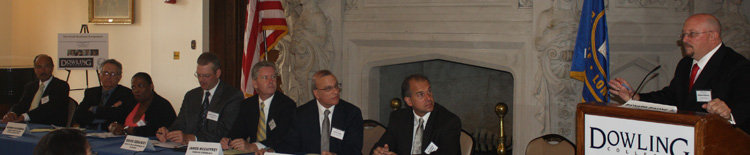
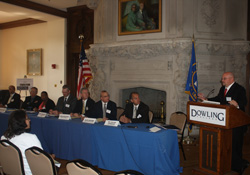
The Small Business Regulations panel included Jim McCaffrey of the Town of Oyster Bay Economic Development, Councilman Ed Ambrosino of the Town of Hempstead, David Genaway of the Town of Islip Planning Department, Phyllis Hill Slater of Hill Slater Group, Keith Archer of Harras Bloom & Archer LLP, Bruce Migatz of Albanese & Albanese LLP and Richard Bivone of RMB Development Consultants as moderator. Although there was a general consensus that regulations are necessary to maintain order and harmony in municipalities, the panelists concluded that there are issues with the current system. Many pointed out that the approval process for small businesses was lengthy and confusing. Potential owners may not be aware of all the steps they must take to meet federal, state and local government guidelines as well as those of civic associations and other external organizations with authority. Panelists also mentioned that zoning codes are often outdated and designed to preserve the status quo instead of to move with the times, which tends to discourage improvements and prevent beneficial designs, such as mixed-use planning.
The panelists then discussed changes that would make it easier to start and maintain a profitable small business. Streamlining the regulatory process was one of the most prominent suggestions. This included reducing the approval process to a single hearing, simplifying and shortening the time period for granting permits and regularly updating zoning codes. Panelists also thought that potential and existing small business owners should have a full understanding of regulations by both studying on their own and seeking out expert advice, especially by participating in pre-application meetings. Overall, consolidating and being knowledgeable of the approval process were believed to the be the key aspects to a successful small business climate.


 The Fast-Growing Small Business Sectors panel focused on Health Services, Professional Administrative Services, Financial Services, Technology, and Environmental (Green) Businesses. Susan Shevlin of North Shore-LIJ Health System demonstrated how technological innovation is transforming the health services sector, telling the group about a new electronic medical record system that her organization is working to develop. With the new system, patients’ record will follow them to all of their health care visits, cutting down on paperwork and also allowing health care professionals to monitor health outcomes in order to identify the most effective treatments and improve the quality of care for everyone.
Ellen Coopersperson of Corporate Performance Consultants spoke about the importance of revisiting our unifying mission and core values. “I don’t believe in profit at any cost. When we are sacrificing integrity for profit we need to back up and fix our equation,” she remarked. Mark J. Grossman of NYS Department of Labor announced the upcoming formation of a Council of Economic Development that will allow for greater public participation in local economic matters. “We want to make sure small business has a big voice on Long Island because every region is different. We’re not the kind of community where big companies dominate. We have lots of small companies and we recognize that that’s who we are.” Chris Spinner of EmPower Solar discussed the mounting importance of green energy and providing incentives to small businesses to improve their energy efficiency and shift toward renewable sources. "Both LIPA and National Grid can help create industries we want to bring here to Long Island," he said.
A large part of the discussion in this worksession revolved around the importance of preparing our young people to meet current workforce demands. Several educators in attendance weighed in on the trend of increasing preference for Humanities degrees and the dearth of students who want to enter STEM fields. Suggestions from attendees emphasized the need for a greater focus on the talent pipeline, creating avenues of communication and collaboration between education and the business sector. Peter Goldsmith of LI Software and Technology Network moderated the discussion. He concluded on a optimistic note, saying that many people are “trying to do things better on the state and on the county level.”
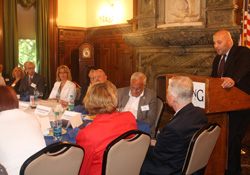
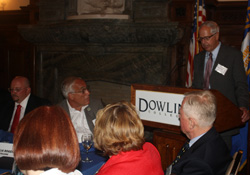
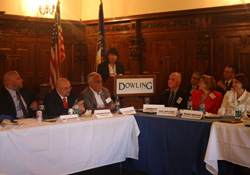



Following the breakout sessions, participants joined together for lunch and a joint small business development session, where attendees presented the discussions and recommendations from their panels. The conversation concluded with recommendations for businesses to partner with local high school and college students to provide internships, mentoring and other practical opportunities. The symposium was part of a larger study being conducted by the American Communities Institute at Dowling College on the needs of small businesses. Further events and information gathering will take place this summer, including another forum on September 16th. Vision Long Island is assisting with the study.
For more information, stay tuned for updates on the Dowling website. Read more at LI Business News.