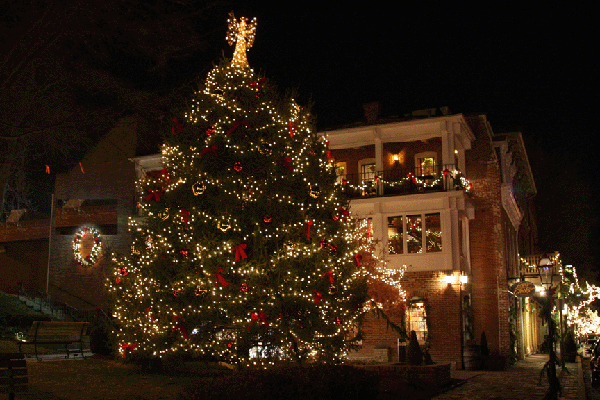
As 2010 draws to a close this holiday season, we have been reflecting on a year of great accomplishments and challenges. We hope that you look to support downtown businesses for your holiday shopping and dining needs. Many downtown businesses make great locations for holiday and New Years parties. And why not look to make it a New Year’s Resolution to continue this support year round?
This has been an exciting and productive year for us here at Vision Long Island. Many small and medium scale projects have been implimented along with multiple community visionings underway in places such as Hicksville, Gordon Heights, Farmingdale and Bay Shore, giving us much to look forward to in the coming year.
In the New Year, we are looking forward to continuing our commitment to the principles of Smart Growth through both strengthening our existing relationships and building new relationships with communities islandwide.
Everyone at Vision Long Island would like to wish you a Happy holiday season. We hope the New Year brings you peace, joy, and happiness.
More details: Long Island Smart Growth Working Group discusses implementation of Public Infrastructure Act
Last week, we gave you a brief overview of the Long Island Smart Growth Working Group meeting, which took place on Wednesday, December 15th at the Sustainability Institute at Molloy College, discussing the implementation of the recently passed NYS Smart Growth Public Infrastructure Act, the landmark legislation requiring all future development in the State to take Smart Growth policies into account during the approval process. Over 80 people, representing nearly 40 organizations, gathered to discuss the future for the development sector and various State departments.
Governor-elect Andrew Cuomo has outlined his support for the NYS Smart Growth Public Infrastructure Policy Act in his transition agenda, The New NY Agenda for a Cleaner, Greener New York. “Passage of the law is just the first step, however; strong leadership is needed to effectively implement these Smart Growth principles in our State's policies," said Cuomo.
The discussion panel featured NYS Assemblyman Steve Englebright, NYS Senator-elect Jack Martins, Michael Posillico of Posillico, Adrienne Esposito of Citizens Campaign for the Environment, Subimal Chakraborti of NYS DOT Region 10, Vincent Palmer from the NYS Department of Environmental Conservation, Greg Watson from the NYS Department of Homes and Community Renewal, Bob Paley of the MTA, Ronnie Epstein of NYPA and Laura Shabe of the Port Authority of NY & NJ. Peter Fleischer of Empire State Future was moderator. Paul Beyer from the NYS Smart Growth Cabinet also called in to speak about implementation of the Act.
The meeting focused on the need for all agencies to come together to implement Smart Growth principles and projects for the entire State and how Long Island, the original suburb, can become an model for the future. Representatives of each attending agencies provided updates and possibilities for coordinated implementation. Though many have already begun to incorporate Smart Growth, this law allows for the necessary broad cooperation.
Assemblyman Steve Englebright, one of the original sponsors of the bill over a decade ago, spoke about the broad need to curtail sprawl on Long Island. We need to add density to our downtowns and preserve our open spaces, he said. We must redesign our downtowns, save taxpayer money and have better infrastructure. These things can only happen if everyone comes together and works on a new suburban vision. Assemblyman Englebright highlighted the Route 347 Greenway project as a great case study in revitalizing basic needs in Suffolk County. This project came about before the Smart Growth bill was passed. Though it is the first project of its kind from the DOT, it has a wider impact in beginning to change the culture of sprawling roads and land use. The new law will solidify and facilitate these changing behaviors.
Jack Martins, Mayor of Mineola and NYS Senator-elect, said that our challenge is to pioneer the new suburbia. The future rests in developing our downtowns through Smart Growth, increased density, affordable housing and accommodating the next generation. This act goes a long way, for the first time recognizing the need of our communities to look at redevelopment through Smart Growth principles. We can approach the implementation in a creative way, he said, concluding that “the last thing we need is another layer of bureaucratic oversight to development. The challenge is how to seamlessly incorporate that oversight so that we can build Smart Growth but not block process.”
Michael Posillico of Posillico called the new law “an opportunity and legacy.” Mr. Posillico’s firm has adapted to changing times and now focuses on brownfield redevelopment, integrated transportation, and pedestrian facilities. There are already several projects in the region that can serve as good examples for how this bill can operate. We have a responsibility to address this concern early.
Adrienne Esposito, Executive Director of Citizens Campaign for the Environment and member of Governor-elect Andrew Cuomo's transition team, explained why this law will work well. In 2004, Governor Pataki signed an ecosystem-based management act requiring a radical new concept: heads of nine different agencies would have to talk with each other about water management. People said then that it would just add another layer of bureaucracy. However, the 2004 law, like the new one, actually streamlines the process by attacking potential problems from the outset rather than after they have occurred. As Albert Einstein said, “intelligent people solve problems but great people prevent them.” Esposito encouraged input on the Long Island Lobby Day Coalition agenda for 2011.
Paul Beyer, director of the NYS Smart Growth Cabinet, called into the meeting via speakerphone, explaining that this law will do two things that Smart Growth advocates have been talking about for years. First, it will join land use planning with infrastructure planning and decisionmaking. At the local level, though the law does not directly impact local spending, it encourages Smart Growth planning over the long-term in anticipation of asking for State infrastructure investments. Beyer hopes to see local zoning changes. Second, the new law will look at infrastructure investments more strategically than in the past, including cost-benefit analyses and fiscal and Smart Growth implications. Beyer called Smart Growth “a grown-up movement,” in that it is now in law, not just advocacy.
Subi Chakraborti, Regional Director of the NYS DOT for Region 10, spoke about the department's commitment to Smart Growth principles through the design process of their upcoming projects. He focused on the Rt. 347 greenway project as an example of all sides coming together in cooperation with the community and many of the ideas Assemblyman Englebright had brought forward. He spoke about his department's support of the Public Infrastructure Act and the anticipation of the creation of a Smart Growth committee to focus on crumbling infrastructure, parkways and the environment in relation to Smart Growth. “The department is ready to implement,” he said.
Peter Fleischer of Empire State Future took the floor next to moderate the panel. The new bill, he explained, sets the stage for an era where we will not have enough money to cover all of our infrastructure needs. The bill sets up a framework so that we can get the best return for our public investments.
Vincent Palmer from the NYS Department of Environmental Conservation talked about brownfields and the severe problem of pesticides in Long Island's groundwater. We need to remediate these sites, and the new Smart Growth bill is a good way to work on this and other environmental issues by involving various state agencies.
Greg Watson of the NYS Department of Homes and Community Renewal discussed the new structure and management system of his department, which will focus, in part, on preservation and community renewal and is already a member of the Smart Growth Cabinet. He hopes to see more green buildings approved and Smart Growth principles incorporated into the green building manual. Moving forward, housing projects will receive priority if they incorporate TOD, mixed-use and other Smart Growth principles. Watson referenced the Wyandanch revitalization as a spotlight community.
Bob Paley, TOD Director for the MTA asserted that implementation of the bill will be easy for the MTA in many ways, as they have already been working with the DOT and other groups on community projects. He hopes that regional growth continues to focus around transit while avoiding sprawl. The challenge moving forward is how to bring stakeholders together to create a more coordinated approach to Smart Growth. A forum such as the Working Group is a good direction and Paley encouraged replicating such forums in various regions in the state to talk about the MTA's capital program and other Smart Growth implementation strategies.
Ronnie Epstein of the NY Power Authority said that NYPA is looking to incorporate more energy efficiency in all of their projects. She said that communication and synergy help to troubleshoot problems later on in the process. "Engagement in advance is better than trouble at the end," she said. NYPA is committed to implementing the Act as it links to energy projects such as the offshore wind project. The authority wants to partner with and engage communities and agencies. Epstein noted that we must have a formalized process for this, or else everyone works in silos.
Laura Shabe spoke for the Port Authority of NY and NJ. The group supports the bill and already incorporates many of its guidelines. The Port Authority can look at energy saving policies at airports and sustainable freight planning. Truck traffic affects town centers and highway congestion, Shabe said, but freight planning is sometimes left out. Long Island needs to create a decent distribution center and system, possibly through freight rail or water access. The Port Authority will help Long Island consider such alternatives moving forward.
Panelists took questions from the audience that ranged from what can be done to ensure that better decisions are made to how we can better allocate resources for Smart Growth. Paddy Steinschneider from the Congress for the New Urbanism-NY Chapter observed that many of the panelists are already on board with Smart Growth. He asked about how to get agencies out of their silos and cross-pollinate information. Mayor Martins recommended the number one goal is to get regional groups and agencies to meet regularly to coordinate Smart Growth initiatives and projects locally. Adrienne Esposito said that another part of the picture is that there are municipalities and agencies on Long Island and in NYS who do not like to work with each other, resulting in turf wars. She hopes that this legislation breaks down the dialogue by bringing people together at the table. "It’s an attitude and culture change," she said.
Panelists also considered whether the bill should be incorporated into the existing state environmental review process (SEQRA). Assemblyman Englebright thought this might be a good idea that would encourage a more flexible and collaborative approach to planning.
A recurring theme arose to direct State agencies to work together to benefit downtown projects throughout Long Island and elsewhere in NYS. The continuation of the NYS Smart Growth Cabinet would be a welcome step in coordinating the activities of state agencies and a regional version of the Cabinet, serving Long Island's needs, could be useful, as well.
Assemblyman Englebright ended the meeting with a call for Long Island stakeholders to stay involved in the process of implementing the Act. The Working Group will meet again in March and will continue to work toward implementation.
Long Island Coalition for the Homeless holding annual coat drive
90% of homeless adults need a new, warm coat each winter because they have nowhere to keep their winter coats over the warmer months. Thousands of New Yorkers may have a home but choose to put dinner on the table for their children rather than buy a winter coat for themselves. Please Join Long Island Coalition now through January 14th in collecting new and gently used coats to distribute to the community.
This chilly holiday season, give the gift of warmth to thousands of less fortunate men, women and children. Contact LICH for more information at 516-742-7770
The Long Island Council of Churches needs food – badly!
Food donations are sorely needed at the Long Island Council of Churches’ Emergency Food Pantries. They have only enough food for about two days--and the months of greatest need are approaching. LICC pantries have fed 30% more people in Nassau this year- 130 families in the first week of this month- but food drives there have brought in half as much as last year. Reimbursement from the County is steadily decreasing and slower than ever and they simply do not have the money to buy more food.
There are some additional needs: donations of toiletries, personal care items, school supplies, small household goods and plastic or paper shopping bags are welcome in addition to food. The Freeport pantry needs a vacuum cleaner and small shopping carts and welcomes donations of clothing. The Riverhead pantry needs a small couch for guests waiting for assistance, but please call Riverhead before taking clothes there. The Hempstead office needs carpeting, a coffee maker and a vacuum cleaner. They also need drivers who can pick up food donations occasionally and deliver them to Freeport, Hempstead or Riverhead, as you are needed and as you happen to be available.
Donations can be dropped off in Freeport (450 N. Main Street, 516-868-4989), Hempstead (Christ’s 1st Presbyterian Church, 516-565-0290), or Riverhead (407 Osborne Avenue at Lincoln, 631-727-2210) or at any LICC meeting or event. For more information on how you can help, please visit LI Council of Churches' website here.
For more information about Vision Long Island, visit visionlongisland.org or contact us at:
24 Woodbine Ave. Suite One Northport, NY 11768.
Phone: (631) 261-0242. Fax: (631) 754-4452.
Email: info@visionlongisland.org



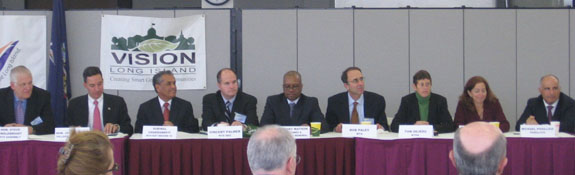
 The discussion panel featured NYS Assemblyman Steve Englebright, NYS Senator-elect Jack Martins, Michael Posillico of Posillico, Adrienne Esposito of Citizens Campaign for the Environment, Subimal Chakraborti of NYS DOT Region 10, Vincent Palmer from the NYS Department of Environmental Conservation, Greg Watson from the NYS Department of Homes and Community Renewal, Bob Paley of the MTA, Ronnie Epstein of NYPA and Laura Shabe of the Port Authority of NY & NJ. Peter Fleischer of Empire State Future was moderator. Paul Beyer from the NYS Smart Growth Cabinet also called in to speak about implementation of the Act.
 Assemblyman Steve Englebright, one of the original sponsors of the bill over a decade ago, spoke about the broad need to curtail sprawl on Long Island. We need to add density to our downtowns and preserve our open spaces, he said. We must redesign our downtowns, save taxpayer money and have better infrastructure. These things can only happen if everyone comes together and works on a new suburban vision. Assemblyman Englebright highlighted the Route 347 Greenway project as a great case study in revitalizing basic needs in Suffolk County. This project came about before the Smart Growth bill was passed. Though it is the first project of its kind from the DOT, it has a wider impact in beginning to change the culture of sprawling roads and land use. The new law will solidify and facilitate these changing behaviors.
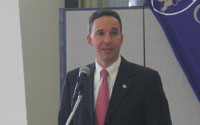 Jack Martins, Mayor of Mineola and NYS Senator-elect, said that our challenge is to pioneer the new suburbia. The future rests in developing our downtowns through Smart Growth, increased density, affordable housing and accommodating the next generation. This act goes a long way, for the first time recognizing the need of our communities to look at redevelopment through Smart Growth principles. We can approach the implementation in a creative way, he said, concluding that “the last thing we need is another layer of bureaucratic oversight to development. The challenge is how to seamlessly incorporate that oversight so that we can build Smart Growth but not block process.”
 Adrienne Esposito, Executive Director of Citizens Campaign for the Environment and member of Governor-elect Andrew Cuomo's transition team, explained why this law will work well. In 2004, Governor Pataki signed an ecosystem-based management act requiring a radical new concept: heads of nine different agencies would have to talk with each other about water management. People said then that it would just add another layer of bureaucracy. However, the 2004 law, like the new one, actually streamlines the process by attacking potential problems from the outset rather than after they have occurred. As Albert Einstein said, “intelligent people solve problems but great people prevent them.” Esposito encouraged input on the Long Island Lobby Day Coalition agenda for 2011.
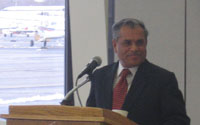 Subi Chakraborti, Regional Director of the NYS DOT for Region 10, spoke about the department's commitment to Smart Growth principles through the design process of their upcoming projects. He focused on the Rt. 347 greenway project as an example of all sides coming together in cooperation with the community and many of the ideas Assemblyman Englebright had brought forward. He spoke about his department's support of the Public Infrastructure Act and the anticipation of the creation of a Smart Growth committee to focus on crumbling infrastructure, parkways and the environment in relation to Smart Growth. “The department is ready to implement,” he said.
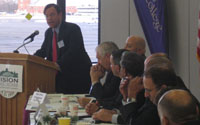 Peter Fleischer of Empire State Future took the floor next to moderate the panel. The new bill, he explained, sets the stage for an era where we will not have enough money to cover all of our infrastructure needs. The bill sets up a framework so that we can get the best return for our public investments.
 Bob Paley, TOD Director for the MTA asserted that implementation of the bill will be easy for the MTA in many ways, as they have already been working with the DOT and other groups on community projects. He hopes that regional growth continues to focus around transit while avoiding sprawl. The challenge moving forward is how to bring stakeholders together to create a more coordinated approach to Smart Growth. A forum such as the Working Group is a good direction and Paley encouraged replicating such forums in various regions in the state to talk about the MTA's capital program and other Smart Growth implementation strategies.
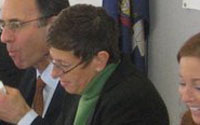 Ronnie Epstein of the NY Power Authority said that NYPA is looking to incorporate more energy efficiency in all of their projects. She said that communication and synergy help to troubleshoot problems later on in the process. "Engagement in advance is better than trouble at the end," she said. NYPA is committed to implementing the Act as it links to energy projects such as the offshore wind project. The authority wants to partner with and engage communities and agencies. Epstein noted that we must have a formalized process for this, or else everyone works in silos.
 90% of homeless adults need a new, warm coat each winter because they have nowhere to keep their winter coats over the warmer months. Thousands of New Yorkers may have a home but choose to put dinner on the table for their children rather than buy a winter coat for themselves. Please Join Long Island Coalition now through January 14th in collecting new and gently used coats to distribute to the community.
  Food donations are sorely needed at the Long Island Council of Churches’ Emergency Food Pantries. They have only enough food for about two days--and the months of greatest need are approaching. LICC pantries have fed 30% more people in Nassau this year- 130 families in the first week of this month- but food drives there have brought in half as much as last year. Reimbursement from the County is steadily decreasing and slower than ever and they simply do not have the money to buy more food.
