Smart Growth On Long Island: 2015 A Year In Review

A Message from Vision......
As the hours tick down towards the end of 2015 it is important to take stock of the many accomplishments this year for the Smart Growth movement.
The big victories were a compendium of small and medium scale projects carrying profound impact. Construction, grand openings and success in revitalization efforts ensued in Farmingdale, Valley Stream, Mineola, Westbury, Great Neck Plaza, Glen Cove, Rockville Centre, Cedarhurst, Lynbrook, Freeport, Port Washington, Huntington, Port Jefferson, Riverhead, Bay Shore, Patchogue, Wyandanch, Babylon, Copaigue, Coram, Central Islip and others.
Plans underway in Baldwin, Hicksville, Great Neck, Manorhaven, Kings Park, Mastic Beach, Huntington Station, Lindenhurst, Amityville, Sayville all provide hope for community and market sober improvements in the coming year.
These downtown victories by local municipalities, small businesses and local residents were not done in a vacuum but aided by some additional allies.
Record infrastructure investment was secured from the federal government with the leadership of Senator Schumer for Bay Park sewage treatment upgrades and for sewers in Mastic and Shirley along with other investments. For the first time in over a decade a bipartisan 5 year transportation bill passed which will positively impact our region.
New York State continued to implement the Smart Growth Infrastructure Act and the Complete Streets law with prioritization of investments in downtowns for their economic development funding and the beginnings of planning for pedestrian and bike safety. A sewer fund for small communities was set up and the Governor and NYS Senate secured $550 million in yet unprogrammed infrastructure funds for Long Island
Nassau County through their IDA and Suffolk County through their capital budget provided significant support for Transit Oriented Development projects over past years. These incentives and investments advanced needed growth on Long Island's Main Streets.
Long delayed large scale projects in downtown Hempstead, Glen Cove waterfront, Heartland, Riverside, Ronkonkoma HUB, and Cerro Wire all advanced this year with groundbreaking promised on many of them in 2016.
A new cadre of the development community embracing small, medium and large scale projects secured approvals of over 1500 units of Transit Oriented Development in 2015. This brings a total of over 11,000 units of approved over the last nine years.
The general public reported time and time again in polls, surveys and in most public hearings to support locally planned downtown redevelopment and infrastructure investment.
Some of the vehicles that brought us together to assist these accomplishments included the Smart Growth Summit, Smart Growth Awards, LI Smart Growth Working Group, LI Lobby Coalition, LI Business Council, LI Complete Streets Coalition, Friends of LI, the Long Island Youth Summit, Smart Growth Saturday, the newly formed Suffolk County Alliance of Chambers and many others.
Barriers to our progress that persist include a lack of public trust in big plans and decision making removed from local governance. These issues came to a head with casino plans, illegal dumping and the usurption of municipal control in specific instances. The first signs of regional gridlock that has been created due to the plethora of large plans with conflicting goals created some confusion this past year as well.
Better ways to adapt the desires of regional interests towards support for local placemaking and community and market based improvements need to be employed in the coming year. More on that later....
Folks on the south shore are still recovering from Sandy and our bus systems in Nassau and Suffolk suffer from loss of routes and lack of investment.
Getting our fair share of resources from NYS and the Federal government continued to be a challenge yet is something where all of the stakeholders that represent communities are unified.
In the meantime let's celebrate a year of progress and growth with reflection on the challenges ahead.
On behalf of the Board, staff and community, business and municipal leaders we are honored and humbled to have worked together to assist many of the projects mentioned above. See you all for an even stronger 2016!
Happy New Year!
Best,

Eric Alexander
Vision Long IslandPlease donate today online, by email or by mailing in the donation form below.
If you have any questions, feel free to contact Vision Long Island at 631-261-0242 or info@visionlongisland.org.
Sincerely,
The Board and staff of Vision Long Island
Thank you for supporting Smart Growth this holiday season!
Online donation available here
__________________________________________________________________________________________________________ *Please note donation amount: ___$50 | ___ $100 | ___ $250 | ___ $500 | ___ $1,000 | ___ $5,000 | ___ Other Amount: ______ Name: _____________________________________________________________________________________________________ Affiliation: __________________________________________________________________________________________________ Address: ___________________________________________________________________________________________________ City: ______________________________________________________ State: ___________________ Zip: ___________________ Phone: ____________________________ Fax: ______________________ Email: _______________________________________*Payment Options: ___ Check __ Credit Card
(Make checks out to Vision Long Island and mail to 24 Woodbine Avenue, Suite 2, Northport, NY 11768) Return to: 24 Woodbine Ave., Suite Two - Northport, NY 11768 Phone 631.261.0242 Fax 631.754.4452 Email info@visionlongisland.org

Join us on


Developments Prove Downtown Revitalization Growing On LI

Gone are the mandatory white-picket fences surrounding single-family homes on Long Island. Instead, a variety of housing options are gradually taking hold.
The island has attracted national developers building downtown rental complexes in recent years, with housing prices soaring and an insufficient number of rental units available. But even in this favorable market, Long Island remains a tough nut to crack for some developers.
"Not a lot of developers want to be pioneers," Director Eric Alexander said. "When they see success from others, they say, 'All right, some people have paved the way.'"
Paving the way continues to come in the form of a lengthy approval process, high costs and opposition from some residents. Local developer Anthony Bartone spent six years trying to bring Jefferson Plaza - a 154-unit complex by the Farmingdale LIRR station - to life. Texas-based TDI entered the fray two years ago, providing financing and experience. Their labor paid off, 39 apartments in one building opened in 2014 and the remaining 115 in the second building should be available spring 2015.
"They were looking for an opportunity on Long Island, and we were looking for a partner with the depth of resources that a national developer would have," Bartone said. "For a project like this you need someone with the financial wherewithal of a national developer like TDI to really get it done."
Dallas-based Mill Creek Residential is preparing to open Modera Mineola summer 2015. The five-story, 275-unit complex in Mineola comes on the heels of a 36-unit building for the 55 and up crowd last year.
“Attitudes are changing in select areas,” Vice President of Development for the Northeast Jamie Stover said.
The demand across Long Island is so much larger than the supply that rents in Nassau and Suffolk are above affordable range. The average apartment can run $2,000-$3,500 a month, peaking around $6,000. Many of those apartment complexes are home to luxuries like pools, gyms and access to mass transit, but some affordable housing advocates believe the current batch of affluent housing will open lower-priced units currently occupied.
For more on this story, check out Long Island Business News and Newsday (subscriptions required).
Alexander: Downtown, Infrastructure Outlook

With more robust economic numbers in store for the coming year, it’s good to look at what community, small-business and municipal leaders are planning across Long Island. At the recent Smart Growth Summit attended by more than 1,100 Long Island leaders, speakers took stock of the plethora of projects underway that have received or are seeking federal or state support that will help leverage private investment in the upcoming year.
U.S. Sen. Chuck Schumer gave a far-ranging speech on infrastructure recognizing the need to repair as well as revitalize Long Island following Hurricane Sandy. Schumer presented a bill to fund infrastructure and about a third of the money served to upgrade resiliency. In Nassau County, the Bay Park sewage plant, which processes sewage for a half-million people, received an $810 million grant to build a more modern, cleaner plant. In Suffolk, where only 30 percent of the county is sewered, flooding is more likely in low-lying communities within Shirley, North Babylon and Oakdale, and $315 million was allocated for new sewer systems.
Schumer also stressed the importance of revitalization projects to bring back downtowns. He used Wyandanch as an example, saying he was able to obtain funds for sewers and the train station. In Nassau, he cited Glen Cove, where the community is moving closer to creating a waterfront development on a former brownfield site.
For the upcoming transportation bill in May 2015, the senator wants to replenish the Highway Trust Fund and make sure Long Island gets its fair share. He also wants to obtain transportation grants to help with the revitalization of the Island’s downtowns. Money also needs to go toward making dangerous roads safer, slowing traffic and improving walkability.
As for the state’s commitment, there is a $5 billion surplus, and upcoming budget negotiations are underway. Here is a preliminary itemization of infrastructure projects across Long Island that will help facilitate smart growth and are ripe for consideration.
Sewers and Water
In East Rockaway, an outflow pipe for the Bay Park sewage plant to protect our bays on the South Shore and associated drainage improvements are needed. In Hempstead, divert sewage flow from the Village of Hempstead treatment facility to Cedar Creek to allow for the Hempstead Rising development, and provide new wells, a water tower and injection points. In Mastic, we need continuation of sewer investment and storm-hardening infrastructure.
In Huntington Station, let’s move on sewer improvements, including an extension to the southern portion of the development area to allow for full build-out potential for piping and pump station.
Installation of a force main, pumping station and gravity collection system for a proposed North Bellport sewage treatment plant will allow for construction/revitalization around the Bellport train station. In Southampton’s Riverside redevelopment, a sewer treatment plant including a permeable denitrifying barrier is needed.
Parking Improvements
For the Nassau Hub redevelopment, parking garages are needed to help allow appropriate densities for walkable development. Structured parking will assist transit-oriented development around the Hempstead, Westbury, Island Park, Oceanside and Huntington Station train stations. Parking enhancements are also needed for the downtown redevelopment underway in Farmingdale.
Traffic Calming and Pedestrian Amenities
Traffic calming along Sunrise Highway through the communities of Valley Stream, Lynbrook, Rockville Centre, Baldwin and Freeport is a priority along with complete streets projects through Babylon, Baldwin, Long Beach and Island Park. Install sidewalks along Middle Country Road to improve walkability surrounding proposed downtown development in Middle Island. Also, phase two of a public plaza for the Glen Cove Piazza project is ready.
Transportation Improvements
Widening of the Sagtikos Parkway between the Long Island Expressway and the Southern State Parkway is required to accommodate planned growth at the Heartland Town Square.
Bus funding for Suffolk is needed to expand Sunday and evening service for riders. Additional transportation projects in the upcoming Metropolitan Transportation Authority’s capital plan and enhanced bike and pedestrian enhancement projects in the Department of Transportation’s capital plan are priorities.
Resiliency
The Carlls River tributary watershed project in Babylon and a drainage plan and other improvements in West Islip are needed. Freeport is proposing creative barriers to protect its waterfront. In Lindenhurst Village there is a need for a storm water drainage system, and flapper duct valves are needed for Babylon and Oakdale.
Across Long Island a local/regional disaster manager, an outage management system, communication system improvements, public bulkhead repairs and emergency preparedness plans for communities are a priority. In addition, support for solar, wind and other renewables will help create local energy independence.
With support in local communities for these and other projects, broad consensus has developed for moving smart growth forward with plans that support growth and resiliency in the right locations. While we know these priorities, let’s communicate them in a robust way to our officials in the coming legislative sessions.
Diana Coleman, Civic Leader And Activist For The People

Diana Coleman, a community activist who once filed a racial discrimination lawsuit against Nassau County over a property tax assessment system, died on Saturday, January 10th. She was 60.
Coleman was a fixture in Roosevelt. She was an advocate for funding education, keeping drugs out of the community and putting youth in a position to succeed.
She fought for civil rights and voting rights, against disinvestment in minority neighborhoods and against racism. In the late 1990s, Coleman was one of six suing the county over a 1938 formula that left poorer, minority communities paying higher taxes than the Gold Coast. On March 28, 2000, just two days before the case went to court, county officials offered a new system without admitting to discrimination. By December 2004, the new bias-free system was implemented.
But no matter the cause she fought for, Coleman was known for going to war over causes, not ego. In an era where self-interest, ego and political ambitions often win the day, she held minimal regard to her personal advancement, titles and big speeches. Instead, the voice from Roosevelt was a real regional leader who spoke to the issues of social equity long before it was fashionable, straightly in an effective manner without alternative agendas and grandstanding.
Coleman spent years in the health claims management industry, including time as chair of the board of the Economic Opportunity Commission of Nassau County. She was the co-Chair of the Long Island Progressive Coalition and served on the executive boards of the Nassau chapters of both the Working Families party and New York Civil Liberties Union. She also co-founded activist coalition United People for Social, Economic and Racial Justice.
“On a personal note, what I found heartening was that she would take the time to work with me and our organization, providing guidance and helping inject sometimes needed balance into certain issues and policies. She would also take the time to work with High School youth through many initiatives including our Annual LI Youth Summit. We were all better due to her contribution,” Vision Long Island Director Eric Alexander said.
Coleman was honored a number times in her career, receiving Vision’s 2008 Smart Growth Award for revitalizing communities. Find the video here.
She is survived by her daughter, Sylenia Farris; three sisters, Sylvia Wright, June Hardy and Carolyn Grimes of Tampa, Florida; two brothers, Dennis and Donald; her twin and two grandchildren.
For more about Coleman, check out this Nassau EOC video and Newsday (subscription required).
Angry Residents Fill School To Protest Fortunoff Casino

If it wasn’t clear how the community felt about a possible Westbury casino, this meeting should have done the trick.
Nearly 2,000 community members joined elected officials at St. Brigid School on a Thursday evening in January to protest a proposed OTB video lottery terminal (VLT) at the closed Fortunoff building at the Source mall.
The largest contingent hailed from Carle Place and Westbury, but residents came from Garden City, East Meadow and across Nassau County with the same message.
“None of us were asked whether we want the casino in our town,” Elizabeth Lapierre, of Westbury, said. “My quality of life and property values are going to go down, and it’s going to impact my children. OTB has too much control with no transparency, and no regard for quality of life. I hope this doesn’t go through.”
Nassau Regional Off-Track Betting Corporation announced intentions to build a VLT in the shuttered department store late last year. Plans call for the gaming facility to include 1,000 slot machines and table games, and could open sometime in 2015. OTB officials said just 15 percent of the building would be used for video lottery terminals with the rest occupied by a food court and high-end restaurants.
But with almost no delay, the plan met opposition from residents, civic leaders and elected officials. Hempstead Town Supervisor Kate Murray, North Hempstead Town Supervisor Judi Bosworth, Town Councilwoman Viviana Russell, Westbury Village Mayor Peter Cavallaro and an assortment of Nassau County Legislators all wrote the OTB last week asking them to cancel their plans.
Later that week, Village officials joined Bosworth, Russell, state legislators, county legislators, county officials, school officials, civic leaders, Village of Old Westbury Deputy Mayor Michael Wolf, Village of Old Westbury Trustee Andrew Weinberg, Garden City Mayor John Watras, Garden City Deputy Mayor Nick Episcopia and Mineola Mayor Scott Strauss in Westbury Village Hall to coordinate their response.
And for this meeting, they were back with reinforcements. More than two dozen elected officials joined the crowds against the Fortunoff VLT. They complained how it will create even more traffic for Old Country Road, add an increased crime element and cause neighborhood property values to sink. The site is within half a mile of 1,220 homes and less than a mile from three schools.
“The OTB says it’s going to do traffic and environmental studies. But no study in the world can turn a bad idea into a good one. And this is a colossally bad idea,” Bosworth said.
Vision Long Island Director Eric Alexander also spoke to the crowd. At no point during his 18 years with Vision and three decades working with Nassau County proposals, he said, has he ever seen a project elicit such a clear, unified message of opposition.
“No economic market or tax impact study has been presented from the proponents. We also know of no standard environmental, traffic or social impact analysis that has occurred as well to date,” Alexander said. “A proposal like this speaks to the continued importance of local control of land use and zoning matters.”
Although Cavallaro charged the community would not be the “path of least resistance” the OTB likely expected, he did admit it would an uphill battle to kill the project. However, he also pledged to sue if another site was not chosen.
Murray said she was “pleading and cajoling” with OTB officials to pick another site, while State Senator Jack Martins urged them to move the gaming facility to the Nassau Coliseum.
“Let’s find a location suitable for this facility. Let’s put this where it belongs-at the coliseum. If it belongs anywhere, it doesn’t not belong near homes in Westbury or Carle Place,” Martins said.
Despite the influx of requests, Nassau OTB President Joe Cairo said they have no intention of moving the location of the gaming facility. By state law, OTBs are exempt from local zoning and site selection requires just approval of the State Gaming Commission.
Cairo confirmed they were negotiating a price for the building, with a contract expected by the end of the month and the gaming machines open by November.
“We will make every effort to satisfy the community's concerns," Cairo said. "But, I don't expect 100 percent of people to agree with us."
Meanwhile, opponents to the project have announced a protest outside the Fortunoff’s on Saturday afternoon.
For more on this story, check out Newsday, News 12 and the Westbury Times.
Loft Development On-Track As Farmingdale TOD Booms

Transit-oriented development in the Village of Farmingdale is very active.
Hauppauge-based Staller Associates confirmed their project, The Loft at 231 Main Street, is still expected to open later in 2015. Mayor Ralph Ekstrand said in October he expects it to open in August.
“The Loft at 231 Main Street will be world class construction, raising the bar of architecture in the Village and offering luxury rentals. This project represents a multi-million dollar improvement to Downtown Main Street and we are all excited to see it come to life,” Ekstrand said recently.
Once complete, the The Loft will house 26 apartments and 3,100 square feet of retail space. Rental units will have high ceilings, LED lighting, custom cabinetry, polished concrete floors, a balcony and other luxury perks.
Staller said work on underground utilities and other infrastructure is almost complete, and parking lots have been re-graded with new drainage installed. The first layer of asphalt is in place and the lot will re-open shortly. The final layer of asphalt will be installed when the weather improves later this year.
The company is also expected to begin renovating 285 Eastern Parkway. A former brick warehouse, the property is being transformed into a 27-unit apartment complex near the Long Island Rail Road. This structure will be adaptively reused and converted into apartments and the warehouse behind it will be completely replaced with a new architecturally significant building.
Meanwhile, Bartone Properties and TDI opened the doors to part of their Jefferson Plaza project last month. The first building houses 39 apartments and 6,000 square feet of retail. The second building, expected to open this spring, will house 115 apartments and 13,000 square feet of retail. Both buildings neighbor the Farmingdale LIRR station.
“Staller Associates, and other developers are contributing to the revitalization of Main Street and Farmingdale Village, bringing housing, jobs, economic activity and great adaptive re-use to the community with Transit-oriented housing,” Ekstrand said.
CBA Approval A Major Step For Huntington Station

Construction can finally begin for the rebirth of Huntington Station.
The Huntington Town Board unanimously approved a Community Benefits Agreement (CBA) in January 2015.
The CBA is designed to provide the community with job growth, minority- and women-owned businesses, green building designs, publicly-accessible civic space and mixed-use development outlines specific goals and objectives. Company and town officials were required to sign it before any work can begin.
“Completion of this agreement is a major step forward for Renaissance’s work to assist Huntington Station revitalization,” Town Supervisor Frank Petrone said. “The agreement will help ensure that revitalization is more than just new buildings. Huntington Station residents will benefit through new jobs and new programs, making sure that the community shares in the success.”
According to the agreement, at least a quarter of the construction jobs must be given to town residents, with a preference for Huntington Station residents. The CBA also requires all contractors offer a construction skills apprenticeship program; one-fourth of the work given to construction subcontractors be awarded to Huntington-based companies; one-fourth of new permanent, non-construction jobs hire Huntington residents; funding derived from the agreement will be used for community-based initiatives like youth partnerships to improve the neighborhood; and the creation of an advisory committee of town officials and community members to identify concerns and receive input.
“I’m very pleased with the outcome of the CBA. It was a collaborative process that included hundreds, if not thousands, of residents,” Vice President of Planning and Development Ryan Porter said, adding that nearly two dozen community organizations also played a role.
Porter also denied allegations of gentrifying the community. The initial phases of the redevelopment will focus on parking lots and vacant lots, he said, with residents and businesses staying put. And throughout the process, the Renaissance VP promised to guarantee local jobs and work with area business owners to benefit from the upcoming change.
Meanwhile, Renaissance is finalizing the SEQUA environmental review process for three proposed projects and expects to have them adopted by late spring. The first development includes a proposed 140-room boutique hotel with a 100,000 square-foot medical office building on the corner of New York Avenue and Railroad Street. A Renaissance Downtowns spokesman said construction remains slated for next year, but the CBA will determine local hiring and contractor provisions.
Renaissance has also proposed to build 21 apartments over retail and office space between Railroad and Church Streets and 28 artists’ lofts on the north end. The state Department of Transportation owns that property, and Renaissance is helping the Town of Huntington petition for the title. Porter was hopeful they could receive a commitment by the middle of the year.
Meanwhile, the developers are also looking to build 68 apartments above 16,000 square feet of retail and restaurants on the corner of Olive Street and New York Avenue.
Should the SEQRA review and land transfer move as expected, Porter said they could begin working on at least one development by early 2016.
Renaissance introduced Source the Station as their social-media based crowd-sourced placemaking campaign after being selected as master developer for Huntington Station by the Huntington Town Board back in 2012. Questions and comments about the project can be directed to their Source the Station office via Facebook, email or calling 631-629-4660.
Porter said community feedback is still heavily requested, despite the approval of the CBA. Meetings and events will continue to be held in Huntington Station businesses and locations; that included a meetup at the Huntington Station library on Wednesday evening. He also confirmed business ideas that receive enough support via social media will win Renaissance’s support in crafting a formal business plan and finding funding from third parties.
“It’s very important we have interaction throughout the process,” Porter said.
For more on this agreement, check out Newsday (subscription required) and Long Islander Newspapers.
LI Lobby Coalition In Albany For Cuomo's Address

Vision Long Island and the Long Island Lobby Coalition was in attendance for the State of the State this past January.
Hours before the governor’s address, Vision staff and board members also met with NYS Senators Jack Martins, Phil Boyle and Michael Venditto; NYS Assemblymen and women Michelle Schimel, Michaelle Solages, Dean Murray, Al Graf and Phil Ramos; Nassau County Executive Ed Mangano; Suffolk County Executive Steve Bellone; Suffolk Comptroller John Kennedy; and NYS Storm Recovery Advisor Jon Kaiman in Albany.

The night prior, Vision also sat down with two dozen members and friends of the Lobby Coalition for dinner. Discussion included infrastructure projects, small business relief, casinos and support for downtowns. The list of dinner guests included: Comptroller Tom DiNapoli; State Senator Jack Martins; Assemblymen Andrew Raia, Chad Lupinacci and Michael Fitzpatrick; LI Federation of Labor; Building Trades Council; former Assemblymen Steve Labriola and Marc Alessi; Sustainability Institute at Molloy Executive Director Neal Lewis; Jeff Guillot from Suburban Millennial Institute, attorney and Vision board member Keith Archer; American Communities Institute at Dowling College, Friends of Long Island Consultant Jon Siebert, Vision co-Chair Trudy Fitzsimmons and Vision Assistant Director Tawaun Weber.

Path Cleared for Transit Oriented Developmet in Valley Stream

After years of seeing vacant storefronts on Gibson Boulevard, residents are finally seeing some progress. The site slated for 39 units of family workforce housing has been cleared and D&F Development has been issued their permits to begin construction. Included in the development is a ground for parking garage with 79 parking spaces which is more than ample for the residents.
Peter Florey, cofounder and co-owner of the D&F Development and Vision Long Island Board member explain that the purpose of the project was t create affordable housing for young professionals and families just starting out that would not otherwise be able to afford to live in the area. Rentals would to range from $1000 to $1500 a month.
David Sabatino, president of Envision Valley Stream ( a local community organization), voiced his support for the project saying he was happy to see the much need affordable housing going up in his community. He felt that the projected was well placed given that it is near the Gibson train station, other multi-family buildings, and local retail and service-oriented businesses. He also gave his support for the saying that he believed the developer seems committed to producing an attractive, well-maintained and -managed building. Vision Long Island was also in support of the project throughout the approval process.
The projected is for mid-2016. Construction is set to begin by early February. However, Florey noted that due to weather conditions it may take some time before residents see major progress.
For more information on this story, click here LI Heartland Valley Stream.
Village of Port Jefferson Holds Hearing on Final Draft of Comprehensive Plan

Vision Long Island attended a public hearing in January in Port Jefferson Village regarding their final draft Comprehensive Plan, which has been a work in progress for almost six years. The plan, which serves as guide for development and revitalization for the 3 square mile Village, tackles issues such as abandoned storefronts, waterfront, parking and traffic issues, walkability and housing. The hearing was standing room only with those in attendance both in support of and opposed to aspects of the plan.
The community-driven plan, which is the third after incorporation (one in 1965 and a revised plan in 1995) aims to have a vision for the area until 2030. Mayor Garant, after having heard from the community advisory committee, engineers architects and the community at large says that the Village Board is prepared to vote to adopt the plan. This, of course, does not come without some discourse from some in the community.
Village Resident Phillip Griffith, who had recently resigned from the citizen’s advisory committee, is opposed to the plan’s adoption. He says part of the plan that will bring more than 800 new rental units to the area will increase traffic congestion to the area. There were plans to potentially place a parking garage Lower Port to help alleviate some of the current and future traffic issues, however that was removed from the plan after receiving community input from the last public meeting this past summer.
Others were favoring the plan, which calls for increasing building heights Upper Port from 35 to 45 feet to allow for apartments to be built above retail space. “In order to revitalize an area such as we have here, you need to get feet on the street. You need to bring in a new population”, Mayor Garant said in an interview.
The public will have opportunities to have the opportunity to give input towards projects as they come along. The plan has been turned over to the Suffolk County Planning Commission for review. Vision Long Island was happy to attend and listen to community concerns and provided testimony in supportof the Village and its efforts to plan for the future.
For more on this story, click here for the Times Beacon Record or here for Newsday.
New Poll on Millennials

A new group representing the millenials has come out with their poll results showing 64 percent of young people plan to stay on Long Island. Suburban Millennial Institute, and affliate group of Vision Long Island, has conducted a poll of 752 Long Islanders, ages 18 to 36. Most who plan to continue on Long Island noted it was because of family and social connections.
The Suburban Millennial Institute is a non-partisan think tank focused on ways to make Long Island more affordable and attractive to the Millennial generation - those of 18 to 34 years of age. "It is not enough to just say our young peope are leaving. We need to look at the causes and make changes if we want to encourage them to stay. Suburban Millennial Institute is taking a great first step." says Vision Long Island Assistant Director and Suburban Millennial Institute Board Member Tawaun Weber.
"I think that, perhaps, the 30 percent of folks we spoke to saying they plan on leaving the region was remarkable and sobering," said Jeffrey Guillot, founder of Suburban Millennial Institute. Of the 30 percent, most noted they were leaving because of the lack of job opportunities.
While family and sociall connections may be engough to keep some of our millenials on Long Island, many realize that they wil face the challlenge of finding affordable housing, job opportunities, affordable health care, and other aspects that contribuute to the high cost of living.
A similiar study was done by Molloy College in polling 20 of thier students from 10 nassau County communities. The study generated similar results. Since then, the two groups have formed a partnership as they continue to analyze the millenials on Long Island.
On Friday, March 13th 2015, the National Center for Suburban Studies® at Hofstra University hosted the Suburban Millennial Institute’s inaugural conference about the Millennial generation and their requirements to thrive on Long Island. The event will be free and open to the public.
For more on this story, click here for Newsday.
OTB Hears Public Outcry On Fortunoff Casino Plans

It was a celebratory atmosphere for businesses and residents in Central Nassau County thanks to the abandonment of plans to approve a small Casino adjacent to downtown Westbury.
“There’s a collective sigh of relief in the Carle Place-Westbury-New Cassel community today,” North Hempstead Supervisor Judi Bosworth said on Saturday. “I am pleased that OTB [Nassau Regional Off-Track Betting Corporation] listened to the voice of the people and did the right thing.”
A gambling facility at the defunct Fortunoff in the Source Mall will not happen after all. The OTB formally announced the news over the weekend.
“It is clear that the level of opposition from the surrounding neighbors and their elected representatives no longer made the Fortunoff property a viable option," OTB said in a statement.
The plan drew massive criticism as soon as it was announced in December 2014. One thousand slot machines and tables games would have been the focus of the video lottery terminal (VLT). OTB officials previously defended the gaming parlor, saying it would also include a large number of high-end restaurants, create 200 jobs and generate $150 million in revenue.
Over 3,000 residents attended a pair of community meetings in January 2015 with concerns about traffic, crime and effects on property value in the neighboring community.
Bosworth, Hempstead Town Supervisor Kate Murray, Town Councilwoman Viviana Russell, Westbury Village Mayor Peter Cavallaro and a contingent of Democratic Nassau County legislators separately requested the OTB change their plan to a different location. County Legislator Siela Bynoe (D-Westbury) wrote Presiding Officer Norma Gonsalves (R-East Meadow) seeking GOP support.
Meanwhile, Bosworth, Murray, Russell and Cavallaro joined elected officials from the Village of Old Westbury, Garden City, Village of Mineola, school board officials, civic leaders and State Senator Jack Martins (R-Mineola) in organizing the formal resistance. That included the community meetings at St. Brigid school in Westbury and Carle Place and Carle Place High School.
“As a resident of Westbury and an elected official representing both Carle Place and Westbury, I am so proud of the communities I represent. It was a pleasure to stand with the residents and my colleagues in government in this fight. We stood shoulder to shoulder, united as a community and we won a great victory for us all,” Russell said.
OTB officials refused to consider relocating the proposed gaming facility for more than a month. They began soliciting business owners interested in selling back in April 2014; 19 property owners responded. The OTB announced in December the Fortunoff site was the top choice. As per state law, OTBs are also exempt from local zoning and site selection requires just approval of the State Gaming Commission. This left little to stop the formal sale and construction - the latter anticipated to be completed by the summer.
But in the wake of public opposition, OTB officials said they will seek an alternative site.
"I am pleased to announce to our residents that OTB has issued a statement today that cancels its plans to establish a 1000 VLT gaming parlor/casino at the old Fortunoff site," said Mayor Cavallaro in a release on January 31st, 2015, "I am proud that our community, as it always does when challenged, came together as one and spoke as one. I am proud of the bi-partisan coalition of elected officials who came together to defend our community. Many of them worked from the beginning behind the scenes (as well as out front) to make sure our community was protected. They all deserve your thanks and credit for this result.."
"This case example is a lesson in failed regional planning by attempting to take away local zoning control from communities," according to Vision Long Island Director Eric Alexander, "Trust cannot be built in this scenario and a robust conversation on benefits and impacts never materializes let alone moves forward.
Kudos to Westbury Mayor Peter Cavallaro, who led the campaign, and North Hempstead Supervisor Judi Bosworth, Hempstead Supervisor Kate Murray, NYS Senator Jack Martins, NYS Assemblymembers Charles Lavine, Micheal Montesano, Edward Ro, Congresswoman Kathleen Rice, Nassau County Executive Ed Mangano, Nassau County Legislators Siela Bynoe, Nassau Presiding Officer Norma Gonsalves and the entire Nassau Legislature, North Hempstead Clerk Wayne Wink, Councilwoman Viviana Johnson Russell, Mineola Mayor Scott Strauss, the Carle Place, Westbury, and Meadowbrook Point Civic Associations, Chamber of Commerce's and many others.
For more on this story, check out Long Island Press, The Island Now and Newsday (subscription required).
Senator fast track for New Wastewater Treatment Plant at Brookhaven Calabro Airport

Another push went underway at Brookhaven Calabro Airport to bring 5,300 homes and a business corridor in Suffolk closer to the reality of having a local wastewater treatment plant break ground in an environmentally and economically challenged area.
US Senator Charles Schumer urged the FAA to approve the Town’s application to build a new waterwater treatment facility at the regional airport. Since the Town receives funding from the FAA, it requires FAA approval by this summer to transfer land to the County so they can break ground on the $196 million phases of the project on schedule.The project, estimated to cost between $300 and $350 million dollars in total, will be the largest sewage infrastructure undertaking in Suffolk County in the last 35 years. $300 million in Community Development Block Grant funds from the Sandy Relief bill are allocated for 4 sewer projects in Suffolk’s most vulnerable areas in order to ensure that the areas are built back resiliently. An additional $83 million in low-interest loans for the projects were announced in October 2014 by Governor Cuomo.
“I worked hard last Congress to secure over $300 million in Sandy-relief funding to get the Mastic-Shirley sewer project off the ground, and this money needs to be spent ASAP in order to get this three year project moving, which will improve quality of life for residents, mitigate flood risk and reduce nitrogen levels in the ground and surface waters. I am urging the FAA to quickly approve Town of Brookhaven’s application to take control of this parcel of land so that the treatment plant needed for this sewer project can be built as soon as possible,” said Schumer.
County Executive Steve Bellone echoed the needs of proper sewage for the area. "I have made it my administration’s top priority to protect the quality of Suffolk County's drinking, surface and ground water as I have worked vigorously with our leaders, including Senator Schumer, to invest in wastewater infrastructure and technology in order to protect our region’s future from nitrogen pollution and potential future storm damage,” said Suffolk County Executive Steve Bellone. “The full implementation of the Mastic-Shirley sewer project is vital in restoring our coastal vegetation along the south shore which is essential to protecting these communities against future storms like Superstorm Sandy. We are grateful for the Senator’s efforts to expedite the transfer process in order for us to break ground on this much-needed wastewater treatment plant.”
“Vision Long Island applauds Senator Schumer for his leadership in fast tracking this sewer infrastructure project for economic development and environmental protection for a peninsula of 45,000 residents. This project has been in the works for over a decade originating from a community vision and thankfully now, due to federal support, coming to fruition,” said Eric Alexander, Director of Vision Long Island.
Low lying areas in Suffolk County that do not have sewer systems had storm surges that exceeded the FEMA 100-year floodplain during Superstorm Sandy. According to Suffolk County, Sandy highlighted a long-neglected environmental problem in low-lying South Shore communities: rising nitrogen pollution fed from failing septic systems and cesspools. As nitrogen has poured into Suffolk’s aquifer, bays and rivers, it has caused not only a water quality crisis, but eroded protective coastal wetlands to the point of failure during a storm.
Read more about this project from Senator Schumer’s press release, CBS News.
Snowy Sidewalks Causing Havoc while North Hempstead Tries to Address the Excess Snow

It has been over two weeks since a storm that dumped over two feet of snow on parts of Long Island, some residents are still facing hazardous conditions on sidewalks and parking lots in their downtowns, residential and commercial areas. At least one pedestrian fatality is being attributed to poor walking conditions.
Vision was out with News 12's Drew Scott today in downtown Bay Shore to see the walking conditions. Seniors, disabled folks, families and all citizens walking need safe passage through the winter. It is the job of local businesses, municipalities and in the absence of that support volunteers to safely clear the areas for walkers.
75 year old Sebaptiste Augustin was killed in February 2015 due to ice and snow covered streets not being cleared when he was struck by a vehicle while walking down West John Street in Hicksville on his way to work. His son said that the sidewalks on the way to work were covered with snow, so his father walked in the street.
Vision Long Island’s Director Eric Alexander says that it is the responsibility of businesses and homeowners to clear their front sidewalks. Other areas are the responsibility of towns and villages. Some towns fine homeowners and businesses that neglect their sidewalks. Alexander encourages municipalities to be as vigilant for their own sidewalks and streets.
With excess snowfall being piled up along shoulders and sidewalks, North Hempstead Township recognized the need for steps to be taken to deplete the accumulation within its boundaries. A $60,000 lease was made on a snow melting machine the size of a bus that will melt an astonishing 100 tons of snow per hour. It is now up and running at a LIRR parking lot in Port Washington where mounds of snow from the lot and adjacent areas remain over two weeks later.
"It piles up in the corners, it piles up in between cars. We had a lot of snow already -- there's nowhere really to put it," Highway Superintendent Thomas Tiernan said. Town Supervisor Judi Bosworth said that with the frequency of recent storms, the town should be more concerned about what happens after the snow is plowed and wants to stay ahead of it. " Parking is an issue in Port Washington. We want to optimize the number of spaces available so they are not taken up by mountains of snow." Piles of snow can also be removed from intersections, where the large accumulations can block driver and pedestrian lines of sight and increase the potential for accident or injury.
North Hempstead is one of the only towns that uses snow melting technology to deplete massive snow piles. They feel that using this technology can also help use less man hours for snow removal, which can rack up a lot of overtime in large snowstorms.
More can be seen about this incident and the unsafe accumulations that were still lingering over a week later on News 12.
You can read more about North Hempstead's snow machine here.
Patchogue Mayor Keeps Revitalization Momentum Going in 2015

Mayor Paul Pontieri continues to move forward with the revitalization of the Village of Patchogue. Over the past decade, the village has developed a new but familiar look. Many longtime residents praise the turnaround saying it has the feel of the old vibrant Patchogue with a something for today’s young people.
The revitalization of the village has brought in new apartments including apartments for artist and the new Four Corners, complete streets components to increase walking, and a vibrant main street with nearly any vacancies. Main St. is now home to a variety of small businesses restaurants, entertainment, and retails shops contributing to the growth of the local chamber and drawing in crowds from neighboring communities. Pontieri, known for his strong desire to make the village a family oriented destination said, "We're the land of $300,000 homes. You have to bring in young families. You want to be a walkable community".
As part of an approximately $6 million plan, Mayor Pontieri plans to focus on street repairs and drainage. A major portion will be the $2.5 million set aside to remove asphalt and install drainage structures, underground chambers and sewer lines to 55 homes on River Avenue in south Patchogue. The project has already received approval from the Suffolk County Department of Health Services and is scheduled to go out to bid this month.
According to the superintendent of Patchogue's Public Works Department, the village recently received $18 million in federal and state grants to add sewer lines to 650 homes in south Patchogue. "We're going to do what's financially and fiscally responsible to do," said Mayor Pontieri, giving some assurance to the residents concerned about the cost.
Repairing 35 miles of small streets throughout the village and adding new seats to the Patchogue Theater also are part of the plans for 2015 as well as replacing streetlights with more energy-efficient lights to brighten neighborhoods.
“Pontieri's plan is a logical next step after focusing on the downtown area”, said Vision Long Island Director Eric Alexander. "He needed to bring more development to improve his tax base, then he brought in more businesses to grow the retail base. “After redeveloping a downtown, residents want amenities and attractions such as walkable streets and neighborhood parks.”
Making Patchogue a family-orientated destination starts with creating a master plan to improve village parks by refurbishing playground equipment, and adding new ballfields and tennis courts, Pontieri said. This would include five parks which have only seen a few upgrades since installation in the 1950’s.
That project was going to be funded by a $1 million bond utility, but the village received a private $5 million donation from an unidentified foundation a couple of weeks ago, Pontieri said.
The village owned the theater will recieve $1 for from every sold ticket at the theater to be placed into a capital reserve account for repairs and upgrades.
The village, which owns the theater, is to receive $1 for from every sold ticket at the theater, with the money put into a capital reserve account for repairs and upgrades.
Fo more on this story, visit Newsday.
Copiague Could See Zoning Changes that Would Revitalize Downtown

Babylon Town Board could set in motions some zoning changes near the Copiague Train Station this spring. The 35 acre area being considered is currently home to some industrial sites, retail buildings, and parking lots, all within walking distance of the train station.
This process will begin with a public hearing on a study of possible environmental impacts. of development. Available on the Town’s website is a draft of the study which anticipates increase in traffic and demand for municipal services such as fire and schools, would also bring more growth and economic development to an otherwise desolate area.
"There's a trend of seeing young people preferring to live in downtown areas," said Jonathan Keyes, director of the town's Office of Downtown Revitalization. "We're cognizant of that trend and want to be a part of it."
The 2009 Copiague Vision Plan, with input from the community, suggested a $144 million buid out plan requiring construction in the area over the next decade.
This scenario suggested an increase in residential units nearly fourfold to 420 units and in retail spacing up 245,064 square feet, housed in buildings of up to four stories. More than 96,000 square feet of industrial space would be converted to other uses, and park space -- including Veterans' Memorial Park -- would be greatly expanded.
Buildings with five or more residential units would contain 20 percent designated as affordable housing. The pedestrian experience on thoroughfares such as Great Neck Road would include buildings constructed closer to the street and parking pushed to the rear.
"The market's there," said Eric Alexander, director of Vision Long Island, a Northport-based smart-growth planning organization that is not affiliated with the Copiague effort. However, he noted that several key components would need to be in place for a full revitalization of the area. "Safety and security, parks, the right mix of small businesses, a sense of community spirit . . . It's not just about putting housing close to transit," he said.
You can read Newsday's article on this subject here.
Downtown Lynbrook Theatre Renovation Moves Foward

The Village of Lynbrook is excited! The proposed rehabilitation of the Lynbrook Theater on Merrick Road, which has been years in the workings, looks like it will be moving ahead. The 100 year old building requires upgrades in order to be a part of the area's downtown redevelopment.
At present, the theater can accommodate 1,800 people. The plans for the future will include rocker seats, 4k projection and accommodations for those who are visually and hearing impaired. Capacity is slated to grow to 3,000 seats, which draws concerns from area residents over parking and concerns of congestion. However, various changes will be made to the surrounding area of the building to make traffic conditions safer for pedestrians, including improvements to stop light timing and crosswalks and the creation of a theatergoer drop-off area along Hempstead Avenue near Patrick Henry Park.
The energy around this project was best explained by Mayor Hendrick. “I am very pleased that Regal Cinemas is going to rehabilitate the movie house that has a long history in the Village of Lynbrook. The modernization of the physical layout of the building as well as the restructuring of the seating will make the Lynbrook movie theater one of the most beautiful and modern on Long Island. We are confident that this will attract new business to our Lynbrook USA”.
More can be read about the progress from the Patch and the LI Herald.
MTA Presents Outlines for Hicksville Train Station Redesign and Capital Improvements

This past February, Hicksville Downtown Revitalization Committee, Hicksville Chamber of Commerce, Hicksville Community Council, and others heard from the MTA outlining the LIRR station redesign and capital improvements. The Hicksville School Board, Hicksville Gardens Civic Association, Duffy Park Civic Association, Midlands Civic Association, West Green Civic Association, Nassau County and the Town of Oyster Bay were all part of the meeting and the revitalization committee.Over 85 people turned out for a rescheduled meeting on a snowy day.
Nassau County Legislators Rose Walker and Laura Schaefer kicked off the meeting with Lionel Chitty from the Hicksville Chamber and Vision's Director Eric Alexander. Kudos to NYS Senator Jack Martins and Assemblyman Michael Montessano for moving the process forward.
The MTA/LIRR took most of the recommendations from the visioning process including lighting, beautification, maintenance, public art, public space, seating, security and accessibility.
Questions from the community included Hicksville artists involved in the design of the station, parking for local residents, details on security cameras, construction timing and schedule, prospects for solar panels, and food vendors.
After a brief update on the status of the revitalization efforts underway, the LIRR presented several renderings of new translucent canopies over the platform allowing natural daylight to illuminate the platform during the day, with high efficiency LED lighting to illuminate at night. The existing canopy supports would be reused and refinished with new canopies installed and new floor surfacing. Heated waiting rooms and art installations on the platforms will also help to improve the rider’s experience. Below in the station plaza area, there will be an additional elevator and wider escalators installed as well as new stairs with ADA compliant railings. The vendor areas will be reconfigured slightly and new LED lighting will brighten the area under the station platform. Additional energy efficient features include escalators and waiting room heaters with occupancy sensors so that they only run when needed.
Other improvements to the tracks themselves will allow for greater flexibility and capacity for service at the station. The renovations do not include the interior of the station which is in good condition or any work east of Newbridge Road at ground level.
Audience members had questions regarding the use of local artists to provide artwork for the station, lack of solar panels on canopy roofs and availability of parking for future increased service. There were also suggestions for adding more color to the design, improved layout for drop offs and picks ups at the station and to clean the overpass and improve platform access for riders east of Newbridge Road.
Construction will start towards the end of this year and will be completed by the end of 2018.
The revitalization process has been long with lots of input but the reinvestment in the LIRR station is a huge victory.
For more on the revitalization efforts, visit them on facebook.
Wincoram Commons Now Accepting Applications

In hopes to create a sense of place for their neighborhood, the Coram Civic Association and residents worked with Vision Long Island to develop a plan for their future. There has been quite a bit of progress with the latest being the redevelopment of a 16 acre site is moving ahead. The once a blighted and vacant movie theater will be turned into a multi-use community that is organized around the concepts of walkability, and improved vehicular and pedestrian connectivity. Applications are now being accepted for a lottery being held on March 19th.
The project, which broke ground in May of 2014, will include 176 one, two and three bedroom units of workforce housing and over 13,000 square feet of commercial space, is expected to inject $56 million in to the local economy as well as create 30 permanent jobs. Significant infrastructure upgrades were required to make this project a success, including connection to a nearby sewer treatment plant, an added connector road to ease traffic congestion and a sidewalk to connect the site to the existing Avalon Bay at Charles Pond luxury apartment complex.
“I am extremely pleased to see the transformation of this long-blighted site into a vibrant, mixed- use development coming to fruition,” stated Councilwoman Connie Kepert. “This project is truly the cornerstone in a community- wide effort to revitalize the hamlet of Coram and will provide much needed investment, jobs, and housing options to the local community. The redevelopment of this parcel will also create a walkable, pedestrian-friendly downtown neighborhood that will ensure a bright future for Coram.”
This unique complex that will feature approximately 7,300 square feet of commercial space on below some of the residential units, energy star kitchens and a playground on-site is expected to have occupancy begin late spring to early fall of 2015 as buildings are completed. Once completed a 6,000 square foot commercial building will also be constructed on Route 112 and serve as a gateway to the community.
The project, which was received support from both state and local entities including the Long Island Regional Economic Development Council, New York State Homes and Community Renewal, Empire State Development, Community Development Corporation of Long Island, Capital One Bank, Conifer Reality, Coram Civic, Suffolk County and Brookhaven Town highlight how a public/private partnership can revitalize an underutilized property to better the community while incorporating Smart Growth principles. The project received the 2014 Smart Growth Housing Choices award from Vision Long Island.
You can see more on this story at the LIBN video.
Baldwin Community Participates in Grand Ave. Complete Street Traffic Study

This past February in Baldwin over 80 people showed up to give their input for the complete streets makeover for Grand Avenue. Nassau County has hired the LiRo Group to redesign Grand avenue to better serve all users. Karen Montalbano, President of the Baldwin Civic Association, kicked off the evening with a explination of how improvements to Grand Ave can help with Baldwin revitalization. Nassau County Legislator Laura Curran and Sean Sallie and Aryeh Lemberger of Nassau County DPW explained the planning efforts that Baldwin has undergone so far and how this redesign will be the next step in the process.
The study area runs from Merrick Road at the southern end, to Stanton at the northern end. It is based on the 1/2 mile radius from the train station that was studied in the TOD infill study and extended north to include the high school and the many students that walk to and from each weekday.
Abid Ansari of the LiRo Group presented the data that they collected and analyzed to understand what sort of existing conditions they are dealing with. They presented traffic counts which showed that the volumes increased the further north you travel along the corridor. The speed data showed that on average 65% of drivers were travelling above the 30 mph speed limit, but most were less than 7mph over. Accident data showed that most accidents caused only property damage with only 25% causing injury and one death over the four year period. Three percent of accidents involved cyclists or pedestrians with an average of 8 per year. Though cyclists and pedestrians were also counted at the time of the traffic counts, it is unclear how the number of accidents relates to the overall number of cyclists and pedestrians.
The community had several questions as to where funding for the study was coming from as well as how long before construction would begin. Over 60 comment cards were collected at the end of the meeting and the design team is currently reviewing them to provide insight and input into the design. Additional stakeholder meetings will be held in order to ensure that the proposed design meets the needs of all of the users of the road.
Nassau County is moving the study forward as a follow up to the Transit Oriented Deveopment plan worked on by the community and VIsion Long Island with results that will drive physical safety and walkability improvements. NYS DOT has also been a art pf the coordination of design recommendations on Sunrise Highway.
Comptroller Maragos and Legislator Denise Ford Host Economic Development Hearing

Over 50 people gathered in February at the Nassau Legislative Building for the Economic Development hearing hosted by Nassau County Comptroller George Maragos, and Nassau Legislator Denise Ford. The hearing was called to discuss the recommendations from the Comptroller's report for a health care cluster of industries with supportive downtown housing options. Legislators at the hearing included Presiding Officer Norma Gonsalves, Richard Nicollelo, Carrie Solages, Delia DeRiggi-Whitton, Don Mackenzie and Ellen Birnbaum.
Speakers included Vision Long Island Director Eric Alexander, Nassau County IDA's Joe Carney, Nick Terzulli, NUMC's Vick Perlotti, South Nassau Hospital's Joe Calderone, Hofstra's Rich Guardino, LISTnet's Peter Goldsmith, Suburban Millennial Institute's Jeff Guillot, Jean Marie Smith, David Kapell and others.
Most of the speakers offered up solutions to locally support economic growth, job development and downtown projects to keep young and older folks here on the island.
Nassau Comptroller George Maragos spoke about the current state of Nassau County’s economic development based on his recently released report. He discussed some of the changing demographics in the county that will significantly affect the local economy. In his report, there are several solutions that the county can do to advert these results. Many will reverse the brain-drain facing the county, create economic vitality and create high paying jobs. The focus of the conference was mainly on investment in the healthcare industry, program development of our higher education institutions, and retention of the millennials.
"The Economic Development forum was the start of a serious dialogue towards building the future Nassau County needs. I am more confident than ever that we can get this done based on the excellent presentations from representatives at various universities, hospitals and think-tank groups such as Vision Long Island. The next step is for continued collaboration, discussion and action", said the Nassau Comptroller.
Nick Terzulli, Director of Business Development for the Nassau Ida, discussed many of the initiatives the county is already taking in that direction. In his update he mentioned the 1200 new apartment going up all over Nassau County downtowns. He briefly touched on the new incubator possibility with NYIT. He also explained the many benefactors the county has received with the new Bethpage studio where movies like The Amazing Spiderman and Salt were filmed among others. Having these movies filmed there not only benefitted the county but the local businesses as well. He gave the example of a local bagel store who saw an average of $16000 in weekly revenue during the production of The Amazing Spiderman.
He also spoke to some of the long term sustainable businesses like a company that is relocating to Nassau County and the Dealer Trap which will be locating their global headquarters in Lake Success. This company with over 300 employees averaging an annual income of $96,000 will be creating another 300 jobs with similar income base.
Many of the colleges, universities, and health care facility presented their various programs that would focus on health care and technology. Nassau Community is looking to expand their program through Nassau Community college, while Hofstra University highlighted their bio-medical engineering programs among others.
Peter Goldsmith of Launchpad talked about the many site they have opening up throughout the county. He explained the great success they are having with young entrepreneurs coming in from around the island to Launchpad and are heavily focused on technology.
Vision Long Island Director Eric Alexander gave an update to the many projects in Nassau County that are headed in the right direction. He also spoke regarding some of the communities that are now coming on board and would like to see change such as Hicksville and Baldwin. “Over the last 8 years, units of transit oriented development have been approved. Nearly 30 communities in Nassau are either approved, planning, or actively trying to envision and get this type of investments in their downtown” said Alexander.
Mr. Alexander also mentioned previous studies which have shown more so in Nassau a desire for downtown living from all generations. More and more, people want to be near activities like bar, restaurants, shops, and train stations with access to NYC. Mr. Alexander said, “Folks want to be on main street... This isn’t just any one demographic that wants this.”
There is also an office market desire in downtowns. Vacancy rates are lower in main streets. “Folks don’t want their grandfather’s office park” said Mr. Alexander.
Jeff Guillot, Suburban Millennial Institute spoke on behalf of the millennial generation citing some of the desires of the generation such as affordable housing, high-paying jobs, vibrant downtowns and reliable transportation. He gave the example of his own downtown of Babylon where things like good restaurants, entertainment, transportation, affordable housing, and a main street/downtown area were part of their biggest draw.
For more on the hearing visit, the Office of the Comptroller.

New Poll Shows More Trust in Local Government

In a recent poll conducted by Siena College, 43 percent of residents expressed trust in their local government, while only 28 percent of New York registered voters expressed the same trust in their state or federal government.
The poll, conducted between the 9th and 12th of February 2015, highlighted the fact that the public rates New York’s Local governments significantly higher than their State Government on a variety of criteria. According to Don Levy, Director of the Siena Research Institute, “When comparing local government and state government on three components of governing - understanding and responding to citizen needs, getting important things done and effectively managing tax dollars - voters across New York, especially upstate and in the downstate suburbs, say local government is better”.
An overwhelming 7 to 2 margin agreed that local government is better at responding to and understanding local needs, showing in comparison to the levels of government above. Between 87 and 96 percent of those polled were satisfied with Fire Department and Ambulance services, which on Long Island is a true testament to the quality and reliability that the mainly volunteer responders provide. About half did approve of an increase of spending on schools and public works, however do not support higher taxes, which creates a deficit with wants versus the availability of funds.
“With half of New Yorkers calling for increased spending on public works and many hesitant to support increased taxes, it may not be surprising that when asked how they would like the Governor and Legislature to allocate the one-time $5 billion surplus the state received from bank settlements, 27 percent call for funding for local infrastructure and 15 percent advocate for state infrastructure,” Levy said.
See more at: https://www.siena.edu/news-events/article/new-yorkers-trust-rate-job-done-by-local-governments-as-better-than-that-do#sthash.V6Sfsfts.dpuf
For more information on the poll and its findings, click here. For more on this story, Newsday (subscription required) and about the positive environmental impact that this project can make here.
Long Island Lobby Coalition Returns to Albany with Platform for Infrastructure, Jobs, Transportation, Energy & Sandy Relief

Another great day for Long Island as the LI Lobby Coalition completed their 7th visit to the state’s capital in 6 years. The coalition consisting of over 75 organizations with nearly 40 groups attending the Lobby Day, headed to Albany with an agenda tackling infrastructure projects for sewers, parking, transportation, small business, energy, human services and Sandy reconstruction.
This diverse group representing a range of Main Street businesses, youth, seniors, Sandy rebuilding groups, environmentalists, labor and other regular Long Islanders rallied around a unified message. The message was clear that Long Island as 14-15% of the population should receive more than slated in numerous categories in this year’s NYS budget. The numerous projects presented are ready to go and will improve the quality of life of our region, bring jobs, protect our environment and strengthen our communities.
Throughout the day, the LI Lobby Coalition held a press conference as well as participated in 3 scheduled meetings which were with the LI Assembly delegation hosted by Assemblyman Phil Ramos, the LI Senate Delegation hosted by Senate Majority Leader Dean Skelos and an assortment of Governor Cuomo’s staff.
Past and present supporters of the Long Island Lobby Coalition include:
AARP - American Communities Institute at Dowling College - American Planning Association-LI Chapter - Baldwin Civic Association - Child Care Council of Nassau - Child Care Council of Suffolk - Citizens Campaign for the Environment - Concern for Independent Living - Concerned Citizens of the Plainview-Old Bethpage Community - Congress for the New Urbanism-New York Chapter - Coram Civic Association - Cornerstone Church of God in Christ - Corridor Magazine - DestinationLI - Elmont Chamber of Commerce - Empire State Future - EmPower Solar - Friends of Freeport - Freeport Chamber of Commerce - Friends of the Bay - Glen Cove Downtown Business Improvement District - Good Harvest Financial Group - Greater Smithtown Chamber of Commerce - Greenman-Pedersen, Inc. - HIA-LI - Hicksville Chamber of Commerce - Huntington Township Chamber of Commerce - Island Park Chamber of Commerce - Island Harvest Jubilee Recovery Center - Mastic Beach - Jobs with Justice - Laible and Fitzsimmons Inc. - Lake Ronkonkoma Civic Organization - Lindy Manpower - Long Island Bus Riders Union - Long Island Business Council - Long Island Hispanic Chamber of Commerce - Long Island Federation of Labor - AFL-CIO - Long Island Housing Partnership - Long Island Minority AIDS Coalition - Long Island Software & Technology Network - Longwood Alliance - Mastic Beach Property Owners Association - Mastics-Moriches-Shirley Community Library - Middle Island Civic Association - Nassau Council of Chambers of Commerce - Nassau County VOA Nassau Legislature Nassau/Suffolk Law Services - Neighborhood Network - Neighbors Supporting Neighbors Nesconset Chamber of Commerce - Northport Village Merchants Association - NY Committee for Occupational Safety and Health - New York League of Conservation Voters - Operation Splash Pharmacists Society of the State of New York Plainview/Old Bethpage Chamber of Commerce - Renaissance Downtowns - Roel Resources - Save the Forge River - Selden Civic Association - Signature Organization - Source the Station - South Yaphank Civic Association - Suburban Millenial Institute Sustainability Institute at Molloy College - them TV - Tri-State Transportation Campaign - Uniondale Community Council - US Green Building Council-Long Island Chapter - Verizon - Village of Mastic Beach - Vision Long Island - Wading River Civic Association - Workforce Development Group - Youth of Ethical Societies, Long Island Chapter.
Part of the LILC growth can be attributed to several millenial groups who signed on and/or took the journey to Albany as well. These groups focus on both local and regional issues facing their generation and advocate for solutions to stop long Island's "brain drain".

Throughout the day, the LI Lobby Coalition held a press conference as well as participated in 3 scheduled meetings which were with the LI Assembly delegation hosted by Assemblyman Phil Ramos, the LI Senate Delegation hosted by Senate Majority Leader Dean Skelos and an assortment of Governor Cuomo’s staff.
This year, the platform agenda was as follows:
INFRASTRUCTURE PROJECTS
Nassau:
- Bay Park Outfall Pipe
- Sunrise Highway Traffic Calming
- Westbury Parking
- Hempstead Parking
- Farmingdale Parking
- Freeport Flood Protection
Suffolk:
- Huntington Station Sewers
- Emergency Supply Depot, Melville
- Sagtikos Parkway Road Improvements
- Mastic/Shirley Sewers
- W. Babylon Flood Mitigation

LEGISLATIVE & BUDGET AGENDA
- Small Business, Jobs, Economic Development
- Tax-Deferred IRA Accounts for Small Businesses
- Transportation
- MMTOA Restoration for Nassau & Suffolk Bus Systems
- Addition funding for Suffolk Bus
- Give Local Communities Home Rule Flexibility on Speed Limits
- Energy & Environment
- Safe Disposal of Pharmaceutical Drugs
- Off-Shore Wind
- Solar
- Human Services & Consumer Issues
- The CARE (Caregiver Advise, Record and Enable) Act
- Establishing an Independent Utility Consumer Advocate
- Work and Save Plan
- Protection of Main Street Pharmacies
- Post-Sandy
- Expedite support from NY Rising
- Expedite project funding from CRP

“The Bay Park STP needs to be prioritized by our Legislature for funding. It’s a onetime cost for a long term benefit. We cannot simply sit and watch our bays die. This year, the state can allocate $500 million from the settle funds for this critical infrastructure. The LI Lobby Coalition is standing behind this request and we need all three branches of government to help us make this essential change,” said Adrienne Esposito, Executive Director of Citizens Campaign for the Environment.
"I look forward to discussing with our state representatives important initiatives to make our neighborhoods more safe and attractive," said Nassau County Legislator Laura Curran (Baldwin). "These include implementing new traffic and pedestrian safety measures along Sunrise Highway, obtaining state grants for a Complete Streets project in Baldwin, and funding an ocean outfall pipe for the Bay Park sewage treatment plant. The more various levels of government are able to work together, the better off all our communities will be."
"Lobby day allows diverse groups to come together with one voice to speak on behalf of Long Island. For us, we have the opportunity to engage with future partners that will help us achieve the vision we have for downtown Hicksville” said Lionel Chitty, Hicksville Chamber of Commerce.
"Long Islanders need to present a united front when asking for our fair share of infrastructure resources," said Suburban Millennial Institute Founder Jeff Guillot. "Elected officials and business leaders from across the state need to work together on a comprehensive strategy to retain a Millennial workforce on Long Island. We are proud to be part of this diverse coalition of stakeholders as we pursue initiatives that will allow the region to remain a fantastic place to live, work & play."
Annual fare hikes, low service levels, and late or no-show buses are the symptoms of an underfunded bus system, and Long Island bus riders are paying dearly due to a lack of state assistance. It is time for New York to step up and pay their fair share to suburban transit systems." said Aaron Watkins-Lopez of the LI Bus Riders Coalition
“Today’s visit to Albany shows the partnership around issues important to Long Island residents, visitors and businesses. Two such issues, adequate funding for Long Island’s transit systems and Complete Streets, have been priorities for many of our groups for years. It’s important to show the breadth of support around transit and safe streets for all road users to guide Long Island’s elected representatives during the budget and legislative season,” says Veronica Vanterpool, executive director, Tri-State Transportation Campaign.
“Our lobby day represents a coming together of groups representing various interests from across Long Island’s diverse communities. These groups share a single purpose; to better the lives of all long Islanders and to preserve, protect and enhance the quality of life of its citizens. This includes ensuring that Long Island continues to offer good jobs with good schools, and affordable places to live; while also continuing to preserve our natural resources. Most importantly, we must ensure that Long Island remains a place that our children and grandchildren can afford to and want to call home." John R. Durso, President Long Island Federation of Labor
Since Sandy devastated Long Island in October 2012, Friends of Long Island grassroot community groups and partners have worked tirelessly to help those recover and rebuild homes, businesses, communities and lives sooner rather than later. We appreciate the Assembly, Senate of Governor's office for continuing to work with and support those on the local level to rebuild the area towards a more resilient future. Jon Siebert, Friends of Long Island
Eric Alexander, Director of Vision Long Island concluded “The Long Island Lobby Coalition has been a true “Main Street” lobbying effort. This shared agenda of local civics, small business and other varied public interests lifts up critical issues that sometimes get lost in the malaise of day to day dealings in Albany. The accomplishments of bills enacted including Complete Streets, Priority Infrastructure, energy programs and other public safety legislation proves that collaboration works. The opportunity this year to create a financing mechanism for Main Street businesses to provide jobs will benefit Long Island’s economic climate without burdening the taxpayer. Lastly we are proud to see Long Islanders united in working to get our fair share of resources from our State government.”
Vision Long Island is proud to be a part of the annual Long Island Lobby Day and looks forward to continuing to work with local groups and communities to create opportunity for projects of signicance on Long Island. We applaud everyone who joined with us this year!
For more information, review a copy of this year’s press release and platform. For more coverage of the day, visit News 12, Newsday, or LI Business News.
Rte 25 in Suffolk County Named the Most Dangerous Road for the Second Year in a Row

Sometimes winning isn’t really winning. For the second year in a row, Route 25 in Suffolk County received the title of the most dangerous for pedestrians in the Tri-State area, having almost double the amount of pedestrian fatalities as Route 24 in Nassau County, which was ranked 2nd with 11 fatalities between 2011 and 2013.
According to an analysis conducted by Tri-State Transportation Campaign, Suffolk County’s Route 25 (Jericho Turnpike) is not only the most dangerous road for pedestrians in downstate New York, but in the tristate region. Half of the 20 fatalities fatalities occurred within the 11.5-mile stretch from Centereach to Ridge.
In June 2014, a $3.2 million federal grant from Highway Safety Improvement Program funds was awarded for operational and pedestrian safety improvements on one of the region’s most dangerous roads, Route 110, in the Village of Amityville and the towns of Babylon and Huntington in Suffolk County. Additionally, Suffolk County legislators approved $250,000 in annual dedicated funding for implementing the County’s Complete Streets policy.
Although the investments are a step in the right direction, the need is so much greater than the investments made to date. Campaign Executive Director Veronica Vanterpool indicated towards some of the issues. "At some of these roadways ... it can be a half-mile before there's another crosswalk," Vanterpool said, "What we see consistently, year after year, is that Long Island is behind the curve as far as their road designs." Wide lanes, steel fences and guardrails along sidewalks contribute to the potential for pedestrian related incidents.
“This report serves as another exclamation point reminding Long Island public officials that our roadways continue to be dangerous for pedestrians,” said Vision Long Island’s Director Eric Alexander. “The recommendations contained herein will serve to reverse what has become a descending spiral of poor safety measures in the design of our regions streets. “
Vision Long Island and other organizations will be asking our public officials to address these findings at the 3rd Annual Complete Streets Summit on Friday, April 10, 2014. You can learn more about the study by reading Tri-State Transportation’s press release, report, summary, or by checking out media coverage on NY CBS, NY Daiy News, Newsday and News 12 (subscription required).
Nassau County Executive Ed Mangano Delivers 6th State of the County Address

Nassau County Executive Ed Mangano delivered his 6th State of the County address last March started by thanking the men and women of the police force who have given their lives and services not only in Nassau County but in surrounding areas as well. He explained that because of their service the crime rate which is down 25% over the last five years with Nassau being the safest large suburban county in America. He also provided details on his action plans to address the heroin crisis.
Moving into economic development, he spoke about creating & retaining 20,000 jobs including biomedical, film industries and companies they have attracted from other regions. Nassau now has a very low 4.9% unemployment rate. A freeze in taxes received a sustained applause. He also announced that the county will sell 5 acres on the southwest side of the Nassau Coliseum to Memorial Sloan Kettering. The cancer center plans to build a $140 million outpatient treatment and research facility at the Uniondale site. “Sloan Kettering will bring 250,000 good paying jobs with an average salary of $150,000 a year,” said County Executive Mangano. He also mentioned partnerships that have come about this year such as the 2 new Launchpad locations an in the county and how he looks forward to continuing this in other areas.
County Executive Mangano addressed the need for water quality action particularly with the "Grumman" plume as it continues to spread and working to tackle aquifer issues across the border with NYC. While Nassau County is far ahead of Suffolk County regarding sewers, the County Executive reaffirmed his commitment to raising financial support for the Bay Park sewage treatment plant as part of his water quality initiatives.
Specific interest to Vision's mission are the downtown redevelopment projects the Nassau IDA is investing in, infrastructure funding in Bay Park sewage treatment plant, a Complete Streets project in Baldwin and high tech incubator space in downtowns in Mineola and Great Neck Plaza.
He mentioned a focus to help promote residents to shop locally and support local businesses through work with the IDA on several projects throughout the county, many of which were highlighted during Comptroller Maragos’s recent hearing that Vision Long Island was a part of.
He discussed his plans to continue to work throughout the county to implement many of the Complete Streets components throughout the county, particularly in the downtowns.
Vision was mentioned by the County Executive for assisting in the implementation of transit oriented development apartments. He continued on to say, “More than 3,500 new apartments have opened or are under construction in our county with more than 1,000 units being constructed through our initiative to convert vacant office space into apartments near transit centers.”
Understanding that partnership is key, he spoke about collaboratives with mentioned the coalition fighting for the outfall pipe at Bay Park and local municipalities in the Villages of Mineola, Valley Stream, Lynbrook and other projects.

Lastly, he referenced his Smart Growth Award from Vision as well as his Environmental Equinox Award from CCE for the work that has been done and he plans to continue with this coming year.
The County Executive ended his speech with an acknowledgement of the bipartisan work of the legislature over the last year.
For more coverage on the State of the County Address, visit Newsday, News12, or to click here to view the speech.
Schumer Anounces Major Victory for Amityville's Liberty Village

Veterans living in newly opened Liberty Village in Amityville received some welcoming news last March after months of uncertainty. After being urged by Senator Charles Schumer, HUD will provide 30 project based HUD VASH vouchers for the facility, giving assistance to some of the 60 veterans and families that now call Liberty Village home.
HUD had previously denied one application for the vouchers, which operator Concern for Independent Living needs to combine rental assistance for homeless veterans with case management and clinical services which allows the veterans to live independently with their families. A second application for the vouchers was initially approved, then denied last month after HUD ruled that the veterans and families that moved in last fall were no longer technically homeless since they were not left on the street until the application was fully processed.
After making a personal call to HUD Secretary Castro urging the agency to reconsider the decision, $250,000 in funding is now available to Liberty Village, with a little less than half of the vouchers being used immediately. The remaining vouchers will be used when available units are occupied with new tenants. Long Island, with over 152,000 Veterans is second only to San Diego in the percentage of veterans that it has in its population. An approximate 5,500 Veterans would be considered homeless on Long Island by estimates from Nassau County Mental Health Association.
More can be read about this victory in the fight against Veteran homelessness in Senator Schumer’s press release here.
Legislator Curran and Freeport Officials Secures $5 Million to Begin N. Main Street Revitalzation in Freeport

This past March, Freeport Village Mayor Robert Kennedy and Trustee Jorge Martinez held a press conference with Nassau County Legislator Laura Curran announcing $5 million in county capital funds to begin the process of revitalizing the North Main Street corridor in Freeport, New York. Main Street in Freeport serves as a major access point for vehicles traveling on the Meadowbrook Parkway and Sunrise Highway and is also adjacent to Freeport’s LIRR station and NICE Bus terminal. The money would be used towards investments in the roadway and potential rezoning by the train station that can bring in mixed use development.
The North Main Street Streetscaping project is the first step towards progressive urban renewal in the northeast quadrant of the Village beginning at Brooklyn Avenue and proceeding north on North Main Street to Seaman Avenue with potential for including additional areas where resources would permit.
During the press conference, Trustee Martinez, who is spearheading the project noted that the project would take at least two years but will include obtaining working easements and acquisitions from property owners, where needed. The scope of the work will include new sidewalks in a stamped brick pattern, ADA compliant handicapped access, supplemental decorative street lighting, tree plantings, street furniture (waste baskets, benches, and planters), enhanced cross walks to help ensure pedestrian safety and new bus shelters.
A task force of stakeholders including business owners, residents and community leaders will be guiding the project. The group has been meeting for the past 6 months and is expected to grow as the project takes shape. In addition to the task force, the village is encouraging participation through a series of public meetings and soliciting developers committed to smart growth principles.
“I am delighted to embark upon the beautification of this important gateway to and from, the Village of Freeport,” said Nassau County Legislator Laura Curran. “The County and the Village of Freeport, working in a bipartisan partnership, have taken the first steps to get this project started, and I look forward to continuing this partnership through to completion.”
“The intergovernmental partnership between Nassau County and the Village of Freeport shows that working together, we can accomplish good things,” said Freeport Village Trustee Martinez. “Legislator Curran is to be commended and thanked for her efforts in recognizing the need to improve and enhance this section of North Main Street and acting on it.”
For more coverage on this story, visit Fios1.
Surburban Millennial Institute Hosts Jobs Conference

Nearly 200 folks gathered at Hofstra University for the Suburban Millennial Institute's Jobs Conference. The conference focused on millennial retention consisted of 3 panels: Work, Live, Play. The Garden City-based institute co-sponsored the free conference with the university's National Center for Suburban Studies. How to generate jobs to keep young adults on Long Island was the key topic for all attendees.
The institute is a nonpartisan organization that focuses on finding public-policy solutions to make Long Island more desirable to young adults. A survey earlier this year by the Suburban Millennial Institute found that 30 percent of young-adult Long Islanders plan to leave the Island because of a lack of job opportunities. The conference brought together business executives, entrepreneurs and government officials to explore ways to stimulate job growth that will provide more employment opportunities for millennials, who range in age from 18 to 34.
Among the speakers were Nassau County Comptroller George Maragos speaking on economic development opportunities in Nassau, Vision Board Member Steven Krieger from Engel Burman speaking on development realities. Speakers on job opportunities included Dr. Brad Sherman from North Shore LIJ, Ryan Stanton with the LI Federation of Labor and others. The millennial voice came from Jean-Marie Smith from Destination Long Island, Jason Lee from the Urban League of Young Professionals, and Samantha Bifulco, 19, the founder of the 3-year-old TerraNut snack company in West Babylon. Vision's Assistant Director, Tawaun Weber, moderated the Live panel on private sector jobs, housing, and development opportunities.
The keynote speaker was Congressman Lee Zeldin who spoke of the challenges he sees as a Long Island native and how it has affected his family, many of whom have moved away because of the high cost of living.
“Nationwide, the more diverse millennial population will eclipse baby boomers in the workplace by 2020, when they will make up 50 percent of the workforce,” said Joan Kuhl, president and founder of Why Millennials Matter, who kicked off the event.
Panelist Samantha Bifulco said, "Five to 10 years from now I plan to grow my business and create more employment opportunities."
Each panel in their own way discussed job opportunities in growing field like technology and health care, affordable housing, start up opportunities for small businesses, transit oriented development, and quality of life factors such as dining and entertainment that would attract millennials to stay on Long Island.
For more coverage on this event, visit Fios1 and Newsday.
Presiding Officers Provide Regional Update

Vision Long Island Board of Directors recently received a visit from both the Nassau and Suffolk County Presiding Officers. Each of them provided an update as to the status of their county and smart growth projects.
Presiding Officer Norma Gonsalves led by mentioning the conference on aging population-economic development conference held by Comptroller George Maragos. She also spoke of the numerous apartment projects going up around the county, however many are not quite affordable. She explained that the housing need for young professionals still continues to be a challenge noting they need jobs and reasonably priced apartments.
She spoke on how Suffolk and Nassau County are working together in bi-county way through a taskforce on efficient governmental coordination. This includes working with Suffolk County on water issues and meeting with Senator Jack Martins for a discussion on possible solutions. Right now, Nassau County is trying to find alternate to solutions what NYC plans to do with wells in the Lloyd aquifer.
In regards to the casino proposal at the Fortunoff site, she explained that she took her position in opposition after she received all in the information. Going forward, she made it clear that she will require that any proposal must have community meetings before plans happen. “Both counties need revenue. If you don’t raise taxes, you can’t say no to every other opportunity.” she said. Each year Nassau County is looking to plug the holes without taking away services people need. The Presiding Officer said that Nassau County has come up with additional ways to fill holes without cutting services like bus funding. The Nassau County Medical Center is also a concern but she believes they will be receiving federal money. The Presiding Officer made a commitment to work towards increased state and federal funding for the county.
Presiding Officier DuWayne Gregory committed to working bi-county at regional efficiencies. “In some of the most recent reports, Long Island is among the most expensive region in the country. This presents challenges, especially young people graduating college and starting careers and leaving Long Island."
He noted that transportation is an important component of affordability. He spoke to the issues Suffolk is having with clear accessibility to bus stops especially during increment weather. However, there are efforts currently to identify and clear the snow covered bus stops. He understands that there are also accessibility needs in transportation for those with disabilities. Suffolk County is investing in it's capital program for complete streets.
Presiding Officer Gregory explained that the county has to do what they can to keep young people here. “(We) don’t always need a 2500sf house with $15,000 taxes. Many want 1-2 bedroom apartment in downtown like Wyandanch rising or the project in Copiague.” He noted that they are looking for anything the county can do to improve affordability. Currently any project is hooked up to county sewer, they must have 20% affordable component.
The presiding officer also mentioned looking in to bringing in development at brownfield properties where developers are willing to do the cleanup and development. Some of these properties have been sitting for years and in downtowns.
A robust dialogue ensued with topics like speed cameras, comprehensive plans, job development, and projects such as the 110 Bus Rapid Transit proposal. Both Presiding Officers confirmed their commitment to downtown redevelopment, millennial retention, and working together to bring in resources from Albany and Washiington.

24/7 Emergency Service Coming Back To Long Beach

A new 30,000 square-foot hospital will replace the defunct Long Beach Medical Center (LBMC).
Oceanside-based South Nassau Communities Hospital (SNCH) formally announced plans Wednesday to spend up to $40 million on a medical center with a round-the-clock emergency department and various other services.
The new facility is expected to open July 1 2015 and will also replace a temporary urgent care center SNCH opened next door last summer.
Once complete, the new center will house a full-service, 16-bay, 911-receiving emergency department and provide a diagnostic imaging suite with CT-scan, MRI and X-ray machines.
Authorization from the state Health Department and other agencies could take up to a year, with construction itself lasting another two years.
South Nassau purchased the 162-bed LBMC for $11.7 million in October. But as architects started on plans to demolish and replace damaged parts of the hospital, South Nassau officials waited for assurance that FEMA will help cover the bill. SNCH officials confirmed plans to raze three buildings and four other structures on the campus. LBMC officials initially spent $20 million on repairs and construction finished in summer 2013, although SNCH officials later said most of the hospital remains irreparably damaged.
The lead proponet of reopening the medical center was pleased with the progress. Legislator Denise Ford praised the proposal, including the added jobs. "This will provide a beginning for a renewed and revitalized medical campus," she said.
Back in January, FEMA committed to giving South Nassau $154 million towards redeveloping health services for Long Beach and neighboring communities. But the situation in Long Beach has been a mess ever since Superstorm Sandy hit the area in October 2012. State health Commissioner Nirav Shah refused to authorize reauthorize opening the hospital, which was losing $2 million annually since 2007, until they could develop a more sustainable business plan. In February 2014, Schumer called on FEMA to transfer $100 million in Sandy aid from LBMC to SNCH; that was finally approved last spring. The project was also delayed last fall when the New York attorney general’s office was tardy signing off on the bankruptcy sale.
Meanwhile, SNCH opened the urgent care facility next door last summer. Emergency care doctors work in the facility, but cannot accept trauma patients or ambulances. That requires designation as an off-site emergency room, which entails state health department approval.
For now, island residents in need of emergency medical care face a trip to SNCH in Oceanside or Nassau University Medical Center in East Meadow. But even once the new facility opens, acute cases like heart attacks will still be routed to other hospitals. “Even before the Long Beach Medical Center closed, such cases routinely bypassed the former hospital as per protocol," South Nassau said in a statement.
Described as a hospital without beds, the new facility will actually be erected on property formerly occupied by Sandy-damaged houses. Bidding for the demolition on several wings of LBMC is almost complete, although questions remain about two newer wings.
For more on this story, check out Newsday (subscription required).
County Executive Steve Bellone Says "The Best is Yet to Come"

Last March, Suffolk County Executive Steve Bellone delivered the 2015 State of the County Address concentrating on downtowns, transportation, and sewers as a way to help retain our young professionals on Long Island. But the county can’t do it all, he explained, calling on the state to provide additional funding. "Suffolk County is home to some of the greatest research institutions in the world, including Suffolk County Community College, Brookhaven National Laboratory, Stony Brook University and Cold Spring Harbor Laboratory and we are home to some of the best educated populations thanks to our excellent public schools" said County Executive Bellone.
"We cannot reach our economic potential, we cannot build a prosperous future if we are not a region that can attract the high-knowledge, high-skill workers necessary to build an innovation economy," said Bellone.
Bellone called on the state to assist with funding transportation project that will improve connectivity to job sites like Stony Brook, Brookhaven National Laboratory, and downtowns suggesting the funds come out of the $5 billion settlement the state has received. The county executive spent quite a bit of his speech talking about Connet Long Island focusing on downtowns and their importance to retaining the millennial generation. Those who are leaving are looking for areas like the NYC or others cities where they can find affordable housing and high paying jobs. Connect Long Island would help to increase by linking the 3 main east/west LIRR lines with a north/south bus rapid transit system. "Suffolk County has vibrant downtowns which are improving and have so much untapped potential. With the Connect Long Island plan, we can leverage all of these resources and enhance what is so great about our communities to build a sustainable, stronger, even better Suffolk County."Vision board and staff were in attendance to hear the county executive as he acknowledged Vision Long Island . Many of the items he discussed in his plan are in line with Smart Growth principals and have been advocated for by the Long Island Lobby Coalition in both Albany and DC.
In his speech, he referenced the 3 major challenges he plans to tackle which are government reform, water quality, and economic development. However, he was optimistic about the future as the county is in better fiscal shape. “It’s time to invest in infrastructure improvements” he said. Bellone did say that he plans to hold off on the Yaphank jail expansion, saving the tax payers $300 million over the next 20 years. Also, He’s keep taxes below the tax cap. Bellone said, "Suffolk County is making smarter decisions to protect taxpayers, saving hundreds of millions by not building a new jail, so that we can continue to deliver balanced budgets under the tax cap."
Some of the things he highlighted were the Reclaim Our Water initiative which helped bring in $383 mill that will go towards clean water initiatives. He noted that there are more sceptic systems in Suffolk County that in the state of New Jersey. The county is now testing for different systems for 4 different companies to see what would work best for the county. "Suffolk County is home to some of our nation’s greatest environmental treasures, from our beaches to our parks to our wine country. We are taking the actions needed to ensure that we #ReclaimOurWater," he said.
He also thanks the men and women of the SCPD and recognized with the special acknowledgement to the officer who was shot last week. "Suffolk County is one of the safest counties in the nation and our dedicated police officers have reduced crime even further through initiatives like Intelligence-Led Policing and focusing on pattern crimes. We are served by heroes like Officer Collins and Detective Guerrero of the Suffolk County Police Department."
Vision members were in attendance to hear the county executive and were happy he acknowledged our work in his speech. Many of the items he discussed in his plan are in synch with advancing Smart Growth projects and the efforts of the Long Island Lobby Coalition in both Albany and DC.
He ended saying, “The best days for Suffolk County are yet to come”.
For more on this story, visit Fios1 News, News12 or Newsday.
Preliminary Design for Former Cerro Wire Site Unveiled

For two nights in April, more than 100 area residents packed the room at the Crest Hollow Country Club in Woodbury to hear about the preliminary design for the site of the former Cerro Wire factory and adjacent former town land in Syosset. The meetings were held by the development group consisting of Indianapolis-based Simon, Garden City-based Albanese Organization and Castagna Realty.
The 90 acre “Syosset Park” site would create a new mixed-use community featuring a “town center” that includes more than 600 non-age-restricted residences, a mix of townhomes and cottages, and more than 350,000 square feet of retail space. Encompassed in the 30 acre multi-use park to be planned by the community will be 100,000 sf of main street retail including cafe's, movie theatre, 8-10 screen small screen movie theatre, outdoor performance space, restaurants, a market and niche retail. There will also be 175-200,000 sf of office space in two buildings, roughly 350 rooms combined from two different hotels, and four decked parking platforms. The height of the buildings are on average 1-3 stories with a few 4 story buildings.
Charles Davis, senior vice president of development for Simon, said that the goal of the project is to build "something that really strengthens the economy around here" and "is going to be economically sustainable." He noted that a complete timeline of the project is hard to determine they do anticipate completing some office, hotel and park space over the next 5 years. "We're not building the same house 600 times," Davis said. "The challenge with a project like this is that you just can't pick and choose the timing."
Andres Duany from new urbanist planning firm Duany Plater-Zyberk & Co., which designed the plan, was on hand to answer questions. With over 300 town centers planned and built, their expertise was appreciated by folks who want to see a distinctive place designed on this site.
As a follow up to this week’s meetings, the development group says they plan to continue communicating with residents over the next few months before submitting their project application to the Town of Oyster Bay.
"The great news is unlike past proposals, that were met with nearly universal opposition and 20 years of litigation, focus of this plan is on walkability with a sense of place.", said Vision Long Island Director Eric Alexander. "Kudos to Todd Fabricant, Howard Avrutine and the literally thousands of residents who defeated a mall to make way for a proposal like this.Feedback from the community and most of the folks we know at these preliminary meetings has been very positive.
To read more on this story, visit LIBN (subscription required)
Shipping Passengers on Freight Rail and the Cross Sound Enhancement Plan Draw Concerns

At a time when plans to reduce truck traffic on Long Island, a regional planning wants to incorporate passenger service in possible freight rail improvements.
The Port Authority is considering 10 options to improve freight service between downstate New York and New Jersey.
Plans range from a $100 million proposal to transfer rail cars between Brooklyn and Jersey City by barge to $11 billion to dig and equip a new tunnel under New York Harbor.
The Port Authority held seven public hearings in the past two months and is expected to decide this summer which, if any, proposals should be recommended.
But before that deadline, the Regional Planning Association is urging the Port Authority to add passenger service using the freight rail system. They recommend adding service from Brooklyn into Queens and the East Bronx. Connections in Queens could be made with the Long Island Rail Road.
Freight currently moving onto Long Island uses one of three options: driven over a New York City bridge by truck, taking trains upstate and coming back down on the east side of the Hudson or loading rail cars onto barges between Brooklyn and Queens before using LIRR tracks to continue east.
Vision Long Island Director Eric Alexander said this idea, and a possible New York Metropolitan Transportation Council recommendationt to ferry trucks from Connecticut onto the North Fork, lack substantive input from the public.
“Folks who work on these varying regional plans should first talk to each other and ensure these numerous regional proposals do not conflict with each other. Then talk with impacted communities and recalibrate proposals before going live,” Alexander said.
Mr. Alexander is not alone in his remarks. Congressman Lee Zeldin has expressed his concerns with the Cross Sound Enhancement project, He was particularly concerned with trucks driving along Route 25, which is a two lane rural route with a designated bicycle route and the safety hazards for the pedestrians riding in the Towns of Southold and Riverhead, especially during the summer months. “The North Fork is not designated to support the diversion of I-95 corridor traffic and I will work hard to prevent this scheme from unfolding to the detriment of my constituents,” the Congressman stated in his letter.
Legislator Al Krupski and the Suffolk County Legislature have also submitted their response opposing Connecticut Plan which will divert heavy truck traffic to Long Island. The letter stated the “proposal offers no substantive benefits to the residents of Long Island, but only adds to the congestion of our roads and the pollution of our air.” The Cross Sound Enhancement Plan calls for the improvement of ferry service from New London, CT to Orient, NY to accommodate an additional 3,000 large freight vehicles per year which would be diverted from I-95 in Connecticut to Long Island roadways.
County Executive Steve Bellone, who is Co-Chair of NYMTC, stated in a letter to the Orient Association that the Cross Sound Enhancement Plan “may have been used as the basis for poor planning and poor public policy” and that he will not vote for the updated Regional Freight Plan unless the Cross Sound Enhancement Project is removed.
For more on this story, check out Newsday (subscription required) or Patch.
Complete Streets Summit Draws Local Leaders

The task of making Long Island’s roads safer for everyone is underway. That was the message at the third annual Complete Streets Summit. More than 100 were at the Sustainability Institute at Molly College in Farmingdale on a Friday morning in April to hear status updates and remember why the mission is so important.
Vision's Director opened the summit with a review of complete streets policies and projects across Long Island. Over 40 complete streets projects are in the planning or construction stage or are recently completed.
Speaking to the crowd of elected officials, business leaders and community organizers, Suffolk County Legislative Presiding Officer DuWayne Gregory said renewing the island’s transportation is a current issue. He revealed it takes his wife 40 minutes to drive seven miles on Route 110 to work at nearby Farmingdale State College.

State Senator Jack Martins (R-Mineola), one of the Summit’s featured speakers, recalled how a highway proved to be a thorny issue in the former Village mayor’s side. Martins wanted to implement Complete Streets practices on parts of Jericho Turnpike, only to be denied by the state Department of Transportation (DOT) in favor of moving more cars. “That wasn’t long ago,” Martins said.
Governor Andrew Cuomo signed Complete Streets legislation in 2011, requiring state, county and local transportation agencies to consider these alternative practices. But, Martins said, New Hyde Park streetscaping efforts took 10 years before the law was signed. He also highlighted Great Neck Plaza Mayor Jean Celender - in attendance last week - for making progress both before and after the state law.
“When it comes to redesigning the infrastructure that’s been here 100 years, we have to be smarter,” the state senator said.
The other featured speaker, DOT Long Island Regional Director Joseph Brown, said Complete Streets planning at higher levels involves several agencies and organizations including the NYS Department of State and Metropolitan Planning Organizations like NYMTC. It also includes a focus on systems instead of projects, he said, adding the DOT is expected to release a Complete Streets checklist later this year.
Touching on bikeshare programs in other parts of the state, Brown also briefly examined the ongoing Route 347 project and the replacement of three traffic lights with two traffic circles in Halesite.
“It’s a safer system,” he said, adding that more roundabouts are being considered for the East End.

The Summit’s first panel touched on the challenges faced and policies employed for Complete Streets on Long Island. Nassau County Legislator Laura Curran (D-Baldwin) has been an active supporter, joining walkability expert Dan Burden tour her community last year. These days, Baldwin is one of three communities were part of the Nassau County Infill Redevelopment Study. Backed by federal funds, Baldwin was chosen as a model how to revolutionize downtown communities. Still waiting on the study’s results, Curran said she anticipated speaking at next year’s Summit with the response.
Out east, Suffolk County Legislator Rob Calarco (D-Patchogue) shared both a success story and a disappointing story. County Road 99 - Woodside Avenue - was originally built to feed a future IRS center in Holtsville. But when the employment surge never happened, the road never saw the expected volume and instead now has a major speeding problem. County officials were eventually able to redesign the road with Complete Streets in mind, although residents unexpectedly caused a delay during which another driver was killed.
“We have a safer road and a calmer road,” Calarco said. “It works.”
Unfortunately, part of County Road 80 has not benefited from the same safety track record. Also known as East Main Street just outside of Patchogue, Suffolk County was considering a Complete Streets plan under former County Executive Steve Levy’s administration. Officials, however, opted to trim plans in favor of saving money. The road has become dangerous with a number of deaths and motorists using on-street parking opening their doors into oncoming traffic.
“It wasn’t done thinking how can we accommodate everyone,” the legislator said.
Citing the 2010 Census, GPI Transportation Safety Director Frank Pearson said Complete Streets planning must focus on the elderly and disabled. Fifteen percent of Nassau County residents and 13.5 percent of Suffolk County are elderly, while 9 percent of Long Islanders have some type of disability. These people, Pearson said, may have hearing and/or vision loss, slower reaction times and longer times to cross streets.
Redesigning streets to accommodate all users can employ options like road diets, installing pedestrian refugee islands, modifying traffic signal times, narrowing lane widths, refurbishing pavement markings and adding traffic signs.
John Canning, managing director of engineering firm VHB, looked at Complete Streets off the island. In the upstate city of Kingston, a $3 million renovation of a road known as the spine of the city will include a variety of uses. Driven by a very active community, the project is expected to improve traffic flow and better serve pedestrians and mass transit patrons.
And wrapping up the first panel, BikeLid President Kimberly Pettit called on Summit speakers and guests to contact their respective elected officials to challenge proposed transportation cuts. Multimodal funding was part of the federal government’s proposed Grow America Act, but Congress cannot agree how to fund the six-year plan. “If we lose our funding because we didn’t have our voices heard...” Pettit said.
Meanwhile, BikeLid, a company that sells bike shelters for installation in public spaces, is in talks to install their product in the Town of Babylon and other parts of the island. Municipalities who purchase their lids, the president said, should take steps to promote bicycling in their community. “'Please carefully consider the type of bicycle parking you choose, simply installing a bike rack at a bus stop is not usually the right solution, people generally do not like to leave their bikes exposed all day so if we just keep installing rack after rack and the racks do not get used, it could be seen as a waste of money. Offering covered, secure bicycle parking like a BikeLid, gives riders peace of mind and also encourages helmet use, which is extremely important because we really want to reduce the number of injuries and fatalities sustained by cyclists. A main reason many riders choose not wear a helmet is because of the inconvenience of what to do with the helmet once they park their bike. Riders do want to leave the helmet on the bike, exposed nor do they want to take and carry the helmet around with them,” Pettit said.

Moderated by Wendel Companies Sustainable Design Coordinator and Vision Long Island board member Aliesa Adelman, the second panel focused more on design and regulation surrounding Complete Streets in Nassau and Suffolk counties.
The Town of North Hempstead implemented a Complete Streets law back in 2011, Planning Commissioner Michael Levine said on Friday. Moving on from his conversation about renovating local streets at last year’s Summit, this time he touched on the need to improve industrial neighborhoods. Scattered throughout the town via piecemeal development over the decades, roads in industrial areas are often not designed for non-car users. Shoulders and sidewalks are intermittent and employees of nearby plants will walk on a road “that clearly doesn’t accommodate them” for lunch.
Levine said the town’s goal is to create safe route in industrial areas for all uses. And where as North Hempstead currently has 20 feet of travel lanes and 18 feet of front yards and/or parking on each side, they’re considering alternatives. One more realistic alternative is to install 6 foot sidewalks on each side and 7 feet of on-street parking on one side.
The Brookhaven Highway Department is required to consider Complete Streets ever since the Town Board passed their own law in 2010. On Friday, Councilwoman Connie Kepert said the change is “working very well.” Sidewalk and curb improvements have been made along Wilson Avenue and a traffic-calming project took place on Granny Road.
However, Kepert said the town hasn’t been able to advance their River Road project. Connecting Southaven County Park and residential neighborhoods, River Road is frequently used as a cut-through for the William Floyd Parkway by speeding cars. Plans have called for traffic-calming measures, a 2.7-mile multi-use path. Town officials accepted federal funding for the project, Kepert said, and yet it remains on hold courtesy of the state DOT. While a DOT spokeswoman recently promised to look into it. The Councilwoman was concerned waiting would push the project beyond the building season and into 2016. “This should not take this long,” Kepert said.
The situation was brighter in the Village of Farmingdale, and not just because of decorative lighting used for TOD projects. More than $100 million in private funds have poured into Farmingdale, with another TOD project near the LIRR station approved last week.
Farmingdale Mayor Ralph Ekstrand ran on Smart Growth campaign when he was elected and said he was on track to fulfill his campaign promises.
Main Street vacancies have dropped and construction on housing walkable both to downtown and trains is nonstop. Once the latest project is complete, pedestrian paths will connect the LIRR station and Main Street on both sides of the track. They’ll include brick pavers, landscaping and decorative lighting.
Unlike Farmingdale and most other Long Island municipalities, the city of Long Beach is home to many surfers, skateboarders and bicyclists. Greg del Rio, director of Traffic Engineering for The RBA Group, said city officials must consider these as well as traffic since a Complete Streets law was signed in 2013.
Earlier this month, city officials also passed the Long Beach Safety Initiative - with engineering support from RBA. Analyzing data, they reduced traffic speeds to 25 MPH in residential neighborhoods. Traffic on Broadway and Long Beach Boulevard will remain 30 MPH. Traffic lights through the heart of the city will be synchronized to keep traffic under 30 MPH after finding they were on three different cycles.
A computer simulation displayed at the Summit revealed how adjusting speed limits and traffic signals can move traffic more efficiently and safer than the current pattern.
Across the county border, Babylon was the first Long Island town to pass Complete Streets legislation back in 2010. Complete Streets practices are a part of the multi-million Wyandanch Rising project, said Babylon’s Director of Downtown Revitalization Jonathan Keyes. Construction of mixed-use buildings is underway, medians were added to roads after sewers were installed underneath and narrow travel lanes are being implemented. Keyes said the project offered them an “opportunity to go back and put the street together properly.”
Vision's Director ended the conference for a call of design review for projects that don't incorporate complete streets standards. The attendees were encouraged to bring projects forward that may need design assistance to meet the needs of non-auto users as well as incorporate safety solutions.


Long Island Business Council Hears Fiscal Update from State and Local Comptrollers

Last April, the LI Business Council filled the room at the East Farmingdale Firehouse with over 100 local business leaders on hand hearing a fiscal update from NYS Comptroller Tom Dinapoli, Nassau Comptroller George Maragos and Suffolk Comptroller John Kennedy. Suffolk County Presiding Officer Duwayne Gregory, Nassau Legislators Richard Nicollelo, Laura Curran, Oyster Bay Councilman Tony Macagnone, the Nassau Village Officials Association, LI Federation of Labor, Gov. Cuomo's staff and a host of local chambers were also in attendance.
The focus throughout the meeting was on economic information and consensus on the need to watch and be vigilant as to where the funding for NYS infrastructure projects slated for LI goes. All three Comptrollers expressed a need to direct those resources towards local and regional projects that help our main streets and small businesses.

NYS Comptroller Tom DiNapoli addressed the crowd of business owners and chambers delivering a message that the state is fiscally stronger and Long Island continues to recover from the recession. However, there are still some major challenges like declining sales tax revenue, a slowdown following Sandy rebuilding and a shortage of “affordable” housing. While things are making a turn for the better, there is still a lot of work to be done.
Nearly half of Long Islanders are spending more than a third of their income on housing causing them to spend less in other purchases. “We’re certainly in much better shape today than we were a few years ago,” he said. However, we are seeing a return in the housing market and affordable housing continues to be an issue. 53 percent of renters in Nassau and 54 percent pay more than what would be considered affordable, based on their income. 43 percent of homeowners in Nassau and 44 percent in Suffolk pay more than that standard defines as affordable. “People are paying it, figuring out how to do it,” DiNapoli said. “But it means you’re not spending money on goods and other services.” While high housing prices are affecting Long Island, DiNapoli said “Long Islanders are finding a way”. He said Internet sales drive down sales tax, but that “so much of household income is going to the housing costs,” leaving less to spend on purchases.
He also noted that unemployment is down over last year on Long Island and the lowest in the state at 5.2 percent while the state’s rate was 5.8 percent. DiNapoli said “it’s an uneven recovery statewide” with nearly 90 percent of job growth in New York City and Long Island. “Long Island is part of a strong area of recovery in terms of jobs,” DiNapoli said.
Sales tax collections have continued to grow despite the harsh winter but still fall short of the 5.2 percent we had the year before and slightly down from last year which may be a continued fall out from Sandy however revenue is up by 7 percent.
“Even the construction industry is beginning to make a very clear comeback in many parts of the Island,” he said. “Some of that has to do with the rebuilding after Superstorm Sandy. Some of that has to do with the fact that the housing market is coming back.”
“NYS is in the best fiscal shape it has been in in a few years... Over $6 billion that came from the federal government should be used in investing in our infrastructure because there is a great need," said Hon. Tom DiNapoli, NYS Comptroller.

Suffolk County Comptroller John M. Kennedy, Jr. said “Chambers are the heart and soul of what we do as government... Groups like this (LIBC) make sure we focus on the small businesses on our main streets.” He explained to the group that his goal was to update the technology the county is using. He wants to bring more of their processes online to help expedite payments and contracts to vendors, making them more competitive and enticing to other businesses.
Kennedy also wants to work more in protecting local businesses from the effects of online sales which is also affecting the county's sales tax collection. He noted his understanding of the effects of shoppers heading to online vendors will have on our small businesses and main streets.
“Long Island needs an economic vision that will revitalize our region, create high paying job opportunities and affordable housing in order to retain our youth. Collaborations by all elected officials and community leaders, such the LI Business Council, are essential to get this done” said Nassau Comptroller George Maragos.
Maragos spoke about his plans to help turn Nassau County in a bio tech powerhouse in the region. His hopes is that, in the process of attracting a new, more modern industry, he will also attract younger, more educated professionals to Long Island.
All three comptrollers agreed to review the projects proposed for the $550 million slated for infrastructure investment on Long Island. The process for project selection is unclear to date and local chambers and municipalities were encouraged to bring their projects forward to ensure that state investment meets the needs of local communities.
Suffolk County Presiding Officer DuWayne Gregory gave a brief update on the 110 corridor and its future contributions to the county’s economy before introducing Suffolk County Comptroller Kennedy.
Dr. Nathalia Rogers, a Vision Long Island Board member, provided updates on the Small Business Savings Accounts legislation.

In process of formation, the Suffolk Alliance of Chamber's was also a part of the morning session. The group met briefly after the meeting to solidify formation of the group and discuss future goals to support Suffolk County's small businesses and main streets.
Suffolk County participants also received a special announcement from NYS Governor’s Office Suffolk liaison Scott Martella announced that with his ascension within the administration, NYS Storm Recovery Suffolk County Representative Vanessa Lockel would be replacing him. Mrs. Lockel has worked with many Suffolk County businesses and residents particularly along the south shore through her work with NY Rising. Mrs. Lockel addressed the group noting she was looking forward to expanding her relationship with those in Suffolk County and is eager to move new role.
The Long Island Business Council is a group of small business leaders who are dedicated to regulatory relief, tax and utility stabilization for the average small business owner in addition to infrastructure investment towards our downtowns. They take our message to Albany and Washington as part of the Long Island Lobby Coalition and other regional initiatives.
For more on this article, visit LIBN (subscription required)
Crowd Draws to Hear Heartland Town Square Proposal

Vision was out among a large crowd of over 200, many testifying in general support of the Heartland Town Square application at the Town of Islip Planning Board. Notable speakers in general support as well include local civic leaders, chambers of commerce and folks wanting jobs and housing options. Some folks from outside Islip and representing regional groups have weighed in in opposition. Local residents who were opposed to the project voiced their concern over the size, traffic impacts of the project, and overburdening community resources.
The hearing began with Significant improvement from the proposal in 2009 include specific changes in walkability, placemaking, infrastructure investment in sewers and transportation, housing options and neighborhood retail. Overall passionate and thoughtful testimonies and questions from local residents as well as Planning Board members.
The $4 billion proposed project would transform 451-acres on the grounds of the now closed Pilgrim State Hospital into a development with a mix of apartments, offices, shops and restaurants and bring some 20,000 much needed jobs to the Brentwood area.
Developer Gerry Wolkoff is hoping to put the plug in Long Island’s “brain drain” trend by providing housing and employment opportunities for the area. “I'm going to make a magnificent development and make it affordable for our young people,” said Wolkoff. The Planning Board will make a recommendation to the Town Board regarding rezoning the area for the proposed uses in the near future.
More can be read about the progress of this plan in Newsday.
West Babylon Community Shares Ideas for Van Bourgondien Playground

Vision Long Island was in West Babylon this past April running a visioning process for the future of Van Bourgondien Park located on Albin Avenue. This community driven process is spearheaded by the efforts of Neighbors Supporting Neighbors Babylon, Inc., a Sandy recovery organization that is a part of Friends of Long Island.
A steering committee built of 16 community organizations and governmental entities including Suffolk County Legislator Kevin McCaffrey and Town of Babylon Deputy Supervisor Tony Martinez have been meeting over the past two months to gather ideas and begin the planning process. No community park, however, should be undertaken without public input by stakeholders, including area residents of all ages and organizations that currently use the property or have an interest in using it in the future. The area, owned by Suffolk County and operated and maintained by the Town of Babylon, currently has a playground, concession stand, tennis courts, multiple soccer fields and a historic home on the property.

Dozens of residents who attended on a day where the area had many other events running concurrently viewed presentations displaying examples of other park’s amenities that could be incorporated into the property, including playground options, trails, fountains, spray parks, concession stands, parking and fitness stations. Those in attendance, as well as the steering committee in previous meetings, were asked to “think big” when they were submitting ideas for the future use. Attendees then had an open session where they could discuss what their wants are for the area, as well as aspects that they would not like to see in the design proposal. Voting on the amenities followed which will allow the design teams to see what aspects of the revitalized park are most important to the residents, and what things should not be undertaken.

The community broke into nine groups, each armed with a map and tasked to “design their park” with people that they were unaffiliated with in order to have a well rounded approach. Ideas included a new layout for parking for ease and safety, entrance and exit location changes to mitigate traffic congestion, a larger playground, repurposing the tennis courts for other activates such as bocce, shuffleboard, and deck hockey, a windmill, revitalizing the Veteran’s park and Eagle Scout project, walking trails, and a butterfly sanctuary with a tulip garden by the historic property. Many other ideas were suggested and will be taken into consideration as the community prioritized.
The steering committee will meet again shortly to review the public input, and will continue to meet as the process moves forward. Those who would like to be notified about the next public meeting or who have questions about the project are encouraged to contact Neighbors Supporting Neighbors at (631) 885-1655 or by email.

Metered Parking Coming To Bay Shore This Summer

New parking meters in downtown Bay Shore will benefit the local economy.That’s the message from Islip Town Hall. Town officials are moving forward with plans to install 48 meters governing 1,450 parking spaces.
"There were a lot of hard decisions with this. It wasn't a knee-jerk reaction," Councilman Tom Cochrane said. "This is going on four years of planning. We're trying to organize our assets and we have to manage them. We're trying to take this town to the next quarter century." Cochrane said the meters will improve customer turnover on Main Street and create revenue to repair the town-owned lots, add cameras around the LIRR station and improve lighting. Islip is facing an $11.3 million budget deficit, and that’s not including the anticipated multi-million price tag for cleaning up Roberto Clemente Park.
The meters, approved in February 2014 with a $750,000 contract to Florida-based Cale America, are slated to be installed in stages. Meters for 500 parking spaces near the trains and 250 spaces on Maple Avenue will be first before meters for 700 spaces on Main Street and in the municipal lots north and south of Main.
About 60 percent of the hamlet’s parking will remain free, town officials said.
Parking meters have become a reality in other Long Island downtowns, like Port Jefferson, Huntington and Patchogue. And like many of those communities, Bay Shore motorists will be able to connect to the new meters wirelessly. Islip officials confirmed the new system will send text messages when time is almost up and can accept payments via smartphone.
With paper receipts on dashboards a thing of the past, town employees would monitor patrons with their own hand-held devices. No decisions have been made about fines or fees for possible parking passes.
And just like other Long Island downtowns where parking meters have taken hold, some opposition has emerged for the Bay Shore system. Attorney Andrew Siben collected more than 1,000 signatures on a petition submitted to Town Hall. Siben argued potential customers will opt for other communities or the South Shore Mall if they have to worry about paying the meter and tickets.
Cochrane, however, dismissed the petition. Many of the signatures, he said, come from outside of the Bay Shore area.
The project also has support from some on Main Street. Charles Beitch, owner of Suffolk Printing, had hopes parking meters would chase away merchants and employees from the prime on-street spaces.
“The local customers that come in either for restaurants or my customers, they can’t find parking,” he said.
"Kudos to the Islip Town Board for making the tough decision to back municipal parking meters in downtown Bay Shore. While initially unpopular the meters provide revenue for parking improvements, create circulation for retail to thrive and are structured to be updated with connections to your cell phone so you can add time without travelling back to your initial spot. Meters are an important tool in the toolbox for downtown parking and have been successful in the downtowns of Huntington, Port Jefferson and Patchogue," said Vision Director Eric Alexander.
For more on this story, check out News 12 (subscription required) and CBS.
Walkability Scores High In AARP Livability Index

How livable is your neighborhood?
Several parts of Long Island were highlighted by AARP with their new Livability Index tool, unveiled in April. The index scores communities on a scale from 0-100 based on factors like Smart Growth and walkability.
“During a lifetime, people develop deep connections to their homes and communities. Our definition of livability considers the likelihood that everyone can continue to enjoy the vibrant communities they know and love as they age,” AARP said.
The index evaluates cities, counties and states based on seven core categories: housing, neighborhood, transportation, environment, health, engagement and opportunity. Fed by sources like the U.S. Census Bureau, U.S. Department of Housing and Urban Development, and Centers for Disease Control and Prevention, these results are compared against national averages.
For example, the Village of Northport earns an overall score of 52. High housing prices make the neighborhood less livable, but a strong opportunity score and solid marks in neighborhood, environment, health and engagement make the village appealing.
All scoring begins at the neighborhood level – identifying more than 200,000 neighborhoods as defined by the Census, with larger municipalities receiving a cumulative score using the averages of the neighborhoods within.
In general, New York City scored the strongest. Nassau County and western Suffolk County earned moderate scores, with weaker marks for the rest of Suffolk. However, Suffolk is one of AARP’s featured communities, as are the Towns of Brookhaven and North Hempstead and Village of Great Neck Plaza. The Village scored a robust 70, powered by strong neighborhood, transportation, environment and health marks. Both Brookhaven and North Hempstead scored identical marks of 58 with average and above average scores across the board.
AARP officials said the project is useful for residents of all ages, although it’s designed to help Americans aged 50 and older be able to stay in their homes.
“The index will help communities and people within those communities work to make their neighborhoods better,” Harrell said. “But what’s most important is, we need to make those changes now. We cannot wait to make the changes communities need,” Rodney Harrell, a housing expert at AARP’s Public Policy Institute, said.
Check out AARP for their Livability Index and the Washington Post for more coverage of the program.
H.S. Students Provide their Solutions to LI Challenges at 2015 Youth Summit at Dowling College

Over 300 High School students from 25 school districts across Long Island converged on Dowling College in Oakdale for the 6th Annual Long Island Youth Summit last May to tackle the region’s thorniest issues including bullying, teen self esteemand wellness, prescription drug abuse, water quality, transportation, energy, socio economic inequality, economic development & housing, and leadership. The Wyandanch High School Jazz Band started off the morning along with remarks from Dowling College President Dr. Albert F. Inserra and Youth Summit Co-Chair Dr. Nathalia Rogers.
The morning keynote address was delivered by Dr. Errol Toulon, Deputy Commissioner of Operations at NYC Department of Corrections, and former Suffolk County Assistant Deputy Executive for Public Safety. Dr. Toulon defined a leader as not necessarily being the most attractive, popular, best athlete or nicest person in school, but as one who accepts the responsibility to be a role model. He described his experience in a school divided by race and class in the South Bronx; divided not necessarily by fear, but by similarities. In his current role as NYC DOC Deputy Commissioner, he is tasked with overseeing an organization that has a $1.5 billion budget, 9,500 employees and 19,000 inmates daily. He left the standing room only crowd with these thoughts: “Leading is a process of growing and evolving; you must rely on everyone in your organization for success."

Dr. Toulon’s message resonated with the students as they broke out into their topic workshops that were relevant to the research papers that they had submitted. Students were challenged to research the issue and provide solutions that they feel would be relevant to the region.
Workshop 1: Socio-Medical Topics 1: Bullying, Cyber Bullying and Social Networking:
Barry McNamara, Ph.D., Dowling College
Barbara Meyers, Psy.D., North Shore LIJ Health System
Gregory Vikingstad, Ph.D., North Shore LIJ Health System
Students discussed Bullying as relevant to their individual schools and lives. In the past, students have produced videos to display bullying in their schools as a method to raise awareness. There was a discussion of creating an awareness weekend, where peers are selected and placed into groups to show examples of bullying both face to face and online. It was also suggested that students have the ability to share their stories confidentially in order to help others relate and give a new perspective on what others are facing to let people understand the issue. One student reported that 1 in 5 kids are bullied a day, and 62% of students have witnessed bullying. In Kings Park High School conducted a survery and found that 52% of respondants said they were victims of bullying with 32% as both bully and victim.
The students discussed various ways to help their peers relate to others, and to humanize people who would bully or be bullied. The students did feel that bullying assemblies are a good tool to combat the issue, but are not effective without follow-up. One solution suggested was a "take one" box that is left with teachers where students can take a "smile" or a "pat on the back." These simple gestures can help to encourage a sense of kindness and goodwill among younger grade levels. Finally, it was suggested that classes could have a dedicated liason to report bullying activities for follow-up.

Workshop 2: Socio-Medical Topics 2: Teens and Abuse of Prescription Drugs
Dr. Lydia Gerges, North Shore LIJ Health System
Colleen Egan, LCSW, North Shore LIJ Health System
In this workshop there was discussion of the various medicines and prescription drugs that can be abused followed by discussion of videos and presentations by the participating students. There is an increase being seen in the field where people are being prescribed medication for legitimate reasons, but then begin to take the medications recreationally or sell them to peers. As body tolerance rises from abuse of the medication it becomes necessary to increase dosage and use various new methods to achieve the same effect. Should the person stops using prescription drugs they begin to feel increasingly sick physically, and desperation can lead to the usage of more dangerous drugs, such as heroin, to feed their addiction.
With prescription drug abuse on the rise, and the ease of drug use facilitated by social media, it was found that parents are in a good position to stop the abuse at home, while it is still important for students to reject peer pressure to abuse prescription drugs. One solution presented in the workshop was to implement a prescription drug turn in program where unneeded prescription drugs can be bought back. Additionally, the need for additional early education regarding the risks and consequences of prescription misuse were expressed, along with a “lockbox” concept in the home where adults can ensure that medications are locked up and out of the hands of children who may be vulnerable to misuse.
Workshop 3: Socio-Medical Topics 3: Teen Mental Health, Self-Esteem and Well Being
Denise Ingenito, LCSW, Dowling College
Carole Rutkovsky, LCSW, Slone Kettering
Danielle Berg, LCSW, CASAC, North Shore LIJ Health System
Sandy Erickson, LCSW, North Shore LIJ Health System
Louis A. Medina, LCSW, New York State Office of Children and Family Service
A robust discussion erupted among the varying medical and social work experts and the students with concerns about this topic. The focus was on awareness since this subject is not typically discussed in an open and honest manner. Such awareness can be raised by facing the issues head on at home, school, or in the work place through discussion with peers. Students also talked about a need to begin awareness programs as early as during elementary school, with some expressing regret that such programs were not available when they were younger.
Discussed solutions to the issues included educating children on the need to balance media portrayals of mental health with reality of those suffering from such disabilities. One suggestion was to use social media to spread the message in a manner similar to the recent "ALS challenge" that was so popular among young people recently. Such awareness could improve the stigma surrounding those with mental health needs while simultaneously improving the self esteem of those who help out. As a Bay Shore student noted, "You gain esteem by doing esteemable things."
Workshop 4: Environment 1: Protection of Water and Open Space and the Impact of Climate Change on Long Island
Adrienne Esposito, Citizens Campaign for the Environment (CCE)
Students presented and received feedback on their projects regarding clean water, the risks of nitrogen overload in the waterways, and the need for open space preservation in order to combat the issue that affects our drinking water supply, ecosystem, commercial fishing industry, and recreational opportunities. After discussions it became clear to students that protection of the water, open space, and recognizing climate change is not just an environmental issue, but one that affects the entire island on multiple levels.
Proper sewage to businesses and residents, denitrification efforts, plastic bags, and microbead production in beauty and hygiene supplies were discussed in order to give a complete view of the issues currently affecting Long Island and to look toward possibly solutions.
Students felt that earlier education would go a long ways in helping to teach the importance of water quality, climate change, our impact on our local ecosystem, and how it affects every resident.One student mentioned connecting with companies that distribute and manufacture environmentally sensitive products, such as those with microbeads, to contribute 10% of their revenue toward measures that would counteract the product’s negative implications.

Workshop 5: Environment 2: Solid Waste
Maureen Murphy Dolan, CCE
Jordan Christensen, CCE
There was a good conversation regarding progress and possible solutions to prevent solid waste accumulation, which affects all aspects of the environment. Styrofoam is being phased out in a lot of local areas and nationwide chains. Fee for use for reusable plastic bags in some areas has been shown to change the wasteful behaviors and have a positive impact on the environment. There is the potential for companies to produce more bulk products to reduce packaging; however that would mean that the consumer would have to buy in bulk as well.
A need to produce more reliable and long lasting products to reduce the “throw away mindset” was noted. Wasteful everyday practices such as lack of accessibility to recycling opportunities were discussed in the workshop. Municipal waste issues including the different municipal regulations across Long Island were also considered.
Use and reuse of glass through proper recycling practices for dune erosion projects, paving, solar cells and countertops was a possible solution for reducing consumer waste while recycling for repurpose, with the Town of Southold being a example of a community where too much glass cannot be recycled. Some of the school districts are trying to encourage kids to recycle, but it is difficult to educate and hold the student's interest in the program. Students also spoke of an incentive program at their school where kids can write their names on a can or bottle before placing it in the recycle bin and receive rewards in the form of school credit at the end of the month. Other solutions included legislation to ban Styrofoam and plastic bags and increasing the reach of recycling centers to be better able to pick up materials for recycling.
Workshop 6: Renewable Energy
John Keating, PSEG
Tara Bono, Empower Solar
Dr. Donald DiMarzio, Northrop Grumman
Students from several schools sat down to discuss renewable energy concepts that included offshore wind platforms, solar panels, nuclear energy, proton exchange membranes, geothermal wells, and hydroelectric plants. There was a consensus that more could be done on Long Island in terms of renewable energy production and use, however cost prohibits some initiatives to move ahead.
The students concluded that education about renewable energy is important and can help bolster additional green projects to move ahead. When asked if PSEG would look into developing offshore wind projects, it was mentioned that it would be very expensive, and as of now Long Island generates enough energy via oil and natural gas generators.
Students recommended to offers extending subsidies, tax breaks and rebates to businesses and homes to use green energy options, increase research and development on Long Island for the younger workers to work on renewable energy projects here rather than in another state. The students believed that having funded programs to help communities get started on green energy initiatives would be beneficial, and that it would be best to deliver that message one community at a time for the biggest impact.
Workshop 7: Living on Long Island: Economic Development, Community, and Housing
Ronald Roel, Roel Resources, LLC
Elissa Kyle, Vision Long Island
Students participated in a discussion about the futures of their community and implementing Smart Growth principles in the redevelopment of their downtowns. Out of the students participating in this workshop, four students were considering a major in architecture, business, tech/business and occupational therapy. Students were looking to live in a place that is communal, collaborative and social with like-minded individuals. The students felt that there wasn’t awareness of Long Island places and proposals such as LaunchPad, and that Long Island communities have seen as opposed to redevelopment. Many expressed surprise at the number of downtowns currently engages in revitalization efforts while expressing a need to raise awareness of why such efforts are necessary.
Feedback from students also included the need for certain communities loike Wantagh to improve their downtown districts with more retail options while others like Kings Park should start thinking "outside the box." Students pointed to the closing of the Kings Park hospital decades ago that has left the area struggling with few entertainment and employment options available to young people in the area. Transportation issues, such as the LIRR Port Jefferson Branch not being electrified and inconvenient were mentioned, as well as the need for biking, walking and green transportation options.
Students suggested that these issues could be tackeld by empowering individuals with opportunities that include financial and material assistance for stert ups while reducing the tax burdens and regulations that make starting a new business more difficult, both of which would help to further the process of revitalization. Having better public transportation access and an open door for younger people to be decision-makers in the process was also desired, as they felt that they should have a stake in their future if they choose to stay on Long Island.

Workshop 8: Leadership- 2015 LIYS topic “Leadership in a Divided Society”
Hon. DuWayne Gregory, Presiding Officier, Suffolk County Legislator
Dr. Errol Toulon, Deputy Commissioner of Operations at NYC Department of Corrections
Berthe Erisnor, North Shore LIJ Health System
Hon. Steven Flotteron, Councilman, Town of Islip
Dr. Nathalia Rogers, Dowling College
Eric Alexander, Vision Long Island
Tawaun Weber, Vision Long Island
In this panel students discussed issues of racism, affordable housing, financial preparedness, and the role of government in the future of Long Island. Discussion included how these challenges will affect their decision to stay on Long Island after college. The students sought a better understanding of the roles of each level of government and how to address the needs of their constituents. Some students felt that incentive programs for students may help others get more involved in their communities and local governments as well as reaching out on more social media platforms. They also felt that there was a need to reach younger children through programs promoting cultural acceptance and participation in local community at younger grade levels.
Solutions provided by the students included promotion of positive mind sets, patience and compassion, and an attitude focussed more on problem solving and less on complaining. Other students felt that a reduction in racial and economic segregation of class, race, income, gender, and geographical regions would benefit their scholastic experience and limit the amount of judgement that some receive when perusing their goals. By promoting interaction between all members of society instead of staying locked into our specific neighborhoods and communities, students felt a sence cultural tolerance and cooperation could be achieved.

The Youth Summit concluded with Awards for the best projects, overall Summit Award winner, and the Diana Coleman Scholarship Award, named in memory of Roosevelt community activist Diana Coleman who passed away earlier this year. All students who attended were finalists in the competition. Southwest Airlines also selected exemplary projects and donated round trip tickets for some award winners.
Newsday columnist Joye Brown was the featured luncheon speaker, and brought up quite a few topics and questions for the students to discuss and bring home with them. During her address she asked the students if they were aware that they could run for a seat on their school boards at 17 years of age, revealing that a vast majority of the students were unaware that they could have a voice in how their education was shaped. Ms. Brown conveyed the message that the body of decision-makers also needs to include fresh faces and ideas to make a difference. For those in the audience who showed interest in running for public office in the future, Ms. Brown reminded that elected officials (that she may not always agree with) are respected by her because “they are the ones that make the decisions and make the changes”.
She went further to discuss some points for reflection most notable why many young people leave Long Island’s 13 colleges after graduation and how can we make sure that local youth and those “imported” for college stay with job opportunities. Ms. Brown also pointed out that racial dempographics had shifted dramatically towards diversity in recent years, with a 25% reduction of whites from the baby boomer generation versus millennials, creating an imperative to figure out ways to live and work together as a society.She then gave the students a challenge: “Diana (Coleman) got up every morning deciding what is wrong and how to fix it. You have more access to information than ever before. Use it well, you have power, keep using it well”.
"I am very excited to see so many high school students who are interested to work with each other on solutions to Long Island's problems. This year's summit's topic was Leadership in a Divided Society. The younger generation is much more diverse and they are bursting with ideas about how to make our society better. I welcome their energy and enthusiasm. The Summit is a tool to empower and give voice to this new generation of future leaders," said Dr. Rogers.
You can view current and past Youth Summit archives here, or see the coverage of the annual event on FIOS1 or News12.
Cost of Child Care Vs. Cost of Living Top Concern

The Suffolk County Welfare to Work Commission, which reports to the County Legislature, took the high cost of living and funding cuts for Long Island’s child care programs into consideration at a conference at Stonybrook University with over 75 people in attendance.
The Commission would like to see companies who apply for the tax breaks under the county’s Industrial Development Agency to have their child care practices to be taken into consideration, and urged business executives and government officials at the “Economic Gardening” conference to look into sourcing additional government funding and private-sector donations and subsidies to increase affordable daycare in the county. "Many Suffolk parents are forced to place their children in lower-cost programs, lower-quality programs and sometimes, illegal and potentially dangerous programs," Koubek said.
According to the CDC, Suffolk has Long Island’s highest rate of single parent households on Long Island at 23.3%. With funding cuts over the past few years dwindling after economic stimulus money ran out, thousands of children whose parent(s) annual household income is low were dropped from pre-k and child care programs, making it even more difficult for those parents at 150% below the federal poverty rate to continue to remain in the workforce. The Commission’s 2014 study noted that there were 226,000 children under the age of 5 with working parents on Long Island, with only about 62,000 spots available with universal pre-k and licensed child-care providers. The income guideline at 150% of the Federal Poverty Level for a family of 3 is $30,135 per year; this equates to a 40 hour a week job at a rate of pay of $14.49 per hour- substantially higher than the State minimum wage of $8.75 per hour.
The IDA already looks at the amount of goods and services that the applicant sources within the county, as well as employment commitments when considering tax break incentives. Suffolk IDA’s executive director, Anthony Catapano, said, “This is something to think about and explore”, which is encouraging as the Commission is looking to conduct formal talks with the IDA of the next few weeks. David Calone of the Suffolk Planning Commission notes that “employers should also consider whether flexible work schedules and allowing people to work from home might address employees’ child care issues.”
To read more about the conference, check out Newsday.
Manorhaven Residents Chart Course for Community Revitalization

Last May, Vision Long Island managed a town hall meeting in the Village of Manorhaven to gather input for what residents and business owners would like to see happen in the Village. Manorhaven is looking to revitalize and improve walkability along Manorhaven Boulevard and develop a comprehensive set of strategies for addressing issues within the village. Over 50 people filled the meeting room, many of them longtime residents of over 60 years. When asked “Why do you live where you live?” many referred to the community feel of Manorhaven and the proximity to the water.
Many of the issues raised during the meeting were issues common to communities across Long Island. A lack of parking, absentee landlords, and pedestrian and cyclist safety were all brought up as items that need to be addressed within the village. Residents are looking for a safer community with access to the waterfront, as well as neighborhood retail to provide basic needs within the community. This was the first in a series of meetings with local stakeholders to develop strategies for revitalization. Vision will be working with the Village to move this revitalization forward.
Rail Realty Project Set to Break Ground in Upper Port Jefferson Village

Upper Port Jefferson Village continued moving ahead on their revitalization efforts with a ribbon cutting ceremony for the groundbreaking of two new three story apartment buildings, creating a well-let, walkable housing solution in proximity to the train station. The undertaking will create 69 construction jobs and 5 permanent jobs for the area.
Rail Realty, headed by Smart Growth Award winner Anthony Gitto, will develop two 3 story apartment buildings on the corner of Texaco Avenue and Linden Place, just north of a LIRR rail yard and a block away from the LIRR Port Jefferson station. Onsite parking, which is a problem being addressed in Port Jefferson’s Comprehensive Plan, will be included. The 74 new one and two bedroom units will be listed at market rate. There is already a waiting list of professional individuals that desire safe, up to date housing in Port Jefferson, with a quick commute to local hospitals, SUNY Stony Brook, and Brookhaven National Laboratory.
"We are extremely pleased to see this project begin as it will lead the way in creating a safe, walkable neighborhood and bring in a new population to help support the merchant base in Upper Port Jeff,” states Mayor Garant, 2015 Smart Growth Planning Award winner.
You can read more about this exciting part of the revitalization of Port Jefferson on LIBN and the Village of Port Jefferson’s website.
Community Level Planning Primary Theme At CNU23

Vision Long Island was present in Dallas last May for a Smart Growth conference attracting hundreds of planners, public officials, developers and advocates nationwide.
Congress for New Urbanism (CNU) focused their 23rd annual Congress on answering the demand for walkable, people-oriented places.
One of the opening sessions on Lean Urbanism, led by Andrés Duany, tackled subsidiarity - an organizing principal calling for political decisions to be made at the lowest levels. This essentially boosts the influence of hyper-local planning as an antidote to overwhelming big government bureaucracy.
On the second day of CNU 23: Meeting the Demand for Walkable Places, sessions tackled more specifics on Lean Urbanism, codes, best practices in public participation, sprawl retrofit, the public demand for walkable communities and dialogues with conservatives. The morning session focused on inclusive planning spoke to the need of including the entire local community in the planning process.
Suffolk County Executive Steve Bellone was honored at the event and AARP presented their Livability Index.
Broader planning issues like reduction of greenhouse gas emissions and the viability of larger regional planning efforts were tackled on the final day. A robust dialogue was held on how the organization dedicated to meeting the demand of creating and supporting great places should be involved in broader planning efforts. The younger segment of the group was very interested in tactical urbanism or more locally produced projects. Others representing larger governments and other bureaucracies pitched regional planning.
It was an interesting dialogue, Vision Long Island Executive Director Eric Alexander said, and offered a snapshot of what is working beyond the Long Island region which was the goal.
CNU24 is slated to be held in Detroit. Mark Nickita, mayor of Birmingham, Mich. And prior Smart Growth Summit speaker, is organizing the event.
For more information, visit http://www.cnu23.org/.

Vision tackles Plans to Fulfill Demand for Wakability in Dallas

Vision was out in Dallas for a few days in May at a gathering of hundreds of our colleagues from around the country creating great places - the Congress for the New Urbanism. One of the opening sessions on Lean Urbanism led by Andres Duany tackles subsidiarity which essentially boosts the influence of hyper-local planning as an antidote to overwhelming big government bureaucracy.
New Urbanism is the movement dedicated to the restoration of existing urban centers, the reconfiguration of formless sprawl into real neighborhoods and diverse districts, the conservation of natural lands, and the preservation of our built legacy.
The annual Congress for the New Urbanism (CNU) is the leading venue for New Urbanist education, collaboration, and networking. New Urbanist communities are walkable, offer a diverse range of housing options, encourage a rich mix of uses, and provide welcoming public spaces as detailed in the Charter of the New Urbanism.
New Urbanism is an interdisciplinary movement which includes developers, architects, landscape architects, town planners, urban designers, engineers, environmental consultants, transit/transportation planners, bicycle and pedestrian advocates, housing specialists, real estate brokers, regulators, real estate financiers and government officials. Students, community activists and interested members of the public are also encouraged to attend.
For more information on the coference, visit CNU23.
For more on the host community, Dallas, and their thoughts on CNU, check out this article.
#SmartGrowthSaturday

Vision Long Island held their third round of Smart Growth Saturday tours this past May. Nearly 100 folks toured the downtowns of: Port Washington hosted by North Hempstead Supervisor Judi Bosworth, Councilwoman Dina De Giorgio, the Residents for a More Beautiful Port Washington, Greater Port Washington Chamber of Commerce, and the Port Washington BID; Freeport's Nautical Mile hosted by Deputy Mayor Jorge Martinez, Lois Howes from the Freeport Chamber of Commerce and Rich Cantwell from Friends of Freeport; Northport Village hosted by Heather Johnson and the Northport Historical Society and Deputy Mayor Henry Tobin; and Riverhead hosted by Supervisor Sean Walter.
Last year the tours included the Nassau communities of Mineola, Farmingdale, Westbury, Great Neck Plaza and Rockville Centre and the Suffolk communities of Huntington, Bay Shore, Port Jefferson, Patchogue and Babylon.
Each group consisted of community, business, and government leaders, and residents. It gave an opportunity for foks who really do things in downtowns to learn alot from each other. Vision's staff and Board spread out among the tours as well.
Here are some words from the elected tour leaders speaking about their communities leading up to the tours:
“Our downtowns are the best indicators of our local economic climate and we must continue to work to grow our downtowns, because when our downtown corridors succeed, so do our towns and villages. In this way, downtowns are the lifeblood of our local economy, and it is our responsibility to help them flourish. Port Washington is a fine example of how to do it right, and this lovely historic downtown is one of my favorite destinations!”
Judi Bosworth, Town of North Hempstead Supervisor
“Freeport is a development friendly Village. We boast of our electric power plant that allows the residents and businesses to purchase electric at 40 percent lower than our surrounding communities, a water department that provides excellent tasting water at 30 percent less than the surrounding communities, and a police force that is second to none while protecting our Freeport families.
Freeport, the second largest Village in New York State has its own Building Department, Zoning Board, and Planning Board which allows the swift review and process of permits and development. Freeport was recently named “ the seventh coolest town in the United States “ Visit Freeport also known as the “Fishing Capital of The Northeast “ and experience charter fishing boats, restaurants, clubs, and nightlife on the Nautical Mile.”
Robert Kennedy, Village of Freeport Mayor
“Early on, Northport Village developed a dense, mixed-use downtown surrounded by a residential community in which families of various income levels were intermingled and where everyone had a strong, mutual sense of community. This survived the mid-Twentieth Century. Our job has been to not ruin that, and just to add some amenities while buttressing our sense of community against locality-blurring suburban sprawl.”
Henry Tobin, Village of Northport Deputy Mayor
“Riverhead has become a tourist destination in recent years due to essentially a building by building redevelopment. New residential housing, reopened theatre and arts programs, unique events and new restaurants and retail have provided a much more thriving downtown.”
Sean Walter, Town of Riverhead Supervisor

Nearly 30 participants joined the Smart Growth Saturday Tour in Freeport. Led by Deputy Mayor Jorge Martinez and Chamber President Lois Howes, the tour focused on South Freeport's Nautical and its recovery post-Sandy.
Nautical Mile has been a long time tourist destination for the Village of Freeport. Filled with notable restaurants, entertainment and attractions, it was recently highlighted as the 7th coolest place in the country.
While Nautical Mile is thriving again, it was one of many Long Island areas devastated by Hurricane Sandy. Some businesses saw more than three feet of water at the height of the storm. But, as explained by Friends of Freeport (a local recovery group) former President Rich Cantwell, "it's the attitude of Freeport. We never give up!" quoting the tagline on the group's well-know red shirts. "It's a Freeport thing".
Gathered at one of Nautical Mile's famous establishments, Jeremy's Ale House, the group began by hearing from Deputy Mayor Jorge Martinez on some of the efforts the village was undergoing. He kicked off the tour and explained some of the plans the village has to aide in storm protection, support for the local businesses through upcoming community events, and newly underway efforts in the northeastern area of Freeport as well. Legislator Curran also talked about her experiences with the businesses affected by Sandy and was glad to see the progress.
Walking along the Nautical Mile, the group was able to see a mix of business including restaurants, fishing suppliers, and law offices. Many business that were affected by the storm have reopened and a few are still under construction. Deputy Mayor Martinez highlighted some of the businesses noting that many were long time residents of the mile and several have even relocated to other areas along the strip to expand their businesses. During the tour, the group heard from a business owners who's family had done just that. After doing so well, they have relocated to a larger space on Nautical mile. Other were signs of businesses opening for the season and almost no vacant storefronts despite the storm.
Deputy Mayor Martinez even alluded to a few future businesses that would be coming to the area and some of the work the village will be doing to make the area more storm resistant.

The Northport downtown tour began in the Carnegie Library, a 1914 building on the National Register of Historic Places that houses the Northport Historical Society and Museum. The tour began with a few words by Heather Johnson, Director of Northport Historical Society, who gave a brief history of the society and its beginnings in 1962 when development plans threatened to change the character of Main Street. After the welcome she turned the tour over to Northport Village Deputy Mayor Henry Tobin, who spoke on a wide variety of subjects concerning the history of the village as well as current efforts to preserve the character and nature of the municipality.
“Early on, Northport Village developed a dense, mixed-use downtown surrounded by a residential community in which families of various income levels were intermingled and where everyone had a strong, mutual sense of community. This survived the mid-Twentieth Century. Our job has been to not ruin that, and just to add some amenities while buttressing our sense of community against locality-blurring suburban sprawl,” said the Deputy Mayor.
Mr. Tobin then led the tour down Main Streets, pointing out numerous buildings that arose during the mid to late 19th century when Northport was a bustling harbor village that relied on trade with NYC as well as professional clam diggers, lobstermen, and other marine trades. He pointed out the original trolley tracks that showed the route it would take through Main Street to the harbor as well as the Northport Hardware Store, which had been the site of Jones Drug Store, one of Northport’s oldest continually running business. He also made note of a lot of the brown stone used in local retaining walls and stone steps, pointing out that they were the same stone used for Brownstones in the city. Most had made their way out here in the ballast from boats that were transporting sand from Long Island, and were re-appropriated for local use after being left behind.
Finally, the tour heard from Suffolk County Legislator Doc Spencer, who spoke about his ties to the community and how they had compelled him to work with the County in order to secure funding for an upgrade to the Northport Sewage Treatment Plant. Spencer noted that his own wife had grown up in Northport and that his kids swam in the harbor and enjoyed the local area. Not only that, but as a local resident and physician it was important for him to take steps to increase the health of the community by lessening the size and effect of the “red tide,” an explosion of algae that can sicken local wildlife and residents. The new upgrades to the treatment plant will lessen the nitrates in the water and help to starve the algae responsible.
Overall Northport’s tour proved to be informative and educational, with everyone who attended leaving with a little bit of history and appreciation for this picturesque Long Island harbor village.

The Port Washington tour, which was organized by Councilwoman Dina DeGiorgio and Supervisor Judy Bosworth of the Town of North Hempstead, the Residents for a More Beautiful Port Washington, the Port Washington Chamber of Commerce and the Greater Port Washington BID began at the Town Dock at Lower Main Street. Despite the gloomy weather, many showed up to see the highlights of Port Washington’s Main Street and waterfront. Vision Board members, Mike Puntillo, Bruce Migatz, and Neal Lewis as well as Mayor Giovanna Guinta and Deputy Mayor Lucretia Steele of Manorhaven, Mayor Nora Haagenson of Baxter Estates, Mayor Jean Celendar of Great Neck Plaza as well as many civic and community members from both Nassau and Suffolk attended the tour.
The first stop on the tour was Long Island Boat Rental which provides residents and visitors a way to enjoy Manhasset Bay from a boat without the expense or hassle of owning one. From there the group could see the new “boatel” which lets visitors arrive by and store their boats while visiting. The group was then treated to homemade ice cream from Sweet Treats on the Wharf (Douglas & James) which happens to be Carson Daly’s (of MTV and the Today Show) favorite small business. “We need to all be working together to promote our downtowns, to promote the idea of shopping local. The thing that has always stuck me about Port Washington is the commitment to supporting local businesses.” said Supervisor Bosworth.
Heading back east along Main Street, the group visited the site of a proposed mixed use building that is the first to come out of the Town’s new “Model Blocks” zoning and many historic buildings, including the Bayles House- a restored mixed use building that won a Smart Growth Award in 2008, that make up the street scape along Lower Main. Finally the group boarded the Port Water Taxi for a tour around Manhasset Bay. Lunch was provided by LaMotta’s Waterside Restaurant while the group got to see a different side of greater Port Washington from the water.
“Model Blocks is Port’s first effort to create a plan for a more walkable and vibrant Main Street. Implementing a mixed-use overlay district provides tools to help building owners fund improvements to their properties; design guidelines to ensure architecture feels unique to Port Washington; and zoning that prescribes housing for young adults and seniors over commercial spaces,” said Dan Donatelli, Co-President Residents For A More Beautiful Port Washington.
Port Washington also holds many events in the downtown and along the waterfront to promote the downtown. There are historical tours, movie nights, concerts in the park and Harborfest. “Port Washington Chamber of Commerce members created Harborfest twenty-five years ago to raise people’s awareness of the need to protect and preserve our precious waterfront, and to celebrate our nautical heritage.” –Bobbie Polay, Port Washington Chamber of Commerce.
“It was so gratifying to have the opportunity to showcase all of the wonderful amenities and attractions that are a part of what makes Port Washington not only a great place to live, but a natural tourist destination for visitors.” -Councilwoman DeGiorgio
Mariann Dalimonte, Greater Port Washington BID said, “Port Washington is a wonderful place to visit, we have so much to offer! We have amazing restaurants, great gift shops and of course, things you can do on the water. Thank you Vision Long Island for allowing us to show off our beautiful town.

Riverhead Supervisor Sean Walter, who knows every business in Town and has marketed and helped redeveloped a bulk of downtown building by building, led the group on the tour.
Throughout the tour, participants stopped at a mixed use building Summerwind which includes both affordable apartments and restaurant. They also checked out some of the new downtown office space that has shared space and smaller flexible and shared space. Participants saw built and soon to be under construction multifamily apartments.
One of the highlights of the tour was the indoor farmers market that attracts people from all over Long Island. They also stopped at the local community gardens which helps to provide some public space on main street. Downtown retail includes new craft beer locations, the Suffolk Theatre and other arts amenities, playground, waterfront park and other amenities. A well-known destination is the downtown hotel and the Atlantis Marine World Aquarium.
Every stop on the tour was uplifting and the tour members had many questions on future development. Riverhead has revitalized as a true destination.
National Infrastructure Week

Over 70 affiliates, including Vision Long Island, were in Washington D.C. last May, bringing a message to directly to Congress that we cannot wait for long-term solutions to its crumbling and costly infrastructure failures. Over 70 national affiliates and a thousand stakeholders flocked to the Capitol at the 3rd annual Infrastructure Week as the Transportation bill is set to expire in two weeks.
Vice President Joe Biden kicked off the packed schedule of discussion and events, saying that “the idea that there is actually a debate in Washington up on Capitol Hill is as to whether or not we need to invest in infrastructure is mind-blowing”.
The fact that America ranks 28th in the world in transportation infrastructure and the investment need of $3.6 trillion to bring the county up to par on infrastructure needs is a lot to digest. Climate change was also touched on as a significant contributor to energy and national security infrastructure needs and investment that require attention.
Vision had meetings with the staff of Congrressman Lee Zeldin, Congesswoman Kathleen Rice, Congressman Steve Israel, and US Senator Chuck Schumer. The meetings included urgency to pass a long term transportation bill, priotization of Long Island infrastructure project driven by local communities and the need for Long Island to receive its fair share of infrastructire investment.
The focus of Infrastructure Week was not only in Washington D.C. Events, social media initiatives and information sessions were staged nationally to bring awareness to the issue.
Form more information about Infrastructure Week, click here.
Study Finds Americans Want Smart Growth Elements

A follow-up study to a 2013 report revealed Americans, especially millenials, prefer communities with Smart Growth values.
The Urban Land Institute released “America in 2015” this past May, a report about housing, transportation and community. They interviewed 1,201 adults across the country.
According to the respondents, Americans are by and large satisfied with the quality of life in their community, range of housing in their community and, size and quality of their current home.
However, there are noticeable trends between generations, classes and minorities. The eldest silent generation is only 6 percent totally dissatisfied with the range of housing compared to 21 percent of millenials. In addition, whites are 9 percent likely to be dissatisfied with quality of life, compared to 16 percent of blacks and 15 percent of Latinos. Renters are also less satisfied in all three categories.
When asked what community values are a top priority, almost every respondent said quality of environment - 87 percent. Healthy food finished second at 73 percent before a significant drop-off with five values at or just above 50 percent: green space, family and friends, space between neighbors, walkability and health care. Both shopping and entertainment, and convenient public transit finished less than 50 percent.
However, walkabiliy and public transportation were more important to millenials than the aggregate. Similarly, walkability, public transportation and health care were more important to minorities, while space between neighbors was only more important to whites. Surprisingly, green space was a high priority for just 47 percent of respondents earning less than $25,000 annually compared to 62 percent of the silent generation.
Less surprising, the importance of public transportation is driven significantly by all city dwellers. Half of city households making 200 percent of the federal poverty level ranked it as a top need and 37 percent of other respondents called it a high priority.
Cities, the survey also revealed, are very popular places to call home. Of the respondents, 36 percent live in medium or large cities. Not only are cities home to the most millenials, but they’re home to about half of all blacks and Latinos. Small towns house 37 percent of respondents, are the most popular with whites and very popular with older generations. With just 26 percent of all survey participants, suburbs are less desired across the board.
Connecting the dots, it shouldn’t be a surprise which respondents reported a need for car-optional communities. While 52 percent of the total pool said they’d like to live where a car isn’t essential, 63 percent of millenials, 60 percent of Latinos, 59 percent of blacks and 59 percent of those earning less than $25,000 identified it as important.
Minority communities are having the most difficulty getting fresh, healthy food and having safe outdoor space for exercise. Of the 16 percent of all respondents without access to fresh, healthy food, 28 percent were black and 25 percent were Latino. When it comes to having outdoor space, 49 percent of blacks and 48 percent of Latinos reported not having any compared to 33 percent of whites.
For more on this story, check out the full report.
New Hyde Park Looks to Revitalize Downtown Business District

The Village of New Hyde Park is asking for at least $450,000 in federal funding to enhance and refurbish a portion of its downtown shopping district.
This follows the completion of Operation Main Street, which was a 12-year long project to remodel a segment of Jericho Turnpike. Its appearance was significantly enhanced and improvements such as bicycle racks, benches, traffic signals, and countdown devices made the stretch much more pedestrian friendly. This project was considered complete in August 2014.
Positive feedback of the project has lead New Hyde Park Officials to plan a similar project for the 3-block stretch in the village that includes includes First, Second, and Third streets in the Cherry Lane area. New sidewalks, benches, and planters are included in the new plans for this area. The work for this project is estimated to take three to four months. If it is accepted for federal funding, Barbieri predicts the upgrades to begin in 2017.
“We’ve been very happy with what has already been done and the way things turned out,” said village trustee Donald Barbieri. He described the positive outcome of the refurbishment, pointing out how local businesses have upgraded their storefronts, giving the community a very pleasant and attractive look.
“We are seeking at least $450,000 in Community Development Block Grant funding. We’re waiting for final plans for the project to be completed to get a final number. The $450,000 is an estimate for the work; we’ll probably end up asking for more than that,” said Barbieri in an interview this week.
AARP and Vision Long Island performed a walking audit of New Hyde Park four years ago in advance of the many improvemets that have been under way.
You can read more on this online at Newsday (subscription required).
Town of Hempstead Moves Forward with Coliseum Redevelopment

Last May the Hempstead Town Board approved Phase 1 of the Nassau Veterans Coliseum redevelopment project. Developer Bruce Ratner’s plan involves a renovation of the Coliseum and a transformation of the 2.4 million square feet of the surrounding property.
Since the master plan was initially submitted in Apri 2015l, town board members have stipulated elements such as environmental and “green building” concerns, leading to the final submission and approval on Tuesday.
"This is a major step for the town board and sets the stage for things to come," Hempstead Town Supervisor Kate Murray said in an interview. "It's a milestone and a step to good reasonable sustainable development and an economically sustainable shot in the arm for Nassau County."
As the Coliseum will no longer host the New York Islanders Hockey Team, seating will be reduced from approximately 16,000 to 13,000 seats. Eight buildings will be added to the property to launch the development into entertainment, retail, hotel, sports, and office operations.
Construction is expected to begin shortly after August 4, 2015, which is the last planned event at the Coliseum. However, the financing of Phase 1 has yet to be finalized. Forest City Ratner plans to spend a total of $260.5 million on the project, which will be partially funded by $91 million in Chinese investments. Now that Ratner has received approval, they will be seeking construction permits immediately.
"We look forward to beginning construction in the near future, so that we can bring all Long Island residents the re-imagined venue they truly deserve," Ratner officials said in a statement.
Vision testified at a hearing for Phase 1 of the Nassau Coliseum plan before the Town of Hempstead. Glad to see progress on this long delayed site.
The positive elements of the first phase of this project include destination recreation, restaurants, hotel, renovated Coliseum, construction and permanent jobs at no cost to the taxpayer.
Vision Long Island Director Eric Alexander said, "It was also wise for the developer to discontinue the proposal for the large scale retail that is available in many other locations around the Island. The design improvements that can be made in this and subsequent phases include: walkable streets, housing, transit access, authentic public spaces and more of a Main Street feel versus a mall like design."
"To be clear Vision - like thousands of Long Islanders - supported the Lighthouse project with the housing, public amenities and higher ratables. It is not the developer or the Town of Hempstead's fault that no infrastructure funds were secured by the prior County administration that made that project unable to approve through the SEQRA process," said Alexander.
This phased approach, hopefully can lift off with community support and Town approval.
For more on this story, visit Newsday.
Glen Cove Welcomes Panera Bread to Kick off the Glen Cove Piaza Downtown Project

Back in May the city of Glen Cove celebrated the “breaking of the bread” at the opening of the new downtown Panera Bread as part of Phase 1 for the Glen Cove Piazza Project. Glen Cove Mayor Reggie Spinello, the projects developer from the Jobco Organization (and Vision Board member) Michael Puntillo, Panera representatives, NYS Assemblyman Chuck Lavine, Nassau County Legislator Delia DeRiggi-Whitton, Glen Cove Deputy Mayor, Barbara Peebles, Glen Cove BID Director Francine Ferrante-Koehler, Glen Cove Chamber's Mary Stanco and many others took part.
The opening and the outdoor seating bring additional street life to the downtown. This new Panera Bread eatery indicates a positive advancement in the local retail community as it replaces what used to be considered a long-time eyesore in the heart of downtown Glen Cove.
The opening of Panera has “created 25 full time jobs and 25 part time jobs. The next phase is the piazza next store, which will absolutely be a great step for Glen Cove,” said developer Michael Puntillo on how this project will be an improvement for the Glen Cove community.
“We fight and we have fought for many years to make Glen Cove what it really is. This is a big step and a good day for the city of Glen Cove,” said Assemblyman Lavine at the opening.
"The opening and the outdoor seating bring additional street life to the downtown. Kudos to the project team for getting this downtown anchor up and running," said Vision Long Island Director Eric Alexander.
The Glen Cove Piazza, which is being built in Village Square, will be made up of one 5-story building and two 4-story buildings. The plan involves 110 apartment units as well as residential parking space. Under these units, there will be 30,000 square feet of retail and commercial establishments. This also incorporates an enhanced village square that will host various community events. This project is a Smart Growth Award honoree.
Suffolk Officials Vote to Advance Improvement of Riverside Traffic Circle

Until recently, revitalization of the Riverside Traffic Circle was postponed until 2018. Now, Suffolk County officials have voted in approval to move forward with the project in 2016 at the urging of elected officials and Riverside residents. Previously, work on the circle was scheduled to start in 2016, but County Executive Steve Bellone pushed the project back as a part of a three-year capital plan that was unveiled this spring. According to Legislator Jay Schneiderman, Bellone now supports starting the project in 2016.
The $4 million project is part of an effort to revitalize the economy of the community. The plan is to widen the circle from one to two lanes to ease congestion at the circle, which is the meeting point for several busy roads in the center of Riverside. Improvement of the traffic circle goes “hand-in-hand” with the community’s future plans for economic revitalization, says Southampton Town Supervisor Anna Throne-Holst.
The Town of Southampton is looking for developers interested in Riverside, a community that has endured high poverty and crime for several decades. A revitalization effort called Riverside Rediscovered is underway and is supported by local and state officials. Southampton has chosen Renaissance Downtowns LLC, based in Plainview, to provide zoning recommendations for possible future developments. Members of the community hope to schedule Renaissance Rediscovered for 2016 to coincide with the traffic circle improvements.
"Glad to see this project to improve the Riverside Traffic Circle back on track. This $4million set of improvements will help leverage needed private development implementing a long awaited Riverside Master Plan," said Vision Long Island Director Eric Alexander.
Kudos to Suffolk County Legislator Jay Schneiderman and the other legislators that supported the allocation and Suffolk County Executive Steven Bellone for including the funding in the Capital project for 2016. Vision was in support of this necessary project.
June
Sen. Gilibrand Speaks Local Flexibilty From Federal Transportation Spending

Help could be coming for local bridges, roadways, and other transportation alternatives through a proposed amendment to the National Highway Performance Program. Sixty five percent of Long Island’s bridges are deemed either functionally obsolete or structurally deficient according to NYSDOT. There are a plethora of transportation needs on Long Island that would benefit from regulatory towards local priorities.
Senator Kirsten Gillibrand’s plans to propose the amendment before the Environmental and Public Works Committee to open up federal funding to locally owned bridges is encouraging. Currently only projects connected to the federal highway system are eligible to be paid by the $21.9 billion program. The proposal did come about last year as part of the transportation reauthorization bill, however a continuing resolution was decided on by Congress instead. “My amendment will finally give states the flexibility to spend federal transportation dollar where they’re needed most, including thousands of locally-owned bridges across the state,” said Gillibrand. “This is among my priorities for the federal transportation spending bill we’ll pass this year”.
The flexibility in funding will not only help the area’s bridges now, but will make repair and maintenance more feasible in the future. A study by the Cornell Local Roads program estimates that $1 of deferred maintenance on roads and bridges will cost $4 to $5 in needed future repairs. Funding needs for local bridges and roads in NY State is estimated to cost $34.8 billion through 2030.
More can be read about the proposed amendment here. You can also check out the conditions of all bridges in Nassau and Suffolk.
Suffolk Leg. Looks to Make Investments in Transportation and Infrastructure

Vision Long Island testified in June at the Suffolk County Legislature supporting the 2016 Capital budget that makes strategic investments in sewers, buses, roadways and other needed infrastructure. This year’s Capital budget reflects the priorities of local communities with projects that support vision and neighborhood plans that have been underway for many years.
One of the major initiatives includes five nitrogen reduction projects at a cost of over $350 million. Sewer investments include: Mastic/Shirley/Forge River, Huntington Station, Port Jefferson, Riverhead, Ronkonkoma HUB, Kings Park, Smithtown and a feasibility study for Central Islip.
Transportation investments include: Sagitkos Parkway area, Paratransit Buses, Rails to Trails from Port Jefferson to Wading River, the Riverside Traffic Circle and the Complete Streets fund. Infrastructure dollars were also set aside for workforce housing tied to downtown redevelopment and the Connect Long Island plan was included to advance the 110 and CR97 improvements.
"I was proud to support a budget that funds projects that protect public safety, encourage economic growth and invest in our roadways," stated Majority Leader Legislator Rob Calarco. "Investing in sewage infrastructure, funding Complete Streets initiatives and increasing traffic safety are priorities for Suffolk County. This Legislature, with County Executive Bellone, made that clear by passing this fiscally responsible budget on Tuesday."
The budget was passed by the Legislature. State and Federal matching is anticipated in order to make the ambitious initiatives a reality.
You can view the budget here, and head coverage on the passing of the Capital budget on the Suffolk Legislature website.
Long Beach Residents, Business Owners, and Officials Voice Opposition to Tax Breaks for iStar & Avalon Bay Towers

A luxury condominium development project has stirred a heavy bout of conflict between its proponents and residents of the community of Long Beach. The two fifteen-story towers proposed by private developers iStar and Avalon Bay cannot move forward unless the plan is granted more than $128 million in tax breaks over 25 years. Most residents and politicians are opposed to seeing this through.
The project proposes to offer Long Beach a handsome new community development to replace a now-vacant lot, described as an “eye sore that (residents have) been looking at for over thirty years” by a resident. It would result in the construction of 522 luxury apartments, atop retail shops and parking spaces. The apartment’s new residents would expand the customer base for local businesses. The development would use $4 million for infrastructure improvements, and would result in the creation of 2,200 temporary construction jobs and permanent operating jobs.
"The Superblock is an unpolished gem," said IStar executive Karl Frey regading the need for the tax break and continued on to say that "every major residential construction project" receives similar incentives.
But residents, local businesses and local officials see that the project could result in more net losses to the community than benefits. At a public hearing held on Wednesday, June 3, City Hall was packed with nearly 400 locals residents, business owners, and officials who oppose the plan. A local businessman provoked, “Why should we give a tax incentive to a developer when my businesses have not received any tax incentives and are paying full tax rates on their properties?” The private, large-scale development would use much-needed taxpayers’ money to its own gain.
Long Beach Chamber of Commerce and former US Senator and area resident Alfonse D'Amato suggests shutting down the project completely; “I’m not against building, but for God’s sake, don’t take it out on the people. What the hell is wrong with you?” Contractors want to see that union labor will be used, and state the need for a project labor agreement before all else.
Vision Long Island Director Eric Alexander reasons, “We are very sober to the fact that most new mixed use development needs tax incentives to pencil out given the upfront costs of building, infrastructure and soft costs associated with long approval processes. Vision has not seen the financial details of this plan beyond what has been reported and the calls we have received to make a judgement.”
Some government, political, business and community leaders stand opposed, or have significant questions about the funding of the project. These include Senator D’Amato and Nassau County Legislator Denise Ford who was vital in calling for this hearing. If Nassau County's Industrial Development Agency grants the project its tax breaks, the amount would be subject to negotiation. The IDA still has not decided on whether it will back the project.
Vision Long Island has been asked to weigh in on the project and would like to hear your thoughts. You can comment on our Facebook Page or email us.
For more on this story, visit Newsday or News12.
Community Garden Opens near Train Station in Port Washington

Vision Long Island joined Port Washington residents as the Peter and Jeri Dejana Family Foundation opened their public garden at the Port Washington Long Island Railroad Station. Planted on either side of the central walkway leading to the station, donated flowers and greenery almost-singularly industrial space situated in the center of Port Washington’s downtown area has been augmented with green space, a shift that will enrich the traveler’s experience at the station, and creating a picturesque spot for residents that stands in coherence with the quaint character of Port Washington.
Those who came together to make the garden a reality include: Mindy Germain and Dan Donatelli from the Residents for a More Beautiful Port Washington, Jim Avena from the Dejana Family Foundation, Mariann Contino Dalimonte from the Greater Port Washington Business Improvement District, Port Washington Chamber of Commerce, Town of North Hempstead Supervisor Judi Bosworth, Councilwoman Dina De Giorgio, Delia DeRiggi-Whitton - Nassau County Legislator, and many others.
The Residents also announced an important Facade Aid program for Main Street businesses to help implement the vision of a walkable downtown destination.
This weekend is also the Port Washington Chamber of Commerce's HarborFest so there are numerous reasons to make your way to Port Washington. Great to see the collaboration between local government, community residents and small business owners.
Senator Martins’ Announces Passage of Small Business Assistance Legislation by NYS Senate

Vision Long Island was pleased by NYS Senator Jack Martins’ announcement on Friday, June 12 of the passage of Small Business Savings Accounts. Sponsored by Martins, the bill is intended to assist businesses create or retain jobs during economic downturns and recovery periods after natural disasters. The savings accounts would function very similarly to individual IRAs - businesses could deposit money tax-free and withdraw to ensure retention of full-time jobs in times of hardship.
Martins emphasized the essential nature of small businesses, citing how they “employ our residents, provide important services, and are a part of our neighborhoods.” Potential tax benefits, like this bill, encourage local businesses to grow and develop. Martins hopes that the Assembly will join the Senate in passing the legislation.
Support for this initiative is wide ranging, with proponents of the bill coming from the business, academic, and not-for-profit spheres. This has been a top priority of the Long Island Lobby Coalition. Vision’s Director, Eric Alexander, applauded the initiative for addressing the needs of small businesses, which he said are the backbone of Long Island’s economy. The Nassau and Suffolk co-chairs of the Long Island Business Council, Richard Bivone and Robert Fonti respectively, both voiced their support for the bill’s focus on local economies. Dr. Nathalia Rogers of Dowling College was pleased to see the NYS Senate promoting the interests of small business owners.
“Kudos to Senator Jack Martins for passing a critical tax incentive helping Main Street businesses. So many initiatives do not reach the backbone of Long Island’s economy, which is the small business community. Thankfully, this one does. We hope the Assembly will advance similar legislation this session,” said Eric Alexander, Executive Director of Vision Long Island, a nonprofit organization dedicated to Main Street revitalization.
“Passing legislation for Small Business Savings Accounts is a monumental step towards aiding local businesses in a tough economy. Special thanks to the New York State Senate for stepping up and assisting our economy,” said Richard Bivone, Nassau Co-Chair, Long Island Business Council and Past President of the Nassau Council of Chambers of Commerce.
“I am pleased and gratified that small businesses will have the opportunity to save tax deferred money in prosperous times and have that rainy day fund available when the economy is on the decline. A win-win for small businesses and government alike,” said Robert Fonti, Suffolk Co-Chair, Long Island Business Council.
For more on this story, click here.
Senator Schumer Secures $210 Million for Bay Park Plant

At Vision Long Island’s 14th Annual Smart Growth Awards on June 12th, Nassau County Executive Ed Mangano announced that he and Senator Charles Schumer secured $210 million in federal funds for the East Rockaway Bay Park Sewage Treatment Plant’s outfall pipe. These funds will come from the Hazard Mitigation Grant Program award, which was approved for New York State by the Federal Emergency Management Agency last month. $1 billion in FEMA aid has already been spent on rebuilding the plant after it sustained damages from Hurricane Sandy, efforts that these latest funds ensure will not have been wasted.
The outfall pipe will wrap up the restoration process, securing that treated sewage waste will not be able to wash ashore and pollute the marsh lands of the Western Bays, and will instead be redirected three miles out into the Atlantic ocean. The pipe will also allow the plant to meet the Environmental Protection Agency’s Clean Water regulatory standards. “The Bay Park Outfall Pipe is the last piece of the puzzle when it comes to rebuilding the Bay Park Sewage Treatment Plant from Sandy and making it more resilient against future storms,” Schumer said in a press release Monday. “It is sorely needed to help prevent another environmental disaster from happening in Nassau County.”
For more on this story, visit Newsday.
The City of Glen Cove Looks for Community Input on Waterfront Project

The City of Glen Cove is making significant strides in its Waterfront Development Project, a process that has taken two decades thus far and has brought together private and public interests to transform the blighted Superfund site at Garvies Point into a lively waterfront community. The development will offer various residential and retail options for those interested in investing, and will provide the public with a new waterfront leisure destination and a place to shop, making Glen Cove more livable, walkable, and economically flourishing.
“This is a win-win situation and a good example of a Public/Private interests working together to revitalize a Superfund site, realize tax revenues for the City of Glen Cove and our school district, spur economic growth, provide residents with new jobs, offer public access to great new amenities and business opportunities,” said Mayor Spinello. “Without the good faith of RXR, this project would have died and Glen Cove would be faced with barren lands, abandoned buildings and a blighted area that would continue to be a tax burden to our residents.”
On June 17th, Vision Long Island attended the Glen Cove revitalization update from Mayor Reggie Spinello and his team. RXR provided information on the waterfront, Jobco delivered an update on the status of the Glen Cove Piazza, and a report on the market viability of the proposed ferry was released. Speakers included Mayor Reggie Spinello, RXR’s Tom Graham, Jobco’s Michael Puntillo, and Deputy Mayor Barbara Peebles.
The City of Glen Cove has also been working to encourage community engagement with its redevelopment process. It is currently focused on gathering information from commuters and travelers on their opinions of its plan to re-establish a Glen Cove Ferry service and the revitalization of their downtown area. A survey, posted to its website, allowed residents and community members of Glen Cove and neighboring towns to share their thoughts. Questions aimed to gage the level of interest in the Ferry service, what factors seem most important to community members, schedules, costs, destinations, and existing modes of transportation used by commuters that the Ferry Service will replace.
According to the Mayor, “As part of our due diligence process, the results of this survey will be a barometer that reflects the interest and opinions of current commuters and future recreational travelers... These findings will assist our team in development of a Request for Proposal (RFP) to attract ferry operators to the Glen Cove Waterfront”. Deputy Mayor Barbara Peebles added, “We anticipate the RFP to be released this summer and are optimistic that we will have a ferry operator in place by the end of the year”.
Meanwhile, the Glen Cove Business Improvement District is busy planning its Downtown Sounds 2015, a concert series held every Friday at 7:30 in Glen Cove’s Village Square, free and open to the public. Featured artists include the Swingtime Big Band, The Glimmer Twins, Los Citron, Marvin Floyd, MacTalla Mor, The Meditations, The Little Wilson Band, The Jersey Four, and Soul Sound Revue.
More information can be found at http://www.glencovedowntown.org/.
Study Shows In-Town Development Produces Less Traffic

Increases in traffic are possibly the most cited reason for opposition to new development. According to a recent meta-analysis of nearly 50 different studies of traffic generation (http://www.tandfonline.com/doi/abs/10.1080/01944361003766766), most calculations for potential traffic in compact, walkable and transit friendly neighborhoods are substantially overestimated. Though it makes sense that people in mixed use, walkable areas would drive less than those in drivable rural and suburban places, there is now data to show how much less.
Trip generation estimates have been based on the Trip Generation Manual of the Institute of Transportation Engineers (ITE). It provides data for how many cars and trucks enter and exit a site per hour for all typical land use types. However, when collecting the data from sites across the country, it controls for external influences by requiring data be collected at “isolated, single-use sites that are neither served by transit nor typically accessed on foot or by bicycle.” Since the numbers are based on data collected at places inaccessible without a car, they cannot accurately predict outcomes in mixed use, walkable places.
The researchers found that estimates were overestimate by approximately 2.3 times for the morning peak-hour period and by 2.4 times for the evening peak-hour period. When broken out by use, office buildings were even more overestimated, averaging 3 times more than actual results while residential buildings were closer to estimates, but estimates were still 1.25 times higher than reality.
The research found that the reductions in trip generation were additive when different factors such as mix of uses and frequency of transit were combined. They used this information to develop a Smart Growth trip generation tool that can adjust generation estimates based on which factors are present. For more information: http://www.accessmagazine.org/articles/fall-2014/trip-generation-smart-growth-projects/
Eric Alexander: Continued signs of progress on Main Street

Daily news reports remind us of struggles in Washington and Albany. What is often missing in this coverage is what’s happening on Main Street.
This year we passed the 10,000 mark of transit-oriented development units approved over the last eight years with projects in over 25 communities. Fifteen additional communities have plans for this sort of growth, and these 40 downtowns combined are considering 12,000 units that are moving through the planning process now.
Downtown redevelopment is not just about providing housing choices: 57 of 103 Long Island downtown business districts have active revitalization programs encompassing restaurant and retail growth, office space attraction, arts and music diversity, public spaces, complete streets, increased events/festivals/fairs and beautification.
Village mayors and some towns are stepping forward to help proactively manage and grow our downtowns. There are over 80 local organizations on the ground that play a role in shaping these successes as well. Their leadership demonstrates the strength of our collective movement.
Signs of progress include: The federal government has stepped forward with the leadership of U.S. Sen. Charles Schumer and the entire delegation to provide sewer assistance for Bay Park, Mastic, Shirley and other downtown initiatives. More money for downtown projects has come from the state than in past years. Our Nassau and Suffolk county executives and presiding officers are working collaboratively with local communities and municipalities to provide infrastructure assistance and incentives for downtown growth.
Who would have thought that a proposal for a regional mall in Syosset would now be a proposed mixed-use town center designed by a principal of the new urbanist movement? Not only does this project have public support, but Heartland Town Square in Brentwood demonstrated radically more support than a proposal for a local fast food restaurant.
Who would have thought that in the car culture of Long Island there would be 40 traffic-calming projects underway with policies in place to make walkability a future reality.
To bring a stronger voice to Main Streets, an alliance of chambers of commerce has formed in Suffolk County to join longstanding small business leadership in Nassau. They are working on legislation to bring financing for job growth to their local businesses.
Post-Sandy, the strongest leadership is still at the grassroots level with community groups rebuilding through the Friends of Long Island support network.
What makes these efforts easier is that the national and local market trends are aligned for financing of downtown projects, a customer base that values authentic, active places and a trend towards infrastructure investment.
Honorees from the 2015 Smart Growth Awards crystalize this hyperlocal community progress from AARP, Island Harvest, Jobs with Justice and projects and leadership in Hempstead, Farmingdale, Port Jefferson, Freeport, Valley Stream, Northport, North Amityville and Great Neck.
We still have tons of issues to grapple with: The small business community is seeing anemic growth and doesn’t easily benefit from existing economic development programs. Workers and college students need better bus service and other transportation alternatives. There are still select projects planned regionally with minimal to no community support - i.e., luxury towers in Long Beach, casinos in Nassau County, a sand mining/freight rail terminal in Yaphank. These conflicts waste time, money and goodwill. Many lessons can be learned here but gladly these are the exceptions rather than the rule.
We still have a plethora of competing large-scale plans and agendas. We have work to do to align the priorities of regional and special interests with those of Long Island’s many local communities. We still need flexibility in regulations and our fair share of resources from our federal and state governments.
The public still is distrustful of many big things: business, government, nonprofits and some large-scale projects. Conversely trust for local government, small business and community initiatives are still in place.
Despite these challenges the honorees of the Smart Growth Awards and folks improving their community each day instruct us that we have more tools to work with than ever. If we learn from past mistakes and have the wisdom to build on what is actually working, we will have the strength to manage success.
To check out more, visit LIBN.
For more coverage on the 2015 Smart Growth Awards visit Vision Long Island Smart Growth Awards Coverage.
Check out an article on the passage of Port Jeff's Comprehensive Plan that just received a Smart Growth Award visit Newsday.
Also check out coverage in Newsday on Suffolk County and the Village of Northport for the sewer plant upgrade which also recieved a Smart Growth Award.
Albany Closes Session bypassing Small Business Support

In the final week of session, Albany fell short of addressing several high-profile issues and instead chose to pass temporary solutions or simply overlook them.
Albany’s most notable action was that legislators extended the rent control law and the statewide property tax cap for four more years, and therefore prevented it from expiring. This legislation affects 1 million apartments in the greater New York City area, but legislators say that expiration of the law was never actually likely.
As this session came to a close, the NY Assembly disappointingly did not follow the Senate’s lead and failed to pass small business legislation. The bill in question would provide small businesses access to tax-deferred savings accounts that could be used in the event of economic downturn or natural disaster. Senator Jack Martins (R-Mineola) was a major proponent of the bill and successfully pushed for Senate passage. Unfortunately, the assembly did not follow suit and the bill was left on the assembly floor this session.
One of Vision’s main concerns is the health and vibrancy of downtowns. Small businesses are necessary to ensure that Long Island’s downtowns are successful and remain pleasant places to live, work, and play. Vision was supportive of the Small Business Savings Accounts Bill, due to its attention to problems small businesses have faced in recent years, such as economic difficulty from the recession and damage from Superstorm Sandy.
Albany further stalled passage of the MTA capital plan, which would grant money necessary for maintenance and improvements to the transportation system. System expansion projects are in the plan, including the East Side Access Project, which is over budget and extensively delayed.
Regarding affordable housing, Albany lawmakers agreed upon a temporary solution for the tax break “421-a,” which is a tax incentive for developers to include affordable housing in their projects. The tax break been extended for 6 months and its future existence depends on agreements between labor unions and developers; if an agreement is not reached, it will expire.
Various other issues were left unattended or settled with temporary solutions such as: raising the age of criminal responsibility; granting tax credits to those who donate to private schools: gun control law changes; raising the minimum wage; mayoral control of NYC schools; and changing the grand-jury process of deadly police-civilian incidents. Small measures were taken towards several of these issues; Cuomo intends to start moving 16- and 17-year-old prisoners out of adult prisons, private schools were given $250 million in funding (which many were already owed anyways), a committee was created to possibly raise the minimum wage of fast-food workers, and Attorney General Eric T Scheiderman will be temporarily appointed as a special prosecutor in cases of violent police-civilian conflicts.
For more information, visit Newsday.
Funding for Downtown Water Infrastructure Improvements Available

The New York State Department of Health and the New York State Environmental Facilities Corporation recently secured a three-year, $200 million New York State local budget for Drinking Water and Wastewater Infrastructure improvements. $50 million will be distributed the first year, and $75 million each of the following two years. The first year, $20 million will be allocated to drinking water projects, and $30 million to wastewater infrastructure projects.
Wastewater Infrastructure funds will be given to towns that meet meet certain economic hardship and environmental health criteria, to programs that address both sewer and storm sewer overflows, and programs that increase the resiliency of their systems to protect wastewater collection and treatment systems from sea level rise and damage from extreme weather. Awarded grants will cover 25% of project costs, of up to $5 million. "Strengthening the infrastructure of our water systems is vital for protecting the long-term health and sustainability of communities across the state," said Sabrina M. Ty, EFC president and CEO. "With these grants, we are adding to the billions of dollars in interest-free loans New York state has provided to help localities move forward with these projects, create jobs and protect the environment."
Drinking Water Infrastructure funds will be given to those that offer the greatest mitigation of public health risks. Grants will provide up to 60% of a project’s costs, at a maximum of $2 million. 75% of funds are being reserved for hardship communities. "Ensuring the delivery of safe drinking water is an essential step in building healthier communities,"said State Health Commissioner Dr. Howard Zucker. "The overwhelming majority of people in New York state receive their drinking water through a public water supply system. These grants will enable localities to make necessary upgrades to their water infrastructure to guarantee that future generations have the same clean drinking water we have today.".
"Along with interest-free and low-interest loans, these new grants will make it more affordable than ever for communities to improve their clean-water infrastructure," said Ty. "Wastewater infrastructure not only protects the environment and promotes public health, it also supports the creation of new jobs and new economic development opportunities". State DEC Commissioner Joe Martens said, "Clean water infrastructure is an investment in the future... These funds will help maintain and improve water quality throughout New York. I want to thank Gov. Cuomo and the State Legislature for building a better New York by providing these critically important clean water funds."
Lindenhurst Continues Downtown Improvement with Potential Redevelopment

Vision is excited to see that this year the Village of Lindenhurst has displayed great interest in downtown redevelopment. In recent years the village has experienced a high vacancy rate and low foot traffic on its main streets - an issue that led to the creation of the economic development committee last year. Since the committee’s meetings began this January, the village has continued to take steps in the right direction towards improving their downtown.
The Economic Development Committee and the Village are working with property owners to identify opportunities for redevelopment. The process is open, Lindenhurst residents shoud stay tuned for upcoming meetings and details. Community and municipality involvement are essential for the approval and success of downtown developments and it looks as though Tritec plans to work closely with the local municipality to build what is best for this community.
Tritec Real Estate presented a conceptual plan for a residential complex in East Setauket for a residential complex on East Hoffman Avenue across from the Lindenhurst LIRR station. The developer is looking to build a multifamily complex with varying unit sizes and a target demographic of residents with incomes ranging from $45,000 to $90,000 a year.
You can read more information at Newsday.
Long Island Downtowns Among Best Places to Start a Business in New York

If you are looking to start a business in New York, Long Island should be among your top choices for location. According to a recent study by NerdWallet, several Nassau County communities are some of the best spots to start a business in the state. The villages of Garden City, Mineola, and Rockville Center rank as the 2nd, 3rd, and 8th best places, respectively.
NerdWallet’s analysis looked at the business climate and local economic health of locations with 10,000 or more residents and at least 500 businesses. They calculated a score for each place based on average business revenue, percentage of businesses with paid employees, number of businesses per 100 people, median annual income, median annual housing costs, and unemployment rate.
The 15 Long Island communities that made the list included - Garden City - 2; Mineola - 3; Rockville Centre - 8; Patchogue - 12; Lynbrook - 16; Glen Cove - 23; Floral Park - 36; Westbury - 38; Lindenhurst - 54; Long Beach - 55; Valley Stream - 57; Great Neck -67; Freeport - 68; Massapequa Park - 78; Hempstead - 80.
It is worth noting that 12 of the 15 have active downtown redevelopment programs including rezoning for transit oriented development, traffic calming, downtown events and overall increased activity. Also of interest is the fact that all ranked Long Island communities were in incorporated Villages and that the survey only included areas with 10,000 or more populations, meaning that areas with stellar revitalization programs like Farmingdale were not included in the sample. New York City also made the list at number 63.
Most of the communities on this list are thriving downtowns with the added benefit of being a short train ride away from Manhattan. Garden City and Mineola have some of the highest ratios of businesses to 100 people. Rockville Center is a hotspot for health care business; most of the village’s major employers are in that field.
Vision Long Island applauds the Mayors and local communities that are working to create an improved business climate for their Main Streets.
For more on this story, visit Nerd Wallet.
Senator Schumer Calls on Feds to Analyze Dangerous Roads and Intersections

Last July, U.S. Senator Charles Schumer announced his bill to improve dangerous roads in the Lower Hudson Valley region, home to some of the highest crash rates in New York. His effort will consist of analysis of dangerous intersections and roads, safety recommendations, and implementation of the recommendations to prevent future accidents. This initiative has been spurred on by a Journal News report that identified 133 sections roadways with higher-than-average crash rates in the Lower Hudson Valley. A dozen sections in Westchester and Rockland counties are noted as “highly dangerous.”
Senator Schumer is looking to get the federal government, specifically the Federal Highway Administration (FHWY), to work with local officials in the counties to identify and then improve especially dangerous stretches of roadway. The first step is for the FHWY to conduct a Road Safety Audit alongside local authorities on dangerous roads, which they can use to recommend safety improvements. To get construction started as soon as possible, Schumer wants the FHWY to prioritize Westchester and Rockland projects for federal funding.
Local municipalities have begun steps to improve road safety, and Schumer wants the FHWY to work with officials to determine their biggest problem areas. White Plains Mayor Tom Roach joined Sen. Schumer at the press conference; the mayor has made steps to improve traffic safety, including advocating for the installation of additional stoplights in his area.
Senator Schumer noted that the federal government has always been involved in highway improvements and that all levels of government must work together to solve the problems. Federal funding will hopefully alleviate strain that local budgets would feel if improvements were left to individual municipalities and will allow this plan to be successful. The bill is awaiting sign-off from Governor Cuomo.
For more on this story, visit LOHUD.
Town of Riverhead Makes Way for Mixed-Use Development on E. Main St.

Last July Riverhead Town Supervisor Sean Walter announced the sale of several vacant properties on East Main Street that have been on the market for years in order to create a mixed-use development after a discussion by the town board on condemning them.
The properties, including the old Sears owned by Riverhead Enterprises have sat vacant for years. Contracts for the sale of the properties are in being processed for Georgia Green Ventures to take over the parcels, with an anticipated closing date of early next year. Initial plans for the site include 100 off-street parking spaces below ground, retail space on the ground level, and floors two through five containing an estimated 160 rental units. Only the mandated 10% of units will be slated for low-income housing per the state’s Workforce Housing Act, with the remainder of the rental units being listed at market value.
Supervisor Walter was excited about the opportunity that development of the vacant parcels provide the budding downtown. “The redevelopment of these four buildings in the middle of downtown Riverhead will prove to be a boom to the business district and the entire Town of Riverhead. Once again, the block by block approach to redeveloping Main Street is proving to pay huge dividends,” said Walter in a press release. The proposed development will join the nearby properties that have been redeveloped and renovated on Main Street, including the Suffolk Theater, Woolworth Apartments, Hyatt Place hotel and planned construction of a 48-unit apartment building being marketed towards artists being made for the Long Island Science Center.
More can be learned about the newest step in revitalizing downtown Riverhead from Newsday, Riverhead Local, Riverhead News-Review, and from Supervisor Walter’s press release.
Sec. to the Governor Meets with Long Island Groups about Bay Park Sewage Treatment Plant

Vision joined the Bay Park Outfall Pipe Coalition led by Assemblyman Todd Kaminsky in early August to meet with Bill Mulrow, Secretary to Governor Cuomo in New York City to stress the importance and vitality of the outfall pipe and to ask for assistance from NYS to fil the funding gap of $175 million.
The broad coalition of environmental, labor and community leaders (including Citizens Campaign for the Environment, Operation Splash, Long Island Federation of Labor, United Water and residents of Long Beach and Island Park) expressed the need for state and federal funding for the much needed project in order to revive the marine ecosystem of Long Island’s back bays and stimulate economic growth in the region. The Bay Park sewage treatment plant was inoperable for a long period of time after Superstorm Sandy in October of 2012.
Although funding was appropriated for extensive repairs out of storm recovery money, including $150 million for a nitrogen removal system, $550 million is still required for an outfall pipe to extend to the Atlantic Ocean to dispose of the 50 million gallons of treated effluent that the plant discharges daily into Reynold’s Channel. Many of the above leaders have been pushing for funding for the outfall pipe from the state; however the most recent budget, which had a $5.4 billion boost from financial settlements, did not include funding for the critical infrastructure.
Although state DEC officials have recognized that the outfall pipe would make wetlands and salt marshes healthier which would promote resilience towards the area, the state has not yet appropriated funding for the project, instead asking the federal government for funding. This request has not yet been approved, partially because the outfall pipe was not in place prior to Superstorm Sandy, precluding it from certain federal funding streams and storm recovery monies. Aware of the importance of the outfall pipe, US Senator Chuck Schumer was able to turn get $230 million to be used by the state. However, state representatives have noted that the funding may be allocated to other projects which will increase the amount of funding needed.
“The group is hopeful that this dialogue will reinvigorate discussions concerning the project and lead to its implementation”, said Assembyman Kaminsky. “Attendees articulated the need for the outfall pipe in order to protect the health of the community, revive the marine ecosystems of Long Island’s back bays and stimulate economic growth in the region. Bay Park residents and local community members have also been vocal in their support for the outfall pipe, citing it frequently as one of the community’s top needs.”
This project is a priority of the lobby coaition that met with state legislators and staff last February. The coalition is now waiting for a follow up meeting on Long Island with NYS DEC and state officials.
Increased Parking Plan for Huntington Village

As part of the effort to keeping Huntington Village alive, the Town of Huntington plans to build up to two new parking lots. The plans have been up in the air for years, but according to Supervisor Frank Petrone the plans will hopefully come together by the end of summer 2015.
For years now, Huntington Village has been making efforts to improve parking. Although three-hour parking, valet parking, increased parking fees, a change in enforcement hours, and a shift to multiple meters have somewhat improved the situation, adding more parking lots is a huge step towards increasing the quality of Huntington Village.
No plans have been finalized yet, but possible locations of these new lots are Elm Street and New Street. Petrone states that a large obstacle in the plans is financing, but these additional lots are extremely important to the future of Huntington Village.
Huntington Village also plans to create about 66 new spots by renovating the lot across from former A.G. Edwards building, which is located at 24 W. Carver Street. It may seem like a small improvement, but re-stripping the lot is actually a whole new beginning. With the addition of new parking spots, Petrone says there’s now the possibility of building a parking garage in the near future. Construction (specifically to build the garage) will cause many parking spaces to close, so these 66 new spots will help with that problem when it does arise.
More can be read about the future parking plans of Huntington Village in The Long Islander
Suffolk County Adopts 2035 Comprehensive Master Plan

On Wednesday, August 12, a ceremony was held at the County Executive’s office in Hauppauge for the official adoption and signing of the Suffolk County Comprehensive Master Plan for 2035, Framework for the Future. A team from AKRF, a leading firm in Environmental, Planning, and Engineering Consulting on Long Island, led by Stephen Holley, assisted with the preparation of the plan, which outlines a foundation for sustainable growth and resiliency for Suffolk County, and drafts ways to encourage economic development that will help to retain and attract business and create jobs for Suffolk County residents.
The plan includes recommendations for the next 20 years of Suffolk County’s transportation, housing, economy, environment, communities, and government policy. Suggestions concentrate on economic growth and sustainable development. Transportation changes include improvements to mobility, access, and safety; housing suggestions aim for a more equitable and affordable county; suggestions are made to improve economic competitiveness and the capacity to innovate. AKRF also includes environmental and sanitation-related recommendations.
Specific suggestions include assisting towns, villages, developers, and organizations in securing funding sources for housing that meets different needs, supporting LIRR track improvements, developing transit infrastructure to meet various needs, reviewing prior studies and exploring means to mitigate traffic congestion between Suffolk County and the New York Metropolitan Area, and developing incentives to grow the tourism industry. These are just a few recommendations, taken from the extensive 2035 plan.
Vision Long Island gave support on Suffolk's Master Plan and specifically wants to see resources dedicated to pedestrian bike safety along county roads.
The full plan can be found at https://www.akrf.com/about/spotlight/suffolk-county-comprehensive-master-plan-2035/.
New Parking Facility Opens at the Wyandanch Train Station

On August 13 a brand new parking garage was introduced at the LIRR Wyandanch Train Station as part of the continuous effort of Wyandanch Rising, a program aimed at helping one of the most economically distressed locations on Long Island.
Wyandanch Rising was implemented in 2010 and since then has provided a major boost to the overall economic welfare of the community. The brand new five-story parking garage holds 920 parking spots, and is complete with colorful glass panels, frequent garage maintenance, and 24-hour security cameras. It is also designed strategically so that it can eventually expand and provide up to 1,500 parking spots. Parking will be open to all LIRR customers free of charge until September 1st, when the facility officially opens, and the following fees will be implemented: a $3 fee for 6-hour parking, a $5 fee for 20-hour parking, a $10 fee for 24-hour parking, and a $70 fee for monthly parking (which is a 35% discount of the regular daily fee). The fees will exist in order to provide maintenance and security for the garage, as well as improve Wyandanch’s overall economic situation.
On the day of the ribbon-cutting, Suffolk County Executive Steven Bellone noted that “Today is a great day as we celebrate yet another milestone in the Wyandanch Rising Project. The construction of the MTA LIRR Wyandanch Parking Facility compliments the Wyandanch Village residential development and serves as a model for the required collaboration of Transit Oriented Developments. I am happy to celebrate nationally acclaimed artist Moe Brooker who designed the painted glass artwork in the garage, Parson Brinkerhoff for the design of the garage, Jeff Speck for the design of the tower which beautifully displays and complements the art work, Torti Gallas and Partners, Inc. and the MTA/LIRR for their willingness to partner on this economic development initiative.”
Babylon Town Supervisor Rich Schaffer then added: “The new Wyandanch Parking Facility provides commuters and travelers with a safe and convenient place to park while using the LIRR. I thank all involved for collaborating on this effort and for their hard work in making this project a reality.” Everybody who attended the ribbon-cutting agrees: the garage not only keeps up with trending societal needs for mass transit but includes the additional parking for a diverse and growing commuter population that will improve Wyandanch’s economic situation.
A feature of the new garage are stained glass windows dominating one wall and featuring bright colors that drew inspiration from the numerous jazz club musicians that would come through the area. Moe Walker, the artist responsible for creating the windows, hoped that others would draw inspiration from his work, stating that "If it goes into the future and another artist sees my work and has some sort of idea, some sort of understanding of what they would like to do, it's worth every moment that you put into it in terms of working."
Along with the new garage, the Town of Babylon is paying for the design and construction of a new station building at Wyandanch’s LIRR train station. The new building will be located just east of the current building, and is planned to break ground next year. The MTA also approved a $14.8 million five-year personal services contract with Allpro Parking of Buffalo, N.Y. back in May. The contract is aimed to have Allpro help in managing and operating the LIRR parking facilities at Wyandanch, as well as in Ronkonkoma and Mineola
Vision Long Island attended the ribbon cutting and is happy to see MTA resources directed to Long Island's downtown revitalization projects.
To learn more about the new Wyandanch LIRR parking garage, as well as other transit-oriented improvements, check out Long Island News’ article here and Verizon FiOS here.

Suffolk County Bus Rider Advocates Call on State for More Aid

The issues with Long Island bus systems have been ongoing, and Suffolk County officials have agreed to stand by Long Islanders when asking NY State for financing.
On Wednesday August 19, a group of Long Island bus riders walked from the Roosevelt Field bus stop to the NICE bus company headquarters in Garden City to emphasize the problems they are currently facing with the transportation system, such as rising fares and lack of bus stops. According to Aaron Watkins-Lopez of the Long Island Bus Riders’ Union, the walk to Garden City was a difficult one. “It’s a game of lethal Frogger,” he said. “You have to pass lanes and lanes of traffic. You have to pass over streets that have no crosswalks, no lights.” However there was no closer bus stop to the destination and riders had no other option. These dangerous walks are common for Long Islanders who use the bus system to get to and from work and school each day, because many destinations aren’t close to bus stops.
Bus riders have complained about other issues as well, such as poor communication for passengers. In a press meeting at the Suffolk County Legislature in Riverhead on Thursday August 20, Watkins-Lopez highlighted issues that not only he has faced with the bus system but issues that riders complain about on a daily basis. He says that buses can often be an hour late to their stop, and sometimes the driver will consider a stop “optional” if nobody on the bus at that time requests to get off there. That poses a problem for people waiting to get on the bus. Bus shelters are often non-existent as well, and during the winter there is nowhere for riders to stand or for buses to stop. Furthermore, Watkins-Lopez comments on the poor Sunday bus schedule and lack of nighttime rides. One Long Islander discussed her bad experience with a late-night bus: She was waiting at a stop for the last bus of the night after work, but when the bus arrived it simply drove past her without stopping to let her on. Left with no other options, she was forced to call a taxi to take her home. The money she had to use to pay for the taxi was the money she needed for her weekly food supply.
Suffolk County Legislature Jay Schneiderman agreed to stand beside the Long Island Bus Riders’ Union and their request to NY State for $50 million in funding. “We need to serve the current needs on Suffolk County,” he said. Richard Koubek of Long Island Jobs with Justice also commented on the bus funding situation. He said that Suffolk County is “tapped out of money, and now New York State needs to help.”
Vision board members and staff participated in the participated in the walk and he call for additional state aid.
More can be read about Wednesday’s events here.
National Association of Realtors Conducts National Survey on American's Preferences for Community & Transportation

Good news came in August from the National Association of Realtors survey on American's preferences on Community & Transportation. Among some of the findings:
Folks like to walk, millennials will walk to transit, a major inhibitor to walking is neighborhood design; 24% rode a bike in the last 30 days; in deciding where to live - 85% want sidewalks, 79% want places to walk to, 64% want access to public transit; maintenance of existing transportation system is a top priority; women, genXr's and millennials all value walkability bike lanes, sidewalks more.
In choosing a traditional suburb vs a mixed use community folks are split 48% choose the mixed use community and 45% choose the traditional suburbs. A different questions shows another split - 48% prefer detached homes in conventional suburbs while 45% prefer attached homes in walkable neighborhoods. While most Americans surveyed live in detached homes 25% of them would prefer living in an attached home in a walkable neighborhood.
Note - Over 1,000 folks were surveyed in 50 metropolitan areas for these preferences including the Long Island market. The National Association of Realtors does not have a horse in the race as they are perfectly capable of selling either form of housing in any community and likely do this poll as intel to see what the market really wants.
Check out the survey findings here.
LIRR Starts First Section of Double Track

“It’s an incredibly exciting day” Suffolk County Executive Steve Bellone said in regards to the first track laid for the 2nd line for Ronkonkoma LIRR system. The area between Farmingdale and Ronkonkoma services 48,000 riders daily. Ridership has doubled since electrification of the line nearly 25 years ago. Senator Charles Schumer and former NYS Senator Chuck Fuschillo helped to secure the funding for this project in prior.
Clearing of the right of way on the 180 year old rail line began last year. The project, which will add close to 17 miles of track, will add additional trains to alleviate congestion as well as make it more reliable. Right now if there are any mechanical issues, all trains will stop in either direction causing severe bottlenecks for commuters. No homes or businesses will be affected in the expansion, which will cost the MTA $138 million for the first phase of the project adding the second rail between Ronkonkoma and Central Islip. Expansion on the second phase between Central Islip and Farmingdale in proximity to Republic Airport is dependent on the MTA’s 2015-2019 Capital Program and would create a new station near Republic Airport.
The expansion on the Ronkonkoma line will double the amount of trains that run on off-peak times and weekends, allowing half-hourly service to and from Ronkonkoma, saving commuters valuable time. The project is slated to create 1,000 jobs and boost the local economy by $100 million. More can be read about the expansion from Newsday or CBS.
New Emergency Management Center in Freeport

On August 25, the Village of Freeport announced that they will be opening an Emergency Management Center in an effort to help locals just in case Long Island is hit with another huge storm in the nearby future.
Freeport Village Mayor Robert T. Kennedy met up with the American Red Cross, the Salvation Army, the Village Police and Fire Officials to announce plans to begin construction on an Emergency Management Center this fall. The state-of-the-art center will be aimed at providing support to local residents during natural disasters such as hurricanes and blizzards. It will house emergency equipment such as food, cots, blankets, clothing, and flashlights, as well as fire department trucks, fire boats, police marine units, and diesel fire pumps. According to Kennedy, the decision was made in response to how badly the Village of Freeport suffered after Hurricane Sandy. The 2011 storm displaced thousands of homeowners, destroyed 63 local businesses, and caused millions of dollars in damage in Freeport alone.
The Center will consist of either one or two 3,000 square foot buildings, and will be located beyond the 100-year flood zone. “It will provide security for Freeport residents for years to come,” said Kennedy. The Center will definitely come in handy, as weather forecasters predict a 70% chance that 6 to 10 hurricanes could hit Long Island between late August and late November this year. However, The Center won’t be the first building opened to help Long Islanders in case a natural disaster occurs. Hurricane and major storm relief is provided in Bay Shore, Lindenhurst, Massapequa, Long Beach, and many other towns. It’s important that Long Island remains safe and protected from all future storms to come.
For more information, visit FIOS1.
Vision Long Island Co-Chair Trudy Fitzsimmons Receives John Klaber Award

Wednesday night, August 25, Trudy Fitzsimmons was awarded with the 2015 John Klaber Memorial Award.
Trudy has been a Huntington community volunteer for over 28 years. She began by volunteering at her church, children’s school, and local theater groups. After that, she worked with Leadership Huntington and later on became a huge supporter of Vision Long Island and Smart Growth. She is now the co-chair of Vision Lon Island's board, and has dedicated much of her time to shaping the Town of Huntington as well as the rest of Long Island. She helped document Vision’s training sessions, presentations, and special events and used these as promotions for Smart Growth Principles.
Trudy received her award on behalf of the Huntington Township Chamber of Commerce because of her great efforts to improve the town. Her decades of hard work and community service for countless organizations makes her the perfect fit as the recipient of this award. Vision Long Island’s board members and staff, as well as Trudy’s friends, family, and colleagues were all filled with joy to watch Trudy receive the honor she truly deserves.
Locals Come Out to Support Caithness II

Vision Board and staff were out in September with over 300 community members, unions, small businesses, school officials and energy experts in support of the proposed Caithness II project in Yaphank Wednesday. The project, which was given the green light by LIPA in July of 2013, aims to build a 750 megawatt natural gas-fired next to the 350 megawatt Caithness I plant. The project was shelved last year by PSEG.
Coalition for a Brighter Long Island, New York State Senate Energy Chairman Joseph Griffo, and a wide range of local government officials attended the event, as well as Vision's Director Eric Alexander and Vision Board member and Sustainability Institute at Molloy College’s Neal Lewis, who addressed the crowd in a show of support for the project.
State Senator Tom Croci attended and supported the project, which PSEG is hesitant on moving forward with until a resource assessment is completed next year. The Senator showed concerns pertaining to resiliency in the event of disaster, stating that about half of Long Island’s power generation comes from sources off of Long Island. "I was a former town supervisor down here on the South Shore of Long Island during Superstorm Sandy," Croci said in an interview, following a rally near the site of the proposed plant in Yaphank. "I just don't think we can depend, when things get bad, on things coming from off the island."
PSEG says that the island won’t need new power generation for another ten years, and that electrical rates would jump 6% in the first year of operation. Caithness Long Island President Ross Ain does not agree with that assessment, saying that rates would drop 3.4% while integrating renewable energies, provide economic development and tax revenues while providing clean energy to the island. According to Caithness, the new plant would reduce air pollution emissions by 95% and save $80 million in fuel compared to energy produced by Long Island’s aging steam plants.
You can check out FIOS1’s coverage on the event here, and see the proposed plan for Caithness II here.

NYS Transfer of Development Rights Program Draws Questions

New York’s Department of State is working on creating a Transfer of Development Rights (TDR) program that would allow higher density development of properties in certain areas in exchange for not building on certain parcels. According to DOS, the original motivation for the program was the devastation brought on by Hurricane Sandy- properties in vulnerable areas would be allowed to have their development rights transferred to less vulnerable areas, retreating from the shoreline. However, DOS does acknowledge that TDR would encompass all of Nassau and Suffolk, and is a tool to help local towns and villages revitalize their downtowns.
Those in favor of a TDR program hope that it will help preserve open land while allowing for denser development in areas that could benefit and welcome a larger population. “Developers, public officials and economic development professionals have long advocated for attractive downtown areas on Long Island to help retain and attract new work,” Laz Benitez, DOS spokesman said via email. “Many businesses are looking to locate in areas where their young talented workers want to live. So TDR can serve multiple goals: conserving certain areas, while at the same time revitalizing Long Island’s downtowns and helping to attract jobs and economic investment.”
Others who are not in favor of the program are concerned with pushback from communities that would be the on the “receiving” end of a TDR program; those who would have the increased development in their community. Brookhaven Town, Long Island’s (and the country’s) largest town in terms of area, has experience with transferring development away from the Pine Barrens region. “When you start transferring development rights in a place it upsets the applecart,” Brookhaven Supervisor Ed Romaine said.
The DOS says that the TDR will be handled locally, and that municipalities can choose to participate in the program and handle all use and zoning issues. (Several municipalities already have TDR programs and regulations written in their codes). “Long Islanders are known to accept density when they are able to shape the character of the planned growth,” said Eric Alexander, director of Vision Long Island. “When dealing with controversial and experimental land-use planning techniques, the place for innovation has been local towns and villages where the public has full access and ongoing communication.”
More can be read about the program from LIBN (subscription required). A 2013 draft study on TDR by Suffolk County can also be read here.
Surgeon General Calls for More Walkability

“Improving walkability means that communities are created or enhanced to make it safe and easy to walk and that pedestrian activity is encouraged for all people. The purpose of the Call to Action is to increase walking across the United States by calling for improved access to safe and convenient places to walk and wheelchair roll and by creating a culture that supports these activities for people of all ages and abilities," said US Surgeon General Vivek Murthy.
U.S. Surgeon General Vivek Murthy launched Step It Up! The Surgeon General’s Call to Action to Promote Walking and Walkable Communities in September, in partnership with various non-profit organizations. With thirty percent of people living in communities without adequate sidewalks and two thirds of Americans being overweight or obese, the Call to Action aims to promote the building of walkable communities as both a health and safety benefit. The goal for the Call to Action is to not only promote walking as an important part of promoting healthy living with a simple action, but also to empower citizens in making their voice heard in decisions that affect how their city or town is planned by supporting efforts to build more sidewalks and hiking trails, as well as partnering with organizations that are already embracing that vision.
Vision Long Island’s Director Eric Alexander was pleased with the Call to Action launch. “I’m glad to see the Surgeon General step forward with his recommendations. Of course we are even happier that there are over 40 traffic calming projects completed in recent years on Long Island with more in the works.” Town's of North Hempstead, Brookhaven, Huntington, Islip, Babylon, Southampton, Riverhead, Hempstead, the City of Glen Cove and Long Beach, Nassau and Suffolk County and the Villages of Great Neck Plaza, Valley Stream, Farmingdale, Westbury, Manorhaven, Lynbrook, Freeport, Port Jefferson, Patchogue, Northport, Babylon, Garden City, Rockville Centre, Huntington Bay and others who have all advanced at least one project with pedestrian or bike amenities and/or have adopted Complete Streets policies.
The Call to Action was launched with a live webcast with private and public sector partners highlighting three key focus areas: To promote optimal health before disease occurs, to focus on the fact that walking and wheelchair rolling is applicable to people at all ages and stages of life, and to promote accessibility to spaces and places that make it safe and easy for citizens to participate for various positive reasons. Co-benefits of walking were discussed, such as social connections, stress relief, creating safer communities by having a street presence, and increased economic benefits for communities and small businesses.
With 66,000 pedestrians injured and 4,700 killed annually, Murthy stressed that improving pedestrian safety is very important. For school children, not being able to safely walk to and from school safely contributes to the 75 percent of high school students that do not get the recommended hour of exercise daily. Equitable accessibility to safe walking was highlighted as a priority, as the Assistant Secretary for Transportation Policy for the Department of Transportation noted that low income communities have more than double the fatality rate in pedestrian accidents, in large part because they have fewer streetlights and crosswalks, but did recommend a way for that to improve. “The House of Representatives is debating what to do with our surface transportation legislation. We have proposed a Grow America Act which would increase our ability to focus on bike and pedestrian safety. There are decisions about how much money will go into transit... That is happening right now at the House of Representatives. If you have the ability to call, I would recommend you do.”
You can check out the details of the Call to Action, including partner resources, an overview of the Call to Action and the Surgeon General’s Walking Playlist on Pandora here. Media coverage of the webcast can be read from USA Today and News 12. A transcript of the webinar can be viewed here.
The CornerStone Breaks Grond in the Village of Farmingdale

Bartone Properties broke ground on their newest project in September, a 42 unit apartment apartment buildingwith a fitting name; it is the third phase and cornerstone of a transit-oriented development in downtown Farmingdale in close proximity to the Farmingdale LIRR station. Vision Long Island worked on a community-based study in 2006 which helped fuel the village's master plan that was adopted in 2011. Mayor Ralph Ekstrand credits his village's master plan asthe the blueprint for the area's revival. "Main Street is getting busier and busier," Ekstrand said. "People from the new transit-oriented developments are walking to the downtownand shopping there. That's what every village would die for."
The first phase of the development which was completed by the end of 2014 has its 39 units fully occupied. Phase two will be ready to open in October and will have about three times as many apartments, with some of them already leased. Close to 20,000 feet of retail space is on the ground level of the development, all in close proximity to the Farmingdale LIRR. "Residents can wait for the train in their own lobby," says Anthony Bartone of Bartone Properties. Foot traffic on Main Street has increased dramatically since the first phase of the development opened, much to the delight of some of the new businesses that have opened up. "Before we broke ground on the first project, there were 23 vacant stores. Now there are maybe two or three."
With two more transit-oriented rental projects coming up from Staller Associates in the near future, the future for Farmingdale looks even brighter. "The redevelopment of downtown Farmingdale has brought customers to local businesses, enhanced tax revenues, new parks, housing options, improoved walkability annd distinctive events into the village," said Vision's Director Eric Alexander. "While there been many examples of revitalization around the region, Mai n Street in Farmingdale stands out as a destination for young people and families."
Farmingdale Village's second annual music festival will be held next weekend, bringing national acts right on Main Street- just one of the reasons that Farmingdale was voted Long Island’s best downtown village by the Long Island Press, topping multi-year awardee Huntington.
More can be read about the various ways that downtown Farmingdale is growing from LIBN (subscription requitred).

Plans for Grand Ave. in Baldwin Moving Forward

The Town of Hempstead will be sending out a request for qualifications for a property on the corner of Grand Avenue and Merrick Road in Baldwin in a few weeks, rather than a request for proposals as it had in the past. There are hopes that the modification of the procedure will help find a developer for the property which has been designated as blighted for almost ten years.
With the change in procedure, there are hopes that potential developers, landowners, lawmakers and other stakeholders in the same room to discuss the potential for redevelopment of the property. Chamber of Commerce President Erik Mahler’s suggestion of creating a mixed-use, pedestrian-friendly development seems to be a popular idea, although those involved are open to a range of options for the site’s new use.
Development of the site has been a challenge due to Silver Lake running under the parking lot behind the property and the shape of the town. “The problem with Baldwin is it’s shaped long, like a lozenge”, said Nassau County Legislator Laura Curran. “East and west is so narrow, and that’s where the natural center is. There’s more there than in the middle.”
You can read more about the potential for development of this site here.
Federal and State Government to Bring $388 Million to Suffolk County for Sewage Expansions

This past September it was announced that FEMA will provide $388 Million worth of state and federal funding to Suffolk County in order to improve sanitary services to local residents.
In a move that's being hailed as a response to Superstorm Sandy, FEMA has announced that it will provide the funds for expansion in order to better prepare Long Island residents for future storms that may tax already overworked sewage systems. The initiative, which was approved under FEMA's Hazard Mitigation Grant Program, is a major step forward in expanding Suffolk county's sewer capacity. Beyond that, however, the plan will provide new life for long overdue revitlaization that efforts that have stalled due to a lack of sewer infrastructure.
“The fact that a significant chunk of this is going toward the Mastic and Shirley community is very significant,” said Vision Long Island Director Eric Alexander. “For the state and federal governments to step forward - with Chuck Schumer, primarily, getting this done - is a very big deal for these communities. People have been working to redevelop the Montauk Highway region for years, and sewers have always been the missing piece to that equation. This is key to that revitalization effort.”
Though many look forward to the revitalization efforts, the true purpose of these funds will be to help shore up local systems in the event of a direct hit from a another Super Storm. US Senator Chuck Schumer, who has acknowledged that Sandy revealed the vulnerability of our sewage system, lauded the funds as the beginning of a more modern system for Suffolk residents.
“We asked FEMA and HUD to provide over $300 million to help with the Suffolk sewers,” Senator Schumer said. “These federal funds will improve water quality, preserve vital wetlands and make Suffolk more resistant if, God forbid, another Sandy occurs.”
A majority of Suffolk residents rely on on-site septic systems, many of which failed and contaminated local waterways while releasing nitrogen pollution during the 2012 superstorm. The proposed mitigation project will address that by starting with a $24.2 million design and environmental review phase. This phase is aimed at creating a master plan that will include cost estimates, timetables, technical specifications, and a cost-benefit analysis. In the end, the plan will try to connect approximately 3,500 residential customers, more than 70 commercial ones, and around 180 "non-vacant parcels" to existing water conveyances and treatment systems. The plan will also include an all new water-collection and conveyance system for the Forge River watershed. This phase will followed by a $364.3 million construction phase.
You read more on this at Innovate LI.
Federal and Local Officials Call for Bay Park Sewage Plant Funding

Federal, State and Local policymakers, residents, environmental groups and other stakeholders are still waiting to see if $210 million of FEMA Hazard Mitigation Grant money that has been awarded to New York State will be allocated towards a much needed ocean outfall pipe for the Bay Park Sewage treatment plant, which was heavily damaged by Superstorm Sandy in October of 2012. The funding has been available since June; however there is still no word from Albany whether all or some of that funding will be appropriated towards the proposed project.
As of September, 50 million gallons of treated effluent are dumped into Reynolds Channel in Long Beach from the plant daily. Although the amount of nitrogen going into the bay daily is less than when raw sewage and partially treated sewage dumped into the Bay for weeks after Sandy hit Long Island, the amount of nitrogen being dumped into the bay is still too high. $150 million has been allocated for denitrification at the plant, however an outfall pipe, which dispose of the effluent 2 ½ miles into the ocean would help restore the bays to a healthy state, increasing commercial fishing opportunities and protecting fragile wetlands which protect the area against storm surge. As it stands, 70 percent of the nitrogen in Reynold’s Channel is attributed to the treatment plant.
The outfall pipe project, which has estimates of about $550 million, is not eligible for CDBG-DR funding through HUD since it was not in existence before Sandy hit. Senator Chuck Schumer and Assemblyman Todd Kaminsky have called on Albany to dedicate the entire $210 million towards the outfall pipe’s funding; however the Bay Park Outfall Pipe Coalition (which Vision is a member of) attended a meeting with Governor Cuomo’s Secretary Bill Mulrow last month and were told that there were “various priorities” for the $210 million sitting on the table. (You can read more about that meeting here). Albany’s most recent budget had a $5.4 billion dollar boost from bank settlements. Although funding for the critical project was requested by the Long Island Lobby Coalition in February, no funding from the budget was appropriated towards the outfall pipe.
Nassau County Executive Ed Mangano is expecting to meet the acting Commissioner Marc Gerstman on funding options for the outfall pipe after a new estimate is given for the project. According to Mangano, the cost is “likely” to drop due to engineering changes. Nassau is able to take out $50 million in no interest loans and receiving a $30 million grant for the project, but that will continue to leave a large funding gap. Cuomo says that funding should come from the Federal government.
More can be read about the latest status in the quest to have a healthy bay here. More can be read about the reasoning behind the ocean outfall pipe here
LI Smart Working Group Hears Update from Local Leaders

The Long Island Smart Growth Working Group met at the Sustainability Institute at Molloy College to discuss Long Island’s infrastructure needs. New York State has $550 million for infrastructure funds, and the working group was convened in order to highlight Long Island’s infrastructure priorities.
Local officials community members gave updates on what is happening around Long Island. Mayor Maura Sperry of Mastic Beach informed the group of festivals being held in the village as well as grant application that are being applied for improvements. Deputy Mayor Jorge Martinez gave updates on the roadwork being done to fix Sandy damage as well as pumps being added to mitigate flooding in the southern part of the Village. Vincent Ang, former Village Clerk of Valley Stream discussed the numerous multifamily housing developments going up around the village, including a recently opened 90 unit luxury building that has already helped downtown merchants as well as several others both affordable and luxury. Linda Henninger of the Kings Park civic announced the upcoming visioning for revitalizing the downtown area of Kings Park. Kim Skillen of Neighbors Supporting Neighbors reminded the group that it has been almost three years since Superstorm Sandy and there are still people out of their homes, but thankfully there has been an extension on insurance claims.
Adrienne Esposito of Citizens Campaign for the Environment kicked of the panel with some of the recent successes Long Island has seen with regards to infrastructure including upgrades to the Northport treatment plant and progress on sewers in Mastic but also a reminder of additional expansions that are needed. She also reminded the group that of the $5 billion surplus New York State had, it is unclear how much Long Island will receive. Long Islanders need to speak with one voice to ensure that our needs are heard and that we get a fair portion of this pot of infrastructure funding.
Kyle Strober of Senator Schumer’s office spoke about all of the projects on and around Long Island that have gotten Federal funding, many due to damages from Superstorm Sandy. In addition to East Side Access and adding a double track to the Main Line of the LIRR, they have funded upgrades to MacArthur and Gabreski Airports. They are also funding dune repair projects along the barrier islands and the south shore as well as additional funding for sewers to protect watersheds of the Call, Connetquot and Forge Rivers.
NYS Assemblyman Todd Kaminski reiterated the necessity of the Bay Park outfall pipe to remove effluent from the channel that it is currently flushing into. In addition, the outfall pipe can allow Long Beach to turn its current sewage treatment facility into a pumping station, freeing up acres of land for redevelopment. This project needs to be at the top of everybody’s list.
Supervisor Frank Petrone of Huntington discussed how the needs of the environment and economic development need to be melded together. Huntington Station revitalization needs a sewer extension to allow for businesses to expand while still protecting groundwater. Recently the town tried to create a parking district within downtown Huntington but stopped because the 2% tax cap would have been exceeded. In order to be able to fund infrastructure projects, there needs to be an exception to the cap for referendums that have been voted on by the public. Another issue that needs to be addressed is solid waste. Much of our waste is shipped off of Long Island when it should be dealt with here. Finally, the town is working to mitigate future electrical failures by requiring new developments to bury electric lines and to create a microgrid for the area around town hall that provides vital services in the event of an emergency.

Councilman Steve Flotteron of the Town of Islip spoke of the need for sewers especially in the eastern parts of the town. Much revitalization has happened in Bay Shore because of its sewer infrastructure, but other hamlets such as Sayville are limited due to a lack of a treatment system. Restaurants have to choose between washing reusable dishes and having extra seats for customers. Industrial areas around MacArthur Airport cannot allow for bio-medical companies due to a lack of sewer capacity.
Sean Sallie of Nassau County Department of Public Works stated that the many planning efforts going on around the county are reaching the point of implementation. There are numerous storm water projects happening along the south shore including a traffic calming project along Austin Boulevard that also incorporates a new storm water pipe. Traffic calming along Grand Avenue in Baldwin is being studied with a public meeting coming up in the fall and the Motor Parkway multiuse path is being expanded to connect two previously separate sections.
Peter Scully, Suffolk County Deputy Executive, noted that the unexpected silver lining of Superstorm Sandy is that many water infrastructure projects are finally moving forward. The previously mentioned sewer infrastructure in the watershed of several rivers, a recently completed water resources management plan, and the expansion of the Bergen Point treatment facility. In the 1960s and 70s, the federal government paid for over half the cost of sewer infrastructure projects, today, not nearly as much, we need to look at other ways of financing them including a county wide sewer district or other methods.
Denise Carter of Greenman Pedersen reminded the group that there will always be more projects than there is funding and the trillions of dollars are needed nationally just to get our infrastructure into a state of good repair. We need to get creative locally to develop funding mechanisms to get the projects built that have local community support. Our automotive infrastructure on Long Island is locked up, we need to get innovative to get more people out of their cars without limiting their mobility.
With the number of infrastructure projects needed around Long Island and the lack of clarity over how any state funding would be determined, a “Call to Action” was made to determine what criteria and process is being used to determine how the $550 million would be distributed.

3rd Annual Long Island Car Free Day a Success

The 3rd Annual Long Island Car Free Day was a success, with almost 3,000 people pledging to be car-free, carpool, telecommute or use public transportation. The international event held in over 1500 cities and 40 countries is held every September. Vision Long Island was proud to attend the rally as well as participate in Car Free Day.
The event started with a kick-off rally last week at Farmingdale State College, which included updates on 511 Rideshare, the Guaranteed Ride program, Suffolk Transit’s new app to help communication to commuters and more. Seven municipalities were awarded for Car Free Day participation; most notable was Town of Huntington, who is offering free rides on the HART system for two weeks (September 21st-October 3rd) in support of the initiative. “We hope that Fare Free Weeks will prompt new riders to give HART at try, learn for themselves what great service HART provides and become frequent riders after the promotion ends,” said Huntington Supervisor Frank Petrone. The Towns of Babylon and Hempstead, Village of Amityville, Malverne and Sea Cliff were also awarded for their participation.
Suffolk County hosted a “Mobility in Suffolk” summit at the Dennison Building in support of Car Free Day for the second year in a row, which included dicussions regarding Bus Rapid Transit (BRT), bike sharing and downtown walkability. “Car Free Day highlights the fact that attractive, affordable 21st-century public transportation is key to the future of Suffolk County,” said County Executive Steve Bellone at the event. In total, those who pledged to support Long Island Car Free Day reduced 77,660 miles of single-car travel, reducing CO2 emissions for the day alone by 39 Tons. You can read more about LI Car Free Day (including raffles being awarded for participation) on their website, and check out Suffolk County’s summit on LI Exchange.
October
St. Joseph's College Announces Attainable Homes Institute

The Institute for Attainable Homes, a project of the Center for Community Solutions at St. Joseph’s College, received the endorsement of County Executive Steve Bellone at a press conference to announce this new initiative on Monday, September 28th. The institute also received a $40,000 grant from the Long Island Community Foundation.
Attainable Homes plans to address the shortage of affordable and sustainable housing throughout Long Island. Their goal is to reverse the trend of people (young adults, families, retirees and businesses) leaving Long Island by supporting the growth of sustainable communities through the development and revitalization of homes and neighborhoods. The group also looks to ensure that Long Island remains a welcoming destination for new residents and businesses. We see economic development and community partnerships as integral components of any viable affordable housing plan. Jo Anne Durovich, Department Chair and Director of the new Institute for Attainable Homes noted they look forward to supporting local initiatives to make homes more attainable for all Long Islanders.
St. Joseph's College developed the Institute for Attainable Homes in partnership with the Long Island Community Foundation and intends to continue the very important work that was begun several years ago through their Affordable Housing Task force and to build on those accomplishments. Our Institute for Attainable Homes is part of the college's Center for Community Solutions and will be the responsibility of Durovich, former Congressman Tim Bishop and their community partners. Their goal will be to address issues regarding affordable housing, community revitalization and sustainable development throughout Long Island and to be a clearinghouse for distribution of information and data regarding these issues.
During the first year, they expect to devote much of our energy to strategic planning and setting the direction of the Institute. In addition, the institute is planning several community events that they hope will begin to expand the regional conversation about affordable housing.
“Our goal should be to get a significant amount of people in homes or get the banks to agree to give us 50 zombie homes at attainable prices,” said Bishop. “I’m hoping we can convince them that if they sell the home for less, they’re on board for giving a local contractor a job, giving a family a place to live and work, fueling the economy and providing an area driven down by property values a leg up, so everyone wins.”
For more on this story, visit the Long Island Advance.
Smart Growth Saturday Participants Tour Local Dowtowns

Fresh off of last spring’s events, Vision Long Island headed up tours in 3local downtowns for the fourth Smart Growth Saturday. Participants visited real places with projects underway and well managed Main Streets, showing the progress of downtown renewal across Long Island. There are many other downtowns across Long Island doing great work including this round of tours in the Village of Valley Stream, Village of Amityville, and Sayville.

Vision Long Island was in Sayville as part of the Smart Growth Saturday tours. Participants were able to experience the small town Main Street feel of downtown Sayville. Chamber Past President Bill Etts led the tour highlighting some of the long time businesses, parks, community spaces and connections to the waterfront attractions.
Although there are many up and coming downtowns on Long Island, Sayville is one of Long Island’s oldest main streets. Throughout the tour led by Chamber President Bill Etts, participants were able to get a sample of the old town feel of Sayville. Along mainstreet, they were able to see several historic sites as well as long time businesses. Etts pointed out how the main street businesses host several annual events as an economic driver to attract outside business. Throughout mainstreet, there is a diverse business community that essentially provides the needs of local residents including a general store, restaurants, pharmacies, cleaners, and banking services. He specifically spoke of ways the businesses utilize having ferry access to cater to the needs of those who heading to Fire Island during the summer season.
The tour also visited community spaces including Gillette Park and the Common Ground. After September 11th, residents were inspired to create a reflective garden dedicated to those who were lost. The Common Ground includes walkways of personalized stones, gardens, memorial benches, the Peace Labyrinth and a pavilion. It was designed as a place where people are encouraged to meet as neighbors and connect as a community. Musical and cultural events are held at the pavilion, and workshops at Common Ground.
This historic downtown is not without its challenges. Etts explained that while the community is happy with their 1-2 story downtown, infrastructure challenges like the lack of sewers prohibit attracting more businesses like restaurants and housing density unlike their sewered neighbors to the east in the Village of Patchogue. However, having both a train station and ferry service in close proximity to their downtown helps to make Sayville a destination and the community is working with local officials to ensure recent funding from Sen. Schumer can be applied to potential growth.

Vision Long Island toured downtown Amityville and saw many new businesses as well as new developments. Starting at Village Hall that was recently renovated to LEED Gold standards, Mayor James Wandell welcomed the group to Amityville. Joining us on the tour were Councilwoman Jacqueline A. Gordon of the Town of Babylon, a representative of Assemblywoman Kimberly Jean-Pierre’s office, Village Clerk and President of the Amityville Chamber of Commerce, Dina Shingleton, members of the Bay Village and other Civic organization in Amityville, among others. Village Attorney Richard Handler led the tour. The group walked up Park Avenue towards Broadway and saw several new businesses that have opened recently including an architectural salvage and design shop called “Anchor & Co.” and a shoe and clothing store called “Flipflopogram” as well as the Amityville Mens Shop which has been in business for a hundred years. Other new businesses on Broadway including “Amity Ales” and the “Kitchen Co-op” show an emerging food scene building upon the numerous breakfast eateries and other ethnic food shops and restaurants.
Next the group headed east on Oak Street and saw the site of a soon to be constructed multi-family apartment development. Three dilapidated houses were demolished and the village worked with the developer to utilize the municipal parking lot next door to reduce the amount of parking provided onsite which helps to reduce the cost of the units as well as encourage residents to reduce car usage. Further down Oak Street and past the historic cemetery, the group headed up Wellington Place to see the Wellington Park Villas. Though a gated community, this development brings housing close to both downtown and the train station helping to support local businesses. The development overlooks Peterkin Park which is part of a series of waterbodies that eventually head south into the canals off of South Oyster Bay.
Finally the group headed back to Broadway and south towards many of the more historic buildings within the downtown. Passing along the way Berger Brothers, one of the two longstanding camera shops in the village and the old Amityville Theater building which has been looked at as a potential site for an ArtSpace development. Some of the programs that the local churches provide for the community were highlighted and the group was able to see the interior of St. Mary’s Episcopal Church which was built in 1888. The tour ended at the Lauder Museum, home of the Amityville Historical Society which has one of the largest memberships on Long Island.

The Smart Growth Saturday tour in downtown Valley Stream included beautiful weather, a chance to see their "Community Fest" on Rockaway Ave. as well as a well maintained downtown business district. Four development projects were toured including the completed Hawthorne Court, Brook Point by the Gibson train station, new office and mixed use buildings including a gym and rooftop tennis courts on Rockaway with new companies siting to be close to the train station and the downtown.
A tremendous amount of planning and day-day management in place to really improve the Village. Kudos to Valley Stream Mayor Ed Fare, Barbara DeGrace and Vincent Ang and D&F's Peter Florey who all did a great job showing us the Village on a busy day.

Infrastructure $$ on the Horizon...

Long Island’s New York State Senate delegation and the Governor’s office will be making some important decisions on our region’s infrastructure. State Senators secured $400 million in this year’s budget and the Governor provided $150 million of the $5 billion in settlement funds for a total of $550 million in new money. Not quite the “Buffalo Billion” but significant to advance projects in local communities.
US Senator Chuck Schumer has led the way with record breaking Federal investment in sewers with over $1 billion for Bay Park and nearly $400 million in Suffolk County including the Mastic and Shirley communities.
The good news is that the NYS Senators have informally been taking input from varying municipalities, business groups and their constituents for best ways to use these resources.
To support job growth Nassau County Exec. Ed Mangano wants investments at the Nassau HUB, Suffolk County Exec. Steve Bellone is targeting the I-Zone transportation project from his Connect Long Island plan.
Municipalities and the 75 member LI Lobby Coalition have been pushing for the Bay Park Outfall Pipe and a long list of sewer, parking, transportation and post-Sandy resiliency projects. An informal survey of 27 municipalities found over 90 municipal projects ready to go in 52 communities ranging from downtown sewers, road, safety and parking improvements, post-Sandy microgrids, emergency management and waterfront upgrades.
Select regional business leaders, builders and academia have backed investments in high tech research at local colleges among other infrastructure priorities.
Clearly the Senators and the Governor have a great deal to consider. Here are some thoughts:
1) Make clear the criteria and the selection process so the public trusts whatever projects are prioritized and ultimately chosen.
2) Make room for hyper local projects that leverage private investment and are ready to go. This speaks to prioritizing sewers, parking and transportation assistance in downtowns that have plans for growth and need local infrastructure.
3) The quality of our region’s water is an environment and economic asset. The Bay Park Outfall Pipe is a regional project that has overwhelming support from the businesses and residents of Nassau’s South Shore.
4) Loosen restrictions that will help leverage State investments locally. The NYS Tax Cap acts as a deterrent for local municipalities to invest in their infrastructure. Allow an exemption for increased investment in local capital projects.
Due to years of public education and outreach folks actually support infrastructure projects. Let's make the most efficient use of these resources to aid our communities and grow our local economy.
This editorial appears in the October 2nd edition of the Long Island Business News.
Growing Community Support for King Park Visioning

“We’re the ones who live here. Who knows better?” said Linda Henninger, Kings Park Civic Association’s Vice President, regarding the visioning process underway for her community. Her organization along with Kings Park Chamber of Commerce have initiated the community visioning process to revitalize business district while at the same time providing housing opportunities to retain residents.
When the 100 year old Kings Park Psychiatric Center closed in 1996, the local economy of the area was severely affected; the population of Kings Park dropped almost 10 percent from 1990 and 2000, with small businesses in the area struggling to recover the loss of approximately 2500 jobs. The area, recognizing that it is up to the community to move the area forward, has been participating in exercises and discussions to learn from other areas and putting the best practices of other areas into a plan for their community. Henninger feels that the community’s participation is critical, so that any plan for downtown revitalization efforts is implemented from the bottom up and not from the top down. One of the learned best practices have included a downtown tour on Smart Growth Saturday to Farmingdale which will be followed up with a community meeting later this month in order for the community to come together and describe how they would like their downtown to be developed.
The area is in need of over $20 million in sewer expansions in order to handle the redevelopment, which County officials have committed to as long as there are workable plans in place to address needed housing and have parking issues resolved. Community leaders are behind the planning process and what it can lead to for the area. “We’ll lobby all of our elected officials to get sewers for 25A,” Kings Park Civic Association President Sean Lehmann said.
More can be read about Kings Park’s push to move their business district ahead here
Friends of Long Island Aid Victims of Joaquin

“One of the most amazing moving I have ever witnessed is how people can come together when disaster strikes. The most amazing thing is seeing communities helping communities, while still working through their own issues in order to help those who are in need. I commend all who have given the effort to assist our neighbors in South Carolina, as they would for us,” said Jon Siebert, Friends of Long Island’s Program Consultant.
Various community organizations and Friends of Long Island have been gearing up to assist our neighbors to the south while ensuring that residents were safe from recent coastal flooding and potential landfall after Joaquin, a Category 4 Hurricane, threatened the area.
Island Park Business & Residential Chamber and Kiwanis have been helping with awareness and raising donations to make the first trip down from Long Island communities to the affected area. To not complicate immediate relief efforts, this first journey will not be bringing a large amount of relief supplies as the situation and needs are still fluid.
Groups in East Rockaway and Island Park including East Rockaway Builders Club arranged several donations drives for a journey down to the affected areas in November.
Friends of Long Island will continue to assist residents of South Carolina with donations and resources that will fill gaps in their relief process however possible.
LIBC Hears Update from NYS Senate Majority Leader John Flanagan

This past October, over 100 business leaders gather in attended of the Long Island Business Council meeting where NYS Senate Majority Leader John Flanagan was the guest speaker. The Senator covered support for small businesses, the need to protect local municipal control, prioritize smaller scale infrastructure projects supported by local communities, partnerships with local governments and meet the quality of life needs of the public.
NYS Senator John Flanagan, who is currently serving as the temporary President in addition to Majority Leader, spoke on efforts to strengthen the property tax cap in order to force municipalities to make more efficient and cost effective choices. Flanagan also spoke on how the tax cap has helped to encourage local governments to communicate and negotiate better in order to fit within the confines of the cap. He compared this with New York’s state budget, which has been under a 2% self-imposed state spending cap for the last five years, and expressed hope that such a cap will be codified.
The Senator went into detail on spending and the budget process, laying out how sudden increases in certain sectors could squeeze out other priorities and a need to balance the budget fully within a sensible increase. Flanagan noted that the governor is moving to lay out what priorities should be discussed now as opposed to waiting until right before the process is to be kicked off. Stating that while he appreciates this process, Senator Flanagan also made it clear that he feels the Governor has made it more difficult to make decisions to provide funding for not-for-profits, smaller projects, and in other sensible spending areas.
Finally, Senator Flanagan discussed the recent push by the Governor to raise the minimum wage, stating that the rise may lead to lower employment and excessive strain on business owners. He expressed the need to examine underlying issues such as savings for small business to offset wage increases and to examine the difference between a wage paid to a teenager for a summer job and an adult seeking to support his or her family. He also tied this to the rise of technology and automated point of sale systems, making them more attractive to business owners as an alternative to paying their employees a higher wage.
"Critical to those efforts is the Senate’s leadership in reducing the tax burden our business community faces and reducing the overwhelming regulations that inhibit growth", said Senator Flanagan.
Flanagan closed out but addressing questions from the group and noting that he is committed to working with the governor on their common interests, however there is still a lot of work to be done in the area of communication and transparency.

Vision Long Island Director Eric Island spoke on behalf of the LI Lobby Coalition which presented the Senator as well as other officials with a list of 90 projects in 52 communities from 27 municipalities that could be considered for the upcoming $550 million of NYS investment. The LI Senate delegation and the Governor's office will be making decisions on this funding soon.
Adrienne Esposito of Citizen’s Campaign for the Environment advised that among the requests for funding, the Lobby Coalition and others are calling for additional funding for the Bay Park Sewage Treatment Plant. The plant which treats over 42% of Nassau County’s sewage needs funding to move its outflow pipe from the bay to the ocean. As it stands, the pipe lets out into the bay which as significant weakened the wetlands that protect the surrounding communities. Some funding has been allocated to the project bringing it close to fruition, however the group is advocating for an additional $150 million to allow for the projects completion.
Several other speakers addressed the group providing updates including environmental issues, state funding available for projects throughout the island, the Small Business Savings Account Legislation, progress of the newly formed Suffolk County Alliance of Chambers, cuts to Suffolk County Bus Service and new efforts by the Nassau County Fire Marshall's office.
Elected officials including NYS Senator Phil Boyle, Nassau Legislator Vincent Muscarella, and Oyster Bay Councilman Anthony D. Macagnone and Freeport Deputy Mayor Jorge Martinez joined us as well.

Garvies Point Project Slated to Start Next Year

After five years of hearings, detailed plans and agreements, the $1 billion Garvies point project is slated to get started next year. The project includes 1100 housing units split between condos and rentals, retail space, waterfront esplanade, parks and access to a constructed ferry terminal. Vision has supported varying versions of this plan at City Council and Planning Board meetings.
The Glen Cove planning board recently gave approval with a 6-1 vote on the 56-acre project, which will include 11 story residential towers and three acres of parkland along the once-toxic Glen Cove creek. Originally a 12 story, 250 room hotel was part of the proposed project being developed by RXR Realty and Posillico, but that has since been removed. The first phase of the project will contain six buildings of 555 rental apartments and 25,000 square feet of retail space. Ten percent of the apartments will be offered as workforce housing per state law. The second phase will include 555 condos for purchase and 50,000 square feet of retail and office space. So far the second phase’s site plans have not been submitted to the planning board. Some residents of Sea Cliff opposed the plan due to the height of the buildings. The towers were chopped down to 11 stories from the previous 12 stories after residents of Sea Cliff were afraid that their views of the waterfront and sunsets would be blocked.
You can read more about the planning board approval of the first phase of the project in Newsday or LIBN
National Survey Finds Millennials Prefer Walking as Mode of Transportation

The 2015 National Community and Transportation Preference Survey found that millennials, those aged 18-34, prefer walking as a mode of transportation by 12 percentage points over driving. Millennials are also shown to prefer living in attached housing, living within walking distance of shops and restaurants, and having a short commute, and are the most likely age group to make use of public transportation according to the report.
The annual survey of 3,000 people found that Americans prefer walkable communities more so than they have in the past. Forty-eight percent of respondents reported that they prefer to live in communities containing houses with small yards but within easy walking distance of the community’s amenities, as opposed to living in communities where they need to drive to stores and services. Also, 60 percent of adults surveyed live in detached, single-family homes, 25 percent of those respondents said they would rather live in an attached home and have greater walkability, highlighting the desire for mixed-use developments and affordable living conditions that are in high demand on Long Island.
The poll also found that millennials show a stronger preference than other generations for expanding public transportation and providing transportation alternatives to driving, such as biking and walking, and increasing access to public transportation.
You can check out the study here
Sandy Groups Continue to Help on LI and South Carolina

Community organizations throughout Long Island were as active as ever last October as the three year anniversary of Superstorm Sandy draws near. In an effort to “pay it forward” to residents of South Carolina who have just started to recover from historic flooding, two separate trucks of relief supplies made the journey down with volunteers to Georgetown, Andrews and Lake City, South Carolina, while rehabilitation of a Sandy home was underway in Lindenhurst.
A group of Island Park residents, who had sprung into action after Sandy in their own neighborhood, gathered up the cash and gift cards they had received from other parts of the county, and as many of those necessities as they could, and drove to Moore, Okla., when they heard about the devastating tornado there in May 2013. Little more than a month later, when there was devastating flooding along the Erie Canal, they did it again. Last Friday, those same good-hearted people - partnering with Island Park Kiwanis, the Island Park Business and Residential Chamber of Commerce, Friends of Long Island, Vision Long Island and Matty Smokes BBQ and Catering (and its traveling barbecue pit) - left for South Carolina to distribute those same necessities to victims of the catastrophic flooding there. They were “sent off” on their journey by Assemblyman Todd Kaminsky, Nassau Legislator Denise Ford and Mayor McGinty. “I am proud of the communities that I represent as they are finding ways to help those impacted in South Carolina. Even as we rebuild, we will help our friends who are just now facing the aftermath of the storm and flooding,” said Legislator Ford, one of many Nassau politicians that continue to help those in need post-Sandy.
East Rockaway’s truck departed with multiple drives and donations efforts stretching across Nassau County in order to assist our neighbors to the south with relief supplies, hygiene products, food, cleaning materials and gift cards. Some of the areas had seen little if any assistance since flooding occurred in early October as the state and local governments of South Carolina scramble to restore hundreds of washed out roads and bridges. “I am so proud of both the Island Park and East Rockaway communities for paying it forward by assisting storm victims in South Carolina. In the aftermath of superstorm Sandy’s devastation, the South Shore received an outpouring of support from all over the country, including vital supplies,” said Assemblyman Todd Kaminsky. “Now, almost three years later, our communities are giving back by driving down to South Carolina with clothing, food and other items. Hurricane devastation hits close to home for many of us and I am glad that we can play a small part in alleviating some of South Carolina’s most dire needs right now.”
Lindy Manpower, in partnership with PSEG volunteers, Neighbors Supporting Neighbors Babylon, Babylon Township and Friends of Long Island packed up and ripped out a Sandy damaged home in Lindenhurst that would have otherwise fallen through the cracks. Plans are underway to perform mold remediation to the home through a private contractor so that the groups can return and make repairs to the flooring, insulation and sheetrock to the structure, allowing the resident to reclaim some of the living space that Sandy took back three years ago. Another house in Long Beach is currently being assessed for work, as the resident needed to abandon her first floor of her home to become FEMA compliant and mitigate against future loss.
Friends of Long Island leaders will continue to assist South Carolina residents in the recovery process by request with a series of conference calls aimed at helping their community organize their relief efforts and know what to expect as the recovery process slowly starts to get underway for them.
You can check out some of the coverage of Long Island’s continuing efforts from Newsday, FIOS1, the Herald and Facebook
Assessing Benefits of Neighborhood Walkability to Single-Family Property Values

A study by six researchers at the Department of Landscape Architecture and Urban Planning at Texas A&M University, "Assessing Benefits of Neighborhood Walkability to Single-Family Property Values," shows an increase in property values in walkable neighborhoods.
The study of nearly 22,000 single-family home sales in Austin, Texas showed that areas with a Walk Score of over 90 showed "a 1 percent increase in walkability yielded a $1,329 increase in property values; a 1 percent increase in sidewalk density generated a $785 increase in property values.” Those neighborhoods that were “somewhat walkable” showed property value increases as well, although considerably less as the Walk Score decreased.
The study, which can be viewed here, corresponded with similar studies that revealed that each additional point of Walk Score is associated with between $700 and $3,000 increase in home values. This study, like many, do raise concerns over housing affordability in cities, however a decrease in transportation costs in walkable neighborhoods does offset some of the housing cost. (The cost of car ownership is approximately $9,000 annually).
You can view your neighborhood’s Walk Score here.
LI Lobby Coalition claims Victory as Governor Signs CARE Act

Governor Cuomo signed the CARE (Caregiver Advise, Record, Enable) Act into law this October, which will help many of New York’s 2.6 million people who provide unpaid care to family and loved ones. Vision Long Island posted an Action Alert last week, urging the Governor to sign the bill, which was passed unanimously by the Senate and Assembly, into law. The CARE Act was a part of the LI Lobby Coalition agenda.
"New York's new CARE Act will make a real difference in patient care and health outcomes," said Senate Health Committee Chair and bill sponsor Kemp Hannon (R-Nassau). "Caregivers will be identified while the patient is still in the hospital, involved in the discharge plan and provided personalized instruction on post discharge care. This new law embodies the triple aim of health care: improving health, enhancing quality and reducing cost, and I congratulate all those who helped make it a reality." The CARE Act takes effect in 180 days and will allow hospital patients to designate a family caregiver for inclusion in medical records, ensure the family caregiver is informed before the hospital patient is to be discharged, and ensure family caregivers are offered instruction and demonstrations by the hospital of health-related tasks they will be expected to provide for their loved ones at home, such as administering multiple medications and dressing wounds.
New York is the 18th state nationally to sign this sort of legislation into law. You can read more about the signing of this important bill here
Suffolk County Alliance of Chambers of Commerce Holds Inaugural Meeting

Vision Board and staff were out in support at the kickoff meeting of the Suffolk Alliance of Chambers of Commerce. The Alliance is a new collaboration from small business leaders and local communities across the County who wish to unite to bring a unified message for local businesses.
Suffolk County Executive Steve Bellone addressed the group looking to work with downtown business districts to assist in their revitalization while protecting home rule. He also stressed the importance of keeping young professionals on Long Island in order to provide qualified professionals to frequent and work at local business. “We’re not going to create sustainable economic growth in this region if we’re a region that can’t attract and retain young people,” Bellone said.
Suffolk County Presiding Officer DuWayne Gregory echoed that sentiment while providing an introduction that focused on County support for job development. Legislators that came out in support of this initial meeting included Rob Calarco, Kara Hahn. Leslie Kennedy, Tom Muratore and Steve Stern. There were nearly 100 in attendance representing the majority of small business groups in the County.
Special thanks to Brookhaven Coalition of Chambers President Barbara Ransome for early efforts at bringing the chambers together. Kudos to the Co-Chairs of the Suffolk Chambers - Gina Cafone Coletti and Bob Fonti for bringing the groups together toward a common agenda.
Vision Long Island is happy to see a local group of business people working to bring positive change to local communities in order to help drive the economic engine of Long Island. It is encouraging that so many elected officials from the county were willing to give their time and speak on a message of economic hope. Stay tuned for more updates as the Alliance beings its efforts to make change.
You can read more on this meeting at LIBN.

Comptroller Report Shows NY Pays More to the Feds than It Gets Back

In a report released by State Comptroller Tom DiNapoli, New York ranked 46th in the nation in its balance of payments between the amount it generated in federal taxes and the amount of federal government spending it received. For every dollar sent to Washington, New York receives about 91 cents back or 25% less in federal spending, compared to a national average of nearly $1.22.
“The Empire State pays more to Washington than it gets back,” DiNapoli said. “A high-income state like New York generates more in federal taxes than other states, but we also have significant costs, and the continuing imbalance raises questions about equity for New Yorkers. Our Congressional delegation has pushed hard over the years to increase New York’s slice of the pie and these continued efforts should be encouraged.” In federal fiscal year 2013, the U.S. government spent nearly $3.5 trillion, and brought in nearly $2.8 trillion in revenue, with a budget deficit of $680 billion. That same year, the latest for which detailed figures are available, New York state generated an estimated $214 billion in all taxes for the federal government, providing $19.9 billion more in tax revenue than it received in return from the federal government.
According to the report, New York contributed nearly a third more than the national average in tax revenue to the federal budget while receiving about $1000 less in per capita spending than contributed, which is slightly below the national average. New York did receive more funding towards Medicaid, which makes up about half of all federal spending out of the second largest spending category in the federal budget- grants to state and local governments. New York’s per captia Medicaid funding from Washington was the highest of any state, even though it was ranked third highest in revenue received, with California and Texas, both with larger populations, contributing more.
DiNapoli’s report notes that unless they are revised, provisions of the Federal Budget Control Act of 2011 will require reductions of hundreds of billions of dollars from baseline spending growth over the coming decade, which could include potential changes in federal programs for health care, transportation and education as well as other services, and calls for tax policy changes. You can read the report here, with detailed figures beyond those in the report available here.
Groundbreaking of the Nassau Coliseum Renovation

Vision Long Island joined elected officials and developers at the groundbreaking of the Nassau Coliseum renovation this November. The $260 million project managed by Bruce Ratner and Brooklyn Nets owner Mikhail Prokhorov is 100% privately funded, provide up to 2,700 jobs and will bring life back to the site while allowing future development, with the end of 2016 being looked at for the reopening date.
Officials are planning to convert the former home of the Islanders into a sports and entertainment hub for Long Island. Ratner’s group has promised six Islander games and at least one Nets game once construction is finished. Some residents and elected officials expressed concern over Prokhorov holding a 85% share in the project, however Nassau County Executive Ed Mangano is not concerned. "It doesn't change any obligations to our great county," says Mangano. "Bruce Ratner is contractually obligated to remain on for five years, so this project is going to move forward." He also said that Ratner will continue to manage the Coliseum and that Nassau taxpayers will continue to own it, adding “"We're glad to bring this vision to reality. With this seed of growth, many new announcements are coming in the future. It's been a long road, but a road that will bring us a world class coliseum and we should all cheer for that."
You can read more about the groundbreaking in Newsday, CBS and News12
275 Unit Apartment Community Opens in Mineola


Mill Creek Residential hosted a reception last November to celebrate the grand opening of Modera Mineola, the much-anticipated 275-apartment luxury rental community, situated within two blocks of the Mineola Long Island Rail Road LIRR station and multimodal transit center. Mineola residents, village and county officials, and local economic development leaders gathered with executives from Mill Creek and new residents of Modera Mineola, which has Leadership in Energy and Environmental Design (LEED) Gold certification through the U. S. Green Building Council.
In planning and building Modera Mineola, Mill Creek applied Mineola’s innovative incentive zoning bonus program to meet the growing demand for amenity-rich, transit-oriented apartment living in the region. As part of the program, Mill Creek also completed the construction of the Hudson House in the summer of 2014. The Hudson House, a four-story, 36-apartment age- and income-restricted community located on Front Street - two blocks from Modera Mineola - was tied to the approval of Modera Mineola. “When Mineola residents first embraced ‘smart growth’ concepts 10 years ago, it was with hopes that the results would be projects like Modera Mineola,” said Mineola’s mayor, Scott Strauss. “Those hopes began with this first project and it is a pleasure to see it come to fruition.”
There was deep community involvement in the project’s undertaking, which played a key part in the approval of the project. “We had a hearing back in 2006 and a bunch of people came in and not a single resident of Mineola complained,” said NY State Senator and former Mineola Mayor Jack Martins. “They understood this is the way to address taxes in the future, redevelopment in the future and revitalizing our downtown. The village gets it and the residents get it.” Mill Creek Vice President for Development Jamie Stover added, “From the beginning of this process, we found true partners in the Village of Mineola, Nassau County, many local business leaders and community organizations. These stakeholders all shared our vision for the redevelopment of the property. Modera Mineola would not have been possible without Mineola’s forward-looking zoning policies permitting for smart growth, and close collaboration with all our partners throughout the process.”
Services and amenities include a state-of-the-art clubroom, business center, a resort-style pool, multi-level parking accessible from the building’s exterior, automated package acceptance and walkability to the Mineola LIRR station, which provides frequent, express access to Manhattan and Brooklyn via the LIRR’s Main Line.
Vision was happy to speak at event and support the project through many public hearings during the approval process.
You can read more on the ribbon cutting at the Mineola check out Modera Mineola’s website here for more information.
Amityville Is Open for Business

"Amityville is open for business. Now we're going to find out is anyone interested in us?" said Tom Howard, co-chairman of Amityville Village's Downtown Revitalization Committee. The Village’s DRC is sending out requests to Long Island developers to gauge interest in redeveloping unused and underused parcels on Route 110 north of Sunrise Highway heading south to the historic district.
The zone under consideration comes after successes by Babylon Town with larger projects, where the creation of a downtown zoning district in 2007 and finishing this year. Amityville Mayor James Wandell said that the Village needs to move faster than that in order to revitalize the area. Some changes such as easing parking, building height and density restrictions could make the area more attractive to developer, and according to DRC co-chairman Warren Cohn, could send a message to potential partners. "Here's a community actively seeking out what my needs are with respect to investment."
The area under consideration for redevelopment in Amityville includes about 60 parcels with 40 owners, and includes the empty 7.67-acre former Brunswick Hospital location which was a major tax-generating source for the Village. There was a DRC open house at Village Hall last month where residents seemed to support some of those changes, although consensus on downtown redevelopment may be difficult. Earlier this year, cost concerns as well as resident’s concerns over the “small-town feel” shelved a project for Artspace to open up shop as they did in Patchogue Village.
There is smaller scale movement on revitalization in the Village, a zoning change vote on November 10th to allow the construction of a 12-unit complex on a half-acre on Oak Street, giving walkable access to restaurants and transportation.
Vision Long Island, along with several local officials and stakeholders, recently toured downtown Amityville as part of our Smart Growth Saturday initiative.
Local Revitalization is Antidote to National Paralysis

According to a recent Quinnipiac poll, 71 percent of Americans are dissatisfied with the direction of our nation. This makes sense given the steady stream of negative news, polarizing, poisonous stories of partisanship and paralysis resulting in national and regional malaise.
This poll speaks to the trends we have been seeing for years on Main Street that folks do not trust big things.
Political consultant Scott Miller tells us “Over 80 percent of the American people, across the board, believe an elite group of political incumbents, plus big business, big media, big banks, big unions and big special interests the whole Washington political class have rigged the system for the wealthy and connected.”
While most Long Islanders may not feel they benefit from elite dealings, what remains unreported is the large swath of community building, small business development and local municipal decisions that strengthen our local communities.
This summer, Long Islanders were enjoying the fruits of the last two decades of downtown revitalization. To start, vacancy rates in downtowns are lower than ever before.
Folks might be enjoying craft beers or wine bars in local downtowns. There are Zagat rated fine dining, diners, drive in’s and dive’s with worthy fare. If fresh food is what you crave, the growth in farmers markets and local food is palatable.
Staycations were a theme with families frequenting local events burgeoning across Long Island. Movie nights, antique car shows, family fun nights, cultural, arts and music festivals were just part of the list. There are exception musical choices on Long Island including downtown theatres that are hosting national level acts.
All told, close to 60 of our Island’s 100 downtown business districts have active revitalization programs. This summer brought us construction, grand openings and other project advancement in nearly 20 downtowns including but not limited to, Valley Stream, Glen Cove, Lynbrook, Farmingdale, Island Park, Hempstead, Westbury, Freeport, Great Neck Plaza, Mineola, Rockville Centre, Riverhead, Lindenhurst, Huntington, Port Jefferson, Wyandanch and Riverside.
The revenue generated from this range of activity benefits Long Island business districts. Villages that have embraced a transit oriented development program have seen tax revenue increases and stronger financial bottom line.
In the coming months you are poised to see more growth in our downtowns to meet the market need. The latest polling from the National Association of Realtors tells us that 45 percent of folks want to live in attached housing in or near downtown. Many want to walk and bike more and shop locally as well.
In our little corner of the world we have experienced firsthand some of the people and places that make up the promise of our country: small businesses and residents who work to make our communities stronger.
There is a lesson here: folks continue to care for, trust, patronize and invest in their local communities. The unity that local residents, business owners and municipal officials of all races, income levels, political persuasions and backgrounds exhibit creating changes on Main Street can be instructive to our national and regional daily mud wrestling.
The concern people have is that the distraction of the national and regional politics will get in the way of local progress. Maybe we can turn that around and have the positive community building aspect of our local growth be an example for this national malaise. Just a thought.
Long Term Highway Bill Approved by Congress for First Time in a Decade, Obama Expected to Sign

After 36 short-term approvals to make sure that funding was still available, the U.S. House and Senate both overwhelmingly passed the Fixing America’s Surface Transportation Act (FAST), marking the first time in a decade the there is a long-term highway bill to fund America’s roads, bridges and mass-transit systems in a decade. The five-year, $305 billion bill is expected to be signed by President Obama shortly.
The bill passed in the House of Representatives by 359 to 65, making its way to the Senate, passing just hours after receiving it by an 83 to 16 margin. The bill keeps the highway tax gas flat, as it has been since 1993. Lawmakers struggled with a way to pay for the bill without increasing the gas tax, citing decreases in revenues from the gas tax over the years due to increased vehicle efficiency. The new bill will include about $207 billion dedicated to highway projects, almost $50 billion for mass transit and $8 billion for Amtrak, which was previously authorized but not appropriated.
Newly minted Congresswoman Kathleen Rice (NY - 4) stated that, "This bill is good for our country, our economy and our workforce. It will finally provide the long-term transportation funding that we need to create good jobs for millions of Americans by rebuilding our crumbling infrastructure on Long Island and across the country."
FAST also strikes down the Herrera Beutler amendment, which would have eliminated $1.6 billion in six years worth of funding to seven states in the Northeast. Senator Chuck Schumer, who was an appointed committee member of a bi-partisan group of lawmakers that worked to negotiate the Senate and House versions of the bills, was less than happy about the proposed cuts to the Northeast. "It is wrong for the House to single out the Northeast's transportation money and cut it so dramatically," Sen. Chuck Schumer (D-N.Y.) said in a statement. "This will hurt LIRR and our bus service, and we must do everything we can to restore this awful cut." $1.5 billion in a national Competitive Bus Grant Program will still be funded, and NY will receive 10% more over a five year period via the High Density States Program. The bill also the Safe Bridges Act, proposed by Congressman Lee Zeldin, which will provide counties and municipalities on Long Island with federal funds to maintain local bridges and infrastructure.
The bill will be funded by a transfer of funds from the Federal Reserve, having the IRS use private contractors for some tax collection duties in order to save money, changes to custom fees and passport rules for those with delinquent taxes, and selling oil from the strategic oil reserve. You can read more about the long-awaited bill’s passage from the Wall Street Journal and The Hill.
Regional Alliance Passes Despite Town Resistance

Suffolk County legislators adopted resolution to form a Regional Planning Alliance crafted by Legislator Bill Lindsay in early December in a 10-7 vote after hours of discussion and debate. In a surprise piece of legislation to most local municipalities the Suffolk County Legislature haggled over the fate of the new entity that would bring together Town and Village officials to plan with the County, prioritize County funds to its members and preapprove design professionals on County projects.
Municipalities in opposition included the Town's of Brookhaven, Islip, Riverhead, Smithtown, East Hampton and Southold. Civic's from Brookhaven and Smithtown were also out in opposition.
Many town supervisors, legislators and organizations had questions regarding the need for the resolution and what consequences it may have for those that do not participate. Although the resolution encourages town leaders to communicate and work together on regional projects, it does not require it. It does, however, require membership in the Alliance in order to be eligible for county funding for those projects. “No one is in favor of this,” exclaimed Legis. Al Krupski (D-Cutchogue). “It’s another layer of government imposed on planning and zoning initiatives. It’s red tape. It’s unnecessary.”
Folks in support included former Director of the Long Island Regional Planning Board Michael White, former Mayor of Greenport and Rauch Foundation's David Kappell, outgoing Southampton Supervisor Anna Throne Holst, Suffolk Planning Commission member Jennifer Casey and Long Island Builders Institute's Mitch Pally.
For many years Vision Long Island has supported the outcomes of numerous regional initiatives in Suffolk County including: Heartland Town Square, the Ronkonkoma HUB, Riverside Revitalization, sewers in Mastic Shirley, Wyandanch Rising, the recently created Master Plan and the Connect Long Island/Izone proposal among others. Vision has also supported Steve Bellone on any number of his initiatives as a Town Supervisor and now County Executive. Vision Long Island received the newest version of this legislation 8 days before the meeting and the staff and Board of Directors have not taken a formal position to date.
In consultation with multiple board members Vision presented a observations on past efforts at regional planning and a series of questions including: 1) whether the numerous existing regional planning resources available are adequate; 2) whether legislators wanted to transfer their authority for choosing "projects of regional significance" and funding county projects to non-elected staff and appointees; 3) whether creating a preselected list of design, engineering and planning consultants is necessary when the bulk of design professionals can ably tackle downtown and infrastructure projects; and 4) questioning what the local municipalities want, which in the past has been regulatory relief, infrastructure funds, and not more layers of government.
None of these questions have been answered to date. It is also unclear if the meetings of the Alliance will be open to the public like other commissions, task forces and boards. After hours of debate and numerous requests to table to solidify the language so there wouldn't have to be future amendments the resolution passed 10-7.
Voting in favor: Presiding Officer DuWayne Gregory, Legislators Sarah Smith-Anker, Jay Schneiderman, Steve Stern, Lou D'Amaro, William Spencer, Monica R.Martinez, Bill Lindsay III, Kara Hahn and Rob Calarco.
Voting in opposition: Legislators Al Krupski, Kate Maguire Browning, Kevin McCaffrey, Robert Trotta, Leslie Kennedy, Tom Cilmi, and Tom Muratore.
The resolution will now go to County Executive Bellone to be signed into law. You can read more about the controversial piece of legislation in Long Island Business News and the Long Island Press
NICE Bus Votes in Favor of New Fare Increases and Route Eliminations

Last month, the Nassau County’s Bus Transit Committee voted in favor of yet another fare increase and eliminating ten fixed routes while reducing service on another in order to cut a projected $7.5 million deficit in NICE’s 2016 operating budget. Dozens of riders and advocates testified at two public community meetings at the Legislative Chambers in Mineola to urge the committee to reconsider the rate increase and cutting of the routes, which will have multiple negative impacts on riders.
The 25-cent fare increases to cash riders and GoMobile app customers will bring the fare due up to the Metrocard rates of $2.75 per ride, which is the current Metrocard rate per ride. Although NICE says that this measure will only affect 1% of riders, Veolia’s 2013 Rider Survey noted that 27.9% of riders use cash as a method of payment for single-use ridership; the survey also found that just under half of riders earn under $25,000 per year, which is substantially below Nassau’s per capita income of $42,400 annually. The measure will only raise revenue for to fill up part of the projected deficit, with fare increases and route cuts expected to save $4.3 million.
NICE Bus CEO Mike Setzer, while saying that cuts in service is something that no one wants to see, and that NICE is aware how vital the routes are to riders. "I hope it didn't sound as if we are saying that these bus routes don't matter because they're inefficient. They are vital to the people that do use them," Setzer said. "This is a resource problem. This is a funding problem.”
Advocates plan to speak to State officials in the near future to push for additional funding to restore cuts to service. You can read more about the cuts in Newsday, or from Tri-State Transportation Campaign.
Zipcar Comes to Downtown Farmingdale

Zipcar recently announced that two vehicles are now available for reservation by the hour or day in Farmingdale, marking the first time that the world’s leading car sharing network is making vehicles available on Long Island.
The two Zipcars are located in designated parking spots at the Farmingdale LIRR station and can be reserved quickly online, over the phone or on Zipcar’s app. “Armond”, a Honda CR-V and a “Maberly”, a Mazda 3 can be reserved as an option for those who use vehicles occasionally, as many in Farmingdale may with commuters renting apartments in close proximity to the LIRR station. Each reservation includes gas, insurance and 180 miles of driving per day, making it an affordable option for those that do utilize public transportation as their primary means to get to work.
“With Farmingdale Village becoming one of the premier examples of transit orientated development and Long Island destination spots, we feel the need for an on-demand car sharing service like Zipcar is at a height - especially near our new apartment facilities,” said Mayor Ralph Ekstrand. “Zipcar provides a sustainable and convenient alternative to car ownership. We are proud to have the first Zipcars on Long Island be right here in Farmingdale and believe it will be a home run.”
Vision Long Island joined Mayor Ralph Eckstrand of Farmingdale and Zipcar officials for the announcement and looks forward to this service being available in other downtowns.
More information is available about this service here.
Brookhaven Petitions DOT for Long Awaited Crossing at Mastics Shirley LIRR Station

Some 50,000 residents of the Mastics-Shirley area continue to cope with daily traffic delays and concerns of gridlock during an emergency due to the MTA’s refusal to allow a crossing at Hawthorne Street in Mastic over the LIRR tracks. Brookhaven Town will now be petitioning the DOT for the crossing, which was part of a Visioning plan in 2002, with multiple recommendations and studies being done in favor of the project moving forward.
The area currently has three crossings, two of them being heavily utilized by residents commuting to and from work, students taking buses to school, and for recreation to Smith Point County Park, one of the county’s most popular shoreline destinations. The crossing adjacent to the LIRR station at William Floyd parkway alone sees 52,000 vehicles cross over every day, with large amounts also at the Mastic Road crossing a mile and a half east. The proposed crossing would be constructed between the two above crossings; alleviating traffic during every day commutes, allowing emergency vehicles to bypass heavy traffic conditions on William Floyd Parkway and Montauk Highway, and providing additional access for evacuations for the peninsula directly to Montauk and Sunrise Highways in the event of emergency.
Beth Wahl, President of the Chamber of Commerce of the Mastics and Shirley and William Floyd Community Summit has been advocating for the crossing for years. "Adding an additional crossing is imperative. We are a densely populated community with only 2 major roadways, North and South. Traffic is horrible on a daily basis and if there were an emergency situation requiring evacuation, it would be impossible to actually evacuate the community." The crossing was also a featured project in the area’s New York Rising Community Reconstruction Plan, with an estimated construction cost of $1.4 million.
The LIRR has continued to deny requests to create the crossing, saying that it has “long opposed the creation of new grade crossings for safety reasons.” Brookhaven Town is in the process of completing the petition to the DOT to request a hearing regarding the matter. You can read more in Newsday and News12.
Nassau County IDA Approves Tax Breaks for Mineola TOD Project

The Nassau County Industrial Development Agency unanimously approved tax breaks for a planned 266-unit transit-oriented apartment Village Green complex in Mineola recently, bringing the project a step closer towards groundbreaking. The project will create 160 construction jobs for two years and build 18 permanent jobs.
The agreement freezes property taxes for five years and then gradually increases them, for a total of $9.1 million over 20 years. Exemptions of up to $750,000 on mortgage recording tax and up to $3 million on sales tax were also approved. The 311,500 square foot project will have underground parking and ground-floor retail space, being built within walking distance to Mineola’s LIRR station as well as the NICE bus hub. Rents will start in the mid $2000s, with 10 percent being at a reduced rate for those who earn up to 80 percent of Long Island’s medium income. The Village of Mineola recently adopted a local law that would set aside 10% of housing units built to be set aside for reduced rental prices, which now qualifies them for incentive bonuses.
The Village will also will be considering a proposal by Mill Creek Residential for Mineola’s fourth downtown commuter apartment complex early next year. You can read more about the recent IDA approval here, and check out the proposed project for Village Green here.
MTA / LIRR and Local Municipalities Tackle Parking

Two LIRR parking lots that the City of Glen Cove pays to maintain will now have reserved parking spaces for city residents after a unanimous 7-0 vote by the city council in an attempt to alleviate parking issues at the lots for resident commuters. “It’s important that we take care of our residents first,” said Mayor Reginald Spinello about the move to ban nonresident parking in most of the spaces available.
The new ordinance will reserve 90 spaces at each station which is more than half that are available, with the remaining spots open for anyone. In a recent check of the two lots, the city noted that about 50 of 180 spots were taken up by non-residents causing concern. One resident said that there is a lack of spaces when she has arrived at the station for a midmorning train, with winter having an uptick in usage when the weather makes it difficult for commuters to drive to the city, and when piles cover some of the spaces.
Spinello said that the plan is to allow nonresidents to use the lots on the weekends and starting in the late afternoon on weekdays. Vision Long Island has called on the MTA to bring its resources to areas like Glen Cove, urging for collaboration in both private and publicly-owned commuter parking spaces.
“There is a lot of downtown growth that is happening right now and parking solutions are part of the equation,” Vision director Eric Alexander said in an interview with CBS2. “They really should work together”. Glen Cove is not alone in its need for adequate parking for LIRR commuters. Last week, Islip Township announced that it will begin charging residents and non-residents for permit access to the Bay Shore parking lot, a move Glen Cove may make if the current ordinance and $250 fine for non-compliance does not.
You can read more about the change from CBS.
Revised Proposal in for 36 Units in Valley Stream

Earlier in December, the Valley Stream board of trustees received revised plans from developer KAY Development Group of Manhattan for the proposed Promenade building, at 49 N. Central Ave after purchasing an adjacent property and a service road that leads to the rear of King Kullen.
The Promenade is a proposed to include 36 two-bedroom rental units in a five-story apartment building that would feature with amenities including balconies, a lounge, gym and laundry room on each floor and a 5,000-square-foot roof garden, and retail space occupying the ground floor facing Central Ave.
The previously planned underground parking was replaced with 20 parking spaces made available by the acquisition of the corner parcel. According to board assistant Vinny Ang, “The water table is higher than anticipated, so they can’t excavate to put a below-grade level.” He added, “So what they’ve done is reconfigured the building. The building remains the same height but they reduced some of the retail area, and they no longer have a driveway cut on Central Avenue.”
Nassau County approved the current proposal back in September after requesting the developer to make several changes. The project was tabled and awaiting review by the Valley Stream board of trustees. If approved, it would go before the zoning board for approval.
For more on this story, visit LIHerald.
Don't forget to save the date for these upcoming events:
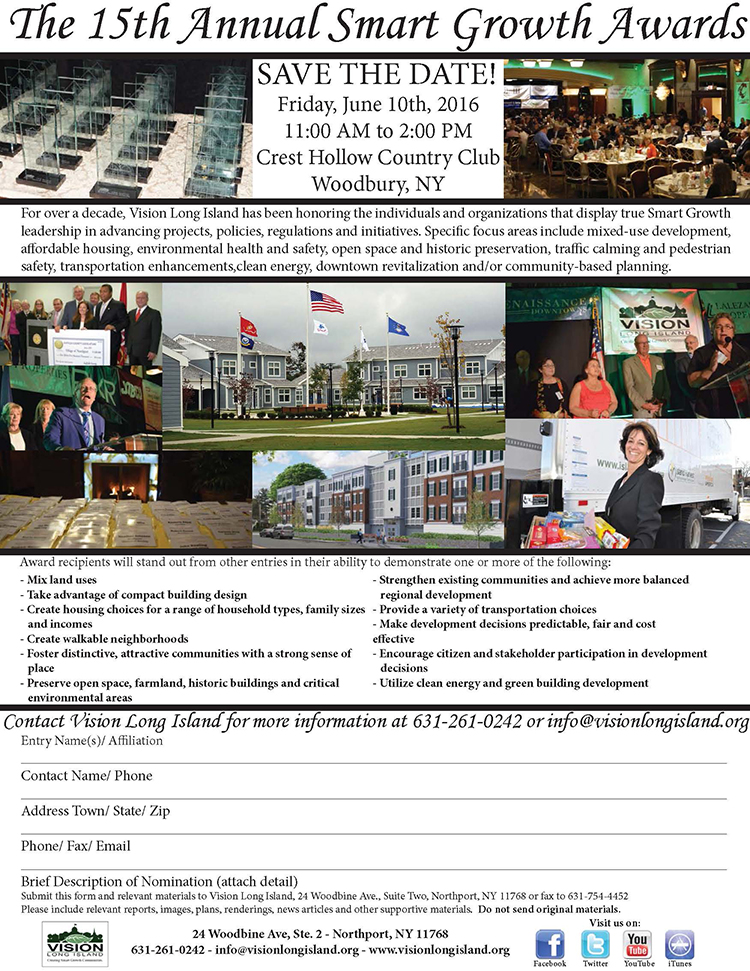

Vision Long Island advances more livable, economically sustainable, and environmentally responsible growth on Long Island through Smart Growth. Smart Growth focuses on infill, re-development, and open space preservation. It supports mixed-use, mixed-income communities that are convenient, attractive, pedestrian-friendly, and that make affordable housing and public transportation desirable and realistic.
Over the past 17 years Vision has counseled downtown Villages and Towns, and has been a resource for the County, State, and Federal governments, as well as the business and civic community on downtown revitalization, planning and infrastructure. Vision has made over 1,900 presentations, performed 20 community visionings and advanced over 60 public and private planning projects towards implementing the goals of Smart Growth on Long Island.
 Facebook | Facebook |  YouTube YouTube |
 |
 Twitter | Twitter |  iPhone app iPhone app |